Real Estate Websites
11 min read
Real Estate Lead Management in Dubai
How UAE brokerages lose portal leads between Bayut, Property Finder, Dubizzle and Meta — and what one pipeline with scoring and routing actually changes.
By NxFold
Updated 7 Sept 2026
A Dubai brokerage principal can usually tell you exactly what they spend on Bayut and Property Finder each month. Very few can tell you what happened to last Tuesday's leads.
That gap is the whole problem. The money going into portals is measured to the dirham; the enquiries coming out land in five different places, get worked by whoever happens to see them first, and disappear into agents' phones. By the time anyone asks why conversion is flat, the evidence is gone.
This guide is about the plumbing between the ad spend and the deal — capture, scoring, routing, and the record that survives an agent leaving. It is deliberately narrower than custom CRM development in Dubai, which covers the general build-versus-buy question for any industry; here the assumption is that you are a brokerage, your leads come from property portals, and the failure modes are specific to that.
The Short Answer
Most brokerages do not have a lead problem. They have a lead custody problem. The enquiries arrive in sufficient volume; they are lost in the handoffs — between portal and inbox, between inbox and agent, between agent and follow-up, between agent and the agent who replaces them.
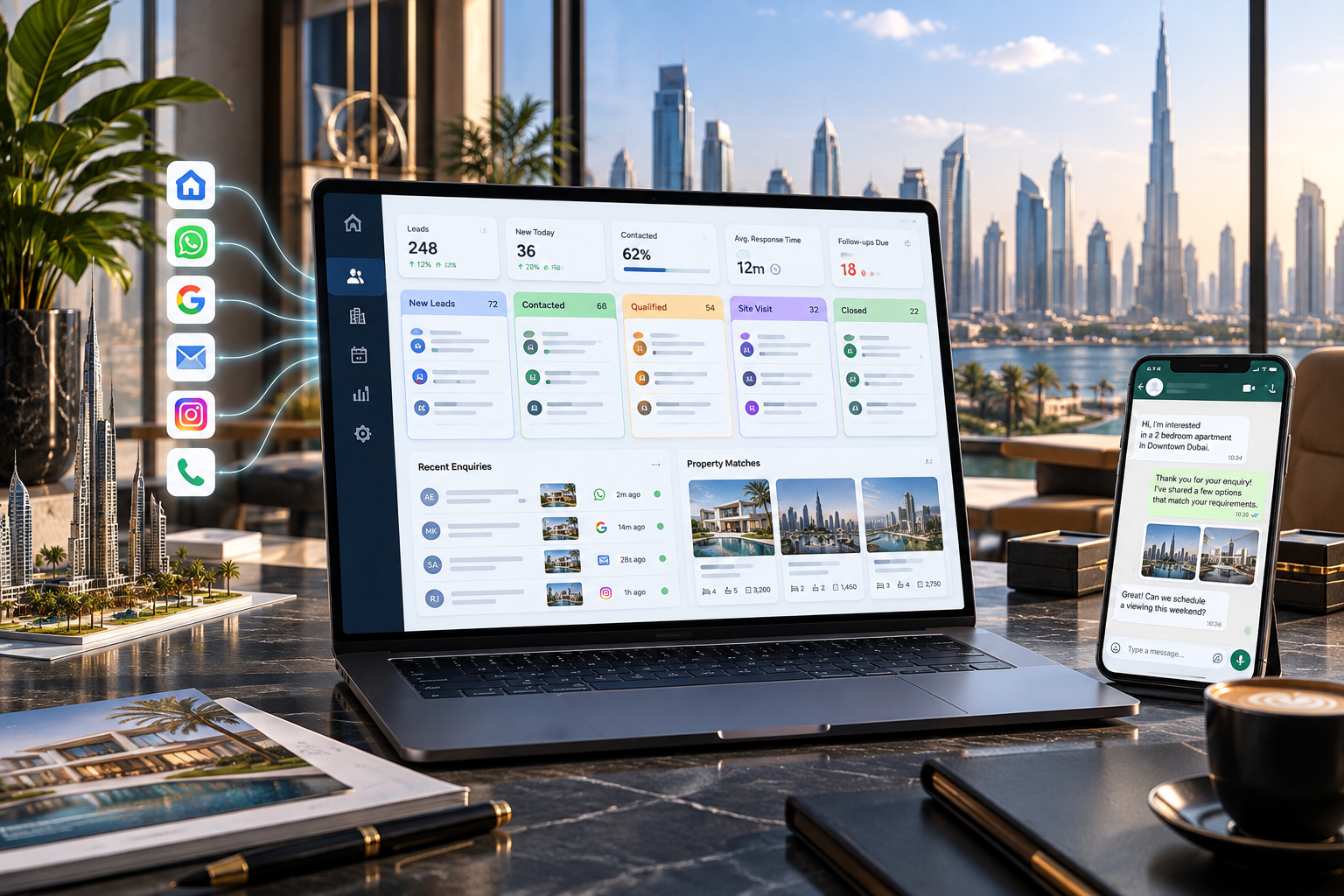
Fixing it is four things in order: get every source into one pipeline, score on arrival so the queue has a shape, route by rule so nothing waits for a human to notice, and log every touch on the lead rather than in someone's WhatsApp. None of that requires a bespoke system for most brokerages — but all of it requires that the portals actually integrate, which is where the off-the-shelf options in this market tend to fall down.
Where Brokerage Leads Actually Leak
Five sources, five destinations. Bayut emails one address. Property Finder emails another, or posts to a webhook if you are on the right plan. Dubizzle does its own thing. Meta lead ads sit in Ads Manager until somebody downloads a CSV. The website form goes to info@. Each of these has a different format, a different arrival time, and a different person who happens to watch it.
The response-time window. Property enquiries are comparison-shopped in real time — the buyer who enquired about your listing enquired about four others in the same ten minutes. First substantive reply wins a disproportionate share of those conversations. An hour is late. A morning is lost.
The duplicate that looks like three buyers. The same person will enquire on three of your listings in one evening. Treated as three leads, they get three agents, three calls, and an impression of chaos. Treated as one, they get a single conversation with someone who can see all three properties they liked — which is a much better call.
The agent who leaves. This is the expensive one. If the conversation history lives in an agent's personal WhatsApp, their pipeline leaves with them. Reassignment becomes archaeology, and the leads you paid for get worked twice or not at all.
Getting Every Source Into One Pipeline
The integration story is less uniform than vendors imply, and it is worth knowing before you buy anything.
Portal leads arrive by email or webhook depending on the portal and your plan tier. Email parsing is unglamorous and entirely workable — the formats are stable and structured enough to extract name, phone, listing reference and message reliably. Webhooks are better where offered because they are faster and less brittle. Either way the engineering that matters is not the connection; it is the normalisation — mapping four different payload shapes onto one lead record with a consistent listing reference, so you can later answer "which portal actually produces deals" rather than just "which portal produces enquiries."
Meta lead ads expose a proper API and should never be worked from a CSV. The lag between form fill and first contact is the single biggest controllable variable in paid social performance.
Website enquiries are the highest-intent source and usually the worst-handled, because they arrive at an inbox rather than a system. They are also the ones you can shape — a form that captures budget and timeline alongside contact details hands the agent a qualified conversation instead of a name. That is a website design decision as much as a CRM one; real estate website development in Dubai covers the front end that feeds this pipeline, and the property search we built for Zain is the version of it that filters by project type, budget, handover date and unit size specifically so the enquiry arrives pre-qualified.
Walk-ins and referrals need a thirty-second manual entry path, or they will not be entered at all.
Scoring: Giving the Queue a Shape
A queue of forty untriaged enquiries is functionally the same as no queue — the agent works from the top, or from whichever one looks interesting. Scoring is what turns it into a work order.
The inputs that actually predict intent in this market are unglamorous: which listing they enquired about (price band is a strong budget signal), what they wrote (a specific question about service charges or handover is a different buyer from "is this available"), source (portal enquiries and website enquiries convert at different rates and you should know yours), repeat behaviour (three enquiries in an evening is a hot lead, not three cold ones), and completeness (a full phone number that connects beats a form filled with junk).
The point is not a clever model. It is that the top of the queue should be reliably worth calling first, so the agent's judgement is spent on the conversation rather than on triage.
Routing: Assigning Without Waiting
Routing rules are where most implementations get political, so decide the policy before the software: round-robin across the team, by specialisation (off-plan versus ready, community, language), by availability, or by performance. Any of them beats "whoever opens the email."
Two details matter more than the rule you choose. Assignment should happen in seconds, not at the next huddle — the response-time window is the whole game. And there must be a reassignment path with a timer: if the assigned agent has not made contact within a defined window, the lead goes back to the pool. Without that, routing simply moves the bottleneck from the inbox to one person's afternoon.
When we built Leadora, a lead platform for UAE brokerages, that was the specification: eleven-plus sources into one pipeline, scored on arrival, assigned in under a minute, with every touch logged and deals tracked through to payment milestones. The routing rules were the part clients spent the most time on, and rightly.
Working the Lead Where the Client Actually Is
In this market that is WhatsApp, and any system that fights it will lose.
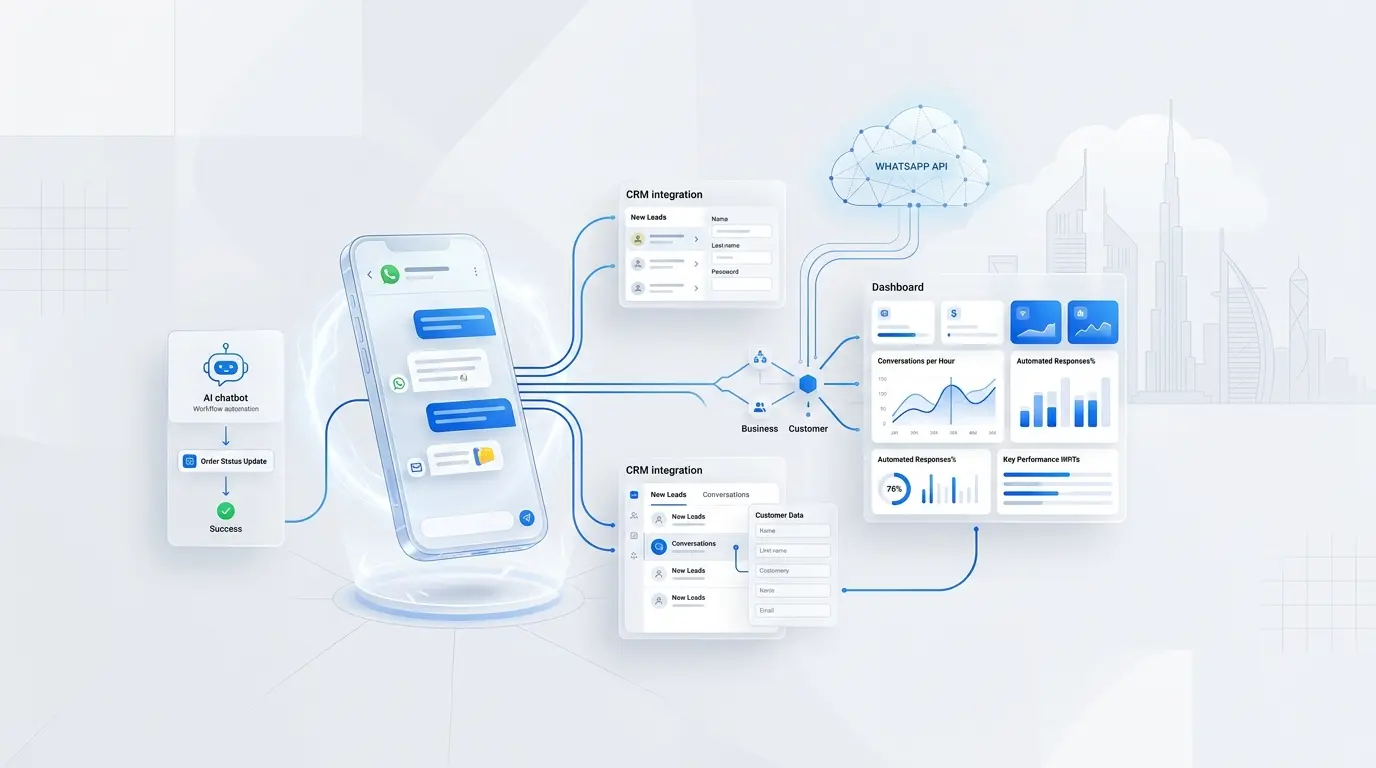
Agents will not migrate their client conversations into a CRM's messaging tab. They have tried, and it does not survive a busy week. The workable pattern is the opposite: let the conversation happen in WhatsApp and log it against the lead, so the agent keeps their habit and the brokerage gets the record. Calls the same way — a call logged automatically with duration and outcome is worth more than a call the agent was supposed to remember to note.
Doing this properly means the WhatsApp Business API rather than a phone on a desk, with the compliance and template rules that come with it; WhatsApp Business API integration in Dubai covers what that involves and where the limits are.
Buy or Build
Buy, usually. This is not the answer a development agency is supposed to give, but for a brokerage running a conventional process, a configured off-the-shelf CRM will be cheaper, faster and better-supported than anything custom.
The honest exceptions, in order of how often they actually apply:
The portal integrations you need do not exist. This is the common one, and it is specific to this market. Generic CRMs integrate with the portals their home market uses; Bayut, Property Finder and Dubizzle are frequently an afterthought or a third-party connector of uncertain quality. If the integration is the point, and the integration is the weak part, that changes the calculation.
Your commission and payment-milestone structure is genuinely unusual. Multi-agent splits, referral fees, developer commission schedules paid in tranches against construction milestones. Off-the-shelf pipelines model a deal closing; they model a deal closing in instalments over eighteen months much less well.
You need it to be one system with something else you run. A brokerage with an in-house property management arm, or a developer selling their own stock, often ends up with the CRM as one module of a larger platform rather than a standalone tool. That is web app development territory rather than CRM shopping.
Scale. Per-seat pricing across sixty agents, for several years, starts to look like a build budget.
If none of those apply to you, configure something off the shelf and spend the difference on listings. The broader version of this reasoning is in custom CRM development in Dubai.
What to Measure Once It Works
The reason to centralise leads is not tidiness; it is that you can finally answer questions that were unanswerable before:
- Cost per qualified lead by source, not cost per lead. A portal producing double the enquiries at a third of the qualification rate is not the better portal.
- Median time to first contact, by agent and by source. This is the number that moves conversion fastest and the one nobody measures before they have a system.
- Source-to-deal, not source-to-enquiry. The attribution has to survive all the way to the closed transaction or you are optimising the wrong end.
- Leads with no contact attempt after 24 hours. Should be zero. Rarely is.
Frequently Asked Questions
Can leads be pulled from Bayut and Property Finder automatically? Yes. Portal enquiries arrive by email or webhook depending on the portal and your plan. Both can be parsed into a structured lead record. The real work is normalising four different formats into one shape and deduplicating — the same buyer will enquire on three listings in one evening.
What is a realistic time to first contact? Minutes, not hours. Property enquiries are comparison-shopped in real time and the first substantive reply wins a disproportionate share. Measuring median time to first contact by agent is usually the single fastest conversion improvement available.
Do agents have to stop using WhatsApp? No, and any system that requires it will be abandoned within a month. The workable pattern is to let the conversation happen in WhatsApp and log it against the lead — the agent keeps the habit, the brokerage gets the record.
What happens to the pipeline when an agent resigns? With a proper system, nothing. Every conversation sits on the lead rather than on a personal phone, so reassignment is a decision rather than an investigation. Without one, their pipeline leaves with them, which is the most expensive failure on this list.
Should we buy a CRM or build one? Buy, unless the portal integrations you need do not exist off the shelf, your commission and payment-milestone structure is genuinely unusual, or you need the CRM to be one module of a larger platform. In this market the integration gap is the most common real reason to build.
How do you stop the same buyer becoming three leads? Deduplication on arrival, matched on phone number primarily, then email. Merged into one record that shows all three listings they enquired about — which makes for a much better first call than three separate agents ringing about one property each.
How long does it take to get a brokerage running on a lead platform? Weeks rather than months, if the platform exists. The time goes into your sources, your routing rules and migrating existing data. Start with one team rather than the whole floor.
Does this replace our website enquiry form? No — it consumes it. Website enquiries are usually your highest-intent source, and a form that captures budget and timeline alongside contact details is worth more than one that captures a name. The form design and the pipeline are the same project.
The Bottom Line
The brokerages that fix this do not necessarily generate more leads. They stop losing the ones they already pay for, and they find out which portal is actually producing deals rather than which is producing enquiries. Those two things together usually move conversion more than an increase in listing spend would.
Start by measuring one number for a fortnight: median time from enquiry to first substantive contact, by source. If it is longer than you expected — and it usually is — you have found the leak, and you can decide whether configuration or a build is the right way to close it.
If you want that mapped against your actual sources and routing rules, get in touch. We have built lead platforms for UAE brokerages, and we would rather tell you an off-the-shelf CRM will do the job than sell you a build you do not need.
Have a project in mind?
Ideas to put into practice.
Turn what you have learned into a clearer plan for your website or product. Tell us what you want to build.
Start your project