Web Apps
13 min read
WhatsApp Business API Integration in Dubai (2026)
How to set up the WhatsApp Business API in the UAE in 2026: per-message pricing, Meta/BSP approval, TDRA & PDPL compliance, and custom CRM integration.
By NxFold
Updated 4 Sept 2026
The WhatsApp Business API is the enterprise-grade interface that lets UAE companies send and receive WhatsApp messages programmatically — from a CRM, a booking system, a support desk, or a custom app — instead of tapping replies into a phone. In a market where WhatsApp is the default way customers talk to businesses, getting this integration right is one of the highest-ROI automation projects a Dubai company can run in 2026.
This guide explains what the API actually is, how the 2026 per-message pricing works, how to get approved in the UAE, and — the part most articles skip — how to integrate WhatsApp directly into your own software instead of renting yet another shared inbox. NxFold builds these integrations as an agency, so the perspective here is a builder's, not a reseller's.
What is the WhatsApp Business API?
The WhatsApp Business API (now delivered through Meta's Cloud API) is a messaging interface for medium and large businesses that need automation, multiple agents, and integration with their existing systems. It has no app or chat screen of its own — it is a set of endpoints and webhooks your software connects to. Messages can be triggered by events in your CRM (a new lead, a paid invoice, a booking confirmation), answered by a chatbot, and escalated to a human agent, all against a single verified business number.
It is different from the free WhatsApp Business App, which is a standalone phone app aimed at micro-businesses and sole traders. The App is manual and single-device; the API is programmable, multi-agent, and built to scale.
WhatsApp Business App vs WhatsApp Business API
| Factor | Business App (free) | Business API (Cloud API) |
|---|---|---|
| Best for | Solo traders, very small shops | SMEs and enterprises with real volume |
| Automation | Basic quick-replies only | Full — event-driven, chatbot, AI |
| Agents | 1 phone (up to ~5 linked devices) | Unlimited agents via your software |
| CRM / system integration | None | Native, via API and webhooks |
| Bulk / template messaging | Very limited, ban-prone | Approved template messages at scale |
| Green tick (verified badge) | No | Yes (on approval) |
| Cost | Free | Per-message + build/BSP cost |
Short answer: if you have more than one person answering chats, or you want messages tied to your CRM, bookings, or payments, you need the API — not the app.
How WhatsApp Business API pricing works in 2026
This is where most UAE businesses get surprised, because the model changed twice in recent years. Here is the current shape.
Since 1 July 2025, Meta bills per message, not per 24-hour conversation. Every template message you send is charged individually, and the price depends on the message category:
| Category | What it covers | Relative cost |
|---|---|---|
| Marketing | Promotions, offers, newsletters, re-engagement | Highest |
| Utility | Order updates, receipts, appointment and payment reminders | Low |
| Authentication | OTPs and verification codes | Low–medium (higher for international) |
| Service | Free-form replies inside a customer-initiated 24-hour window | Free since 1 Nov 2024 |
Two facts matter most for UAE budgeting. First, service conversations are free: when a customer messages you first, you can reply freely for 24 hours at no per-message cost, which makes customer support and inbound sales extremely cheap to run. Second, since 1 February 2025 the UAE was moved into Meta's higher "authentication-international" band, so OTP messages to Emirati numbers cost more than in some other markets — worth knowing if you plan to use WhatsApp for login codes.
Indicative 2026 rates for the UAE, before any provider markup, land roughly in these ranges:
| Category | Indicative UAE rate (per message) |
|---|---|
| Marketing | ~AED 1.20–1.45 |
| Utility | ~AED 0.15–0.20 |
| Authentication (OTP) | ~AED 0.30–0.40 |
| Service (24h window) | Free |
Treat these as directional, not gospel: Meta revises its rate card periodically, and Business Solution Providers (BSPs) add their own markup — often 10% to 100%+ on top of Meta's base rate. Always confirm the live rate card with your provider before you model volume. The practical takeaway: design your messaging so that utility and service messages do the heavy lifting, and reserve marketing templates for genuinely high-value, opted-in sends.
How to get WhatsApp Business API access in the UAE
You cannot download the API. Access is granted by Meta once your business is verified. There are two routes.
- Direct Cloud API — you (or your development partner) onboard the number directly through Meta's Cloud API and Business Manager. You pay Meta's rates with no reseller markup, but you own the technical setup and hosting of the integration.
- Through a BSP — a Meta-authorized Business Solution Provider (Infobip, Twilio, Gupshup, CEQUENS, Unifonic, 360dialog, Wati, SleekFlow and others operate in the region) handles onboarding and gives you a dashboard, in exchange for a per-message markup and often a monthly fee.
Whichever route you choose, the UAE verification steps are the same:
- Create a Meta Business Manager and add your business details.
- Complete Business Verification — you will typically be asked for your UAE trade licence and the Emirates ID of the authorized signatory, plus verifiable business contact details. Approval usually takes one to five business days for UAE entities.
- Register and verify a phone number that is not already tied to a personal WhatsApp account.
- Set a display name that matches your brand and passes Meta's naming policy.
- Submit message templates for each category. Bilingual Arabic and English templates are strongly recommended for the UAE market; template review usually completes within about 24 hours.
- (Optional) Apply for the green tick — the Official Business Account verified badge is a separate application based on brand notability; it is not automatic and not required to start sending.
A frequent, expensive mistake here is burning your main company number by loading it into the API while it still has an active personal WhatsApp, or by blasting un-opted-in marketing on day one and getting quality-rated down. Plan the number strategy before you onboard.
BSP shared inbox vs custom integration: build vs buy
This is the decision that actually determines your ROI, and it is the one the reseller-heavy search results rarely frame honestly.
A BSP shared inbox (Wati, SleekFlow and similar) is fast to switch on and fine if all you need is a team chat panel with some canned replies. But it is a separate silo: your customer conversations live in their tool, not your system, and you pay a recurring per-seat and per-message premium indefinitely.
A custom integration wires WhatsApp directly into the software you already run — your custom CRM, your booking engine, your ERP — so a message becomes a record, a status change fires a notification, and an AI agent can answer using your real data. You typically go direct on the Cloud API, so you pay Meta's rate with no reseller margin.
| Factor | BSP shared inbox | Custom integration |
|---|---|---|
| Time to launch | Days | Weeks |
| Upfront cost | Low | Higher (a build) |
| Ongoing cost | Per-seat + marked-up messages | Meta base rate only |
| Data ownership | In the BSP's tool | In your own database |
| CRM / workflow depth | Shallow, generic | Exactly your process |
| AI on your own data | Limited | Full |
| Lock-in | High | Low |
Rule of thumb: if WhatsApp is a side channel, a BSP inbox is fine. If WhatsApp is where your revenue conversations happen — real estate enquiries, rental bookings, order support — a custom integration pays for itself by removing per-seat fees, message markups, and the copy-paste work between tools.
What a custom WhatsApp integration looks like
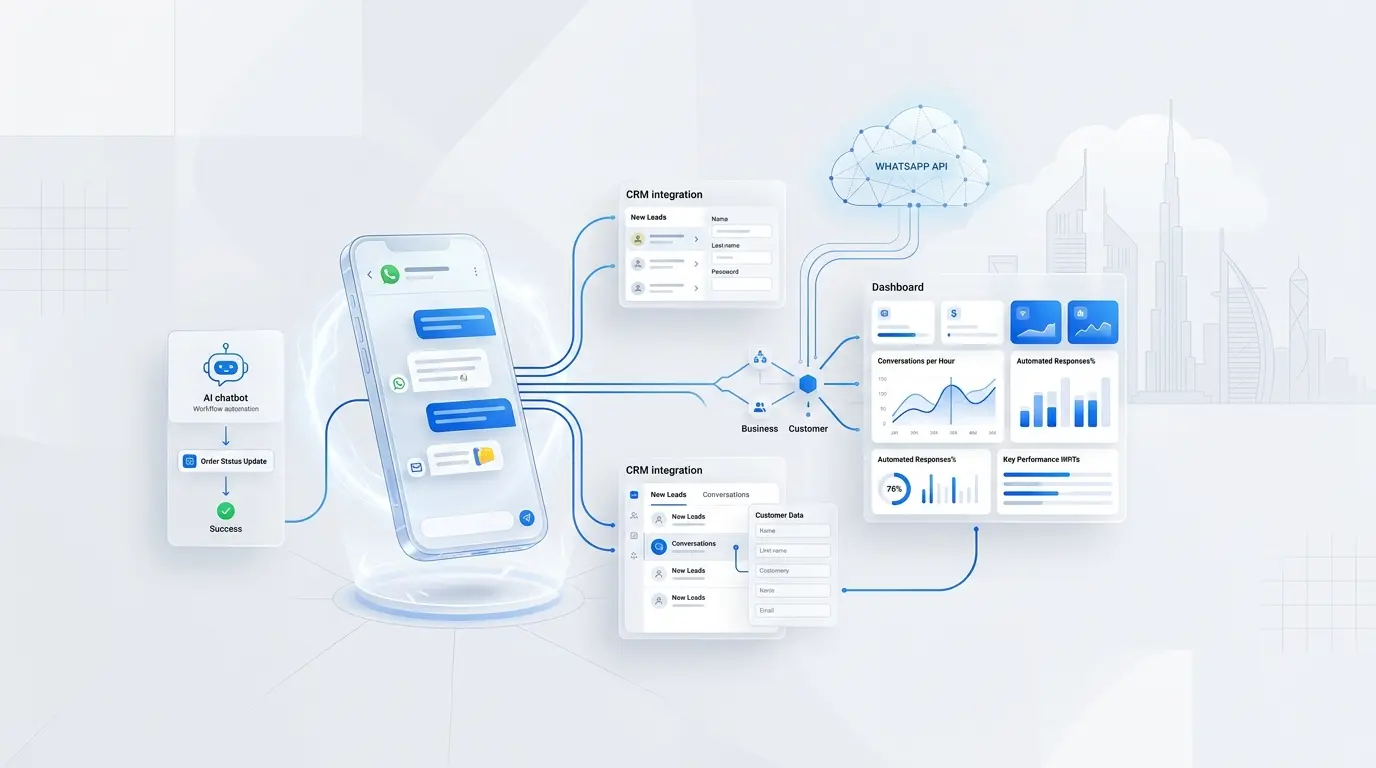
A production integration NxFold builds for a UAE client usually has these moving parts:
- Cloud API connection to a verified, dedicated business number.
- Webhook listener that receives every inbound message and status event in real time and writes it to your database.
- Template manager so your team can create, translate, and submit Arabic/English templates without touching code.
- CRM sync that matches each chat to a contact, deal, booking, or ticket — no orphaned conversations.
- Automation rules that send utility messages on real events: booking confirmed, invoice paid (often paired with a payment gateway), document expiring, appointment tomorrow.
- AI chatbot with human handover that answers common questions from your own knowledge base and cleanly passes complex chats to a live agent.
- Analytics on response time, resolution rate, template performance, and cost per category.
This is standard business process automation work — WhatsApp just happens to be the channel your UAE customers actually prefer.
High-value use cases by sector
- Real estate — instant enquiry response, listing details on demand, viewing reminders, and lead routing to the right agent. A natural fit with a real estate platform.
- Car rental and chauffeur — booking confirmations, driver-on-the-way updates, contract and Salik reminders.
- E-commerce and retail — abandoned-cart nudges, order tracking, and re-orders, all opted-in.
- Healthcare and clinics — appointment reminders and results-ready notifications (with strict consent handling).
- Hospitality and holiday homes — check-in instructions, upsells, and guest support inside the free 24-hour window.
- Logistics and fintech — delivery ETAs, OTPs, and payment confirmations.
UAE compliance: TDRA, PDPL and opt-in
WhatsApp automation in the UAE is not a free-for-all, and getting this wrong risks both Meta penalties and regulatory exposure.
- Explicit opt-in is mandatory for marketing messages. Keep a timestamped record of when and how each contact consented.
- TDRA promotional-messaging rules apply, including restrictions on unsolicited marketing and on late-night sending. Schedule marketing within acceptable hours.
- The UAE Personal Data Protection Law (PDPL) governs how you collect, store, and process the personal data flowing through these chats — covered in depth in our UAE PDPL compliance guide.
- Honour opt-outs immediately and give an easy way to stop messages.
A custom integration makes compliance easier, not harder: consent, audit logs, and opt-out handling live in your own database where you can prove them, rather than scattered across a third-party tool.
What does a custom WhatsApp integration cost in Dubai?
Message costs are only part of the picture; the build is the other part. As a directional guide, a focused Cloud API integration into an existing system — webhooks, template management, and basic automation — typically starts in the low-to-mid five figures in AED, while a full build with a custom CRM, AI chatbot, and multi-team routing scales up from there depending on scope. The honest answer is that price tracks scope: the number of systems you connect, the depth of automation, and whether AI is in the loop. The recurring saving — no per-seat inbox fees and no message markup — is what makes the build pay back over 12–24 months for message-heavy businesses.
Five costly mistakes UAE businesses make
The top search results for this topic sell you a dashboard; few warn you about the traps that quietly wreck a rollout. These are the ones we see most often.
- Blasting marketing on day one. A brand-new number that sends thousands of un-opted-in promotions gets its quality rating knocked down fast, which throttles how many messages you can send and can lead to a block. Warm the number up with utility and service traffic first, and never buy contact lists.
- No opt-in ledger. Consent is not a checkbox you forget about — under TDRA and PDPL you need to prove when and how each person agreed. Build the opt-in record into your database from the start, not as an afterthought.
- Treating templates as an afterthought. Every marketing and utility message must use a pre-approved template. Teams that do not plan Arabic and English templates up front end up blocked mid-campaign waiting on Meta review. Draft and submit your core templates during the build.
- Ignoring the free service window. Because customer-initiated conversations are free for 24 hours, a smart design nudges customers to message you first (Click-to-WhatsApp ads, a website widget, a QR code), turning expensive outbound into free inbound support and sales.
- Locking data in a third-party tool. If your entire customer conversation history lives inside a BSP's inbox, you do not truly own it — and migrating later is painful. Keep the source of truth in your own system.
Avoiding these is mostly an architecture decision, which is exactly why the build-vs-buy choice matters so much.
How NxFold approaches a WhatsApp integration project
Because we build these as a web app and software agency rather than reselling a SaaS seat, our process starts with your workflow, not a dashboard. We map the conversations that actually drive revenue — the enquiry, the booking, the payment reminder — and design the integration around them. We handle the Meta Business Manager and Cloud API onboarding, verification with your trade licence, and the display-name and template approvals. We then wire the number into your CRM or booking system with a real-time webhook layer, add automation rules tied to genuine business events, and layer in an AI assistant with clean human handover where it adds value. Consent capture, audit logging, and opt-out handling are built in from the first sprint so compliance is provable, not bolted on. The result is a system your team runs from the tools they already use — with WhatsApp as a first-class channel inside it, not a separate tab.
Frequently asked questions
Is the WhatsApp Business API free? The software interface (Meta Cloud API) has no licence fee, and service replies inside a customer-initiated 24-hour window are free. You pay Meta per template message for marketing, utility, and authentication sends, plus any BSP markup and the one-time cost of building or configuring the integration.
Can I use my existing company WhatsApp number? Only if it is fully removed from the WhatsApp Business App or consumer WhatsApp first. Most UAE businesses onboard a clean, dedicated number to avoid disrupting existing chats and to protect quality rating.
How long does UAE approval take? Business verification is usually one to five business days with a valid trade licence and Emirates ID, and message templates are typically reviewed within about 24 hours.
Do I need a BSP, or can I go direct? You can go direct on the Cloud API — that avoids reseller markup and keeps your data in your own systems. A BSP is faster to switch on but adds ongoing cost. For businesses where WhatsApp drives revenue, a direct custom integration is usually the better long-term economics.
Can WhatsApp connect to my CRM and send automatic messages? Yes. That is the core value of the API: events in your CRM, booking system, or payment flow can trigger approved templates automatically, and inbound replies are written straight back to the customer's record.
Build WhatsApp into the software you already run
WhatsApp is where UAE customers actually talk to businesses — so it should live inside your systems, not in a rented inbox that charges by the seat. NxFold designs and builds custom WhatsApp Business API integrations for Dubai and UAE companies: direct Cloud API onboarding, CRM and booking sync, bilingual templates, AI chatbots with human handover, and compliant opt-in handling.
Tell us what your customer conversations look like today, and we will map the integration that removes the manual work. Start a conversation about a custom WhatsApp integration with NxFold.
Have a project in mind?
Ideas to put into practice.
Turn what you have learned into a clearer plan for your website or product. Tell us what you want to build.
Start your project