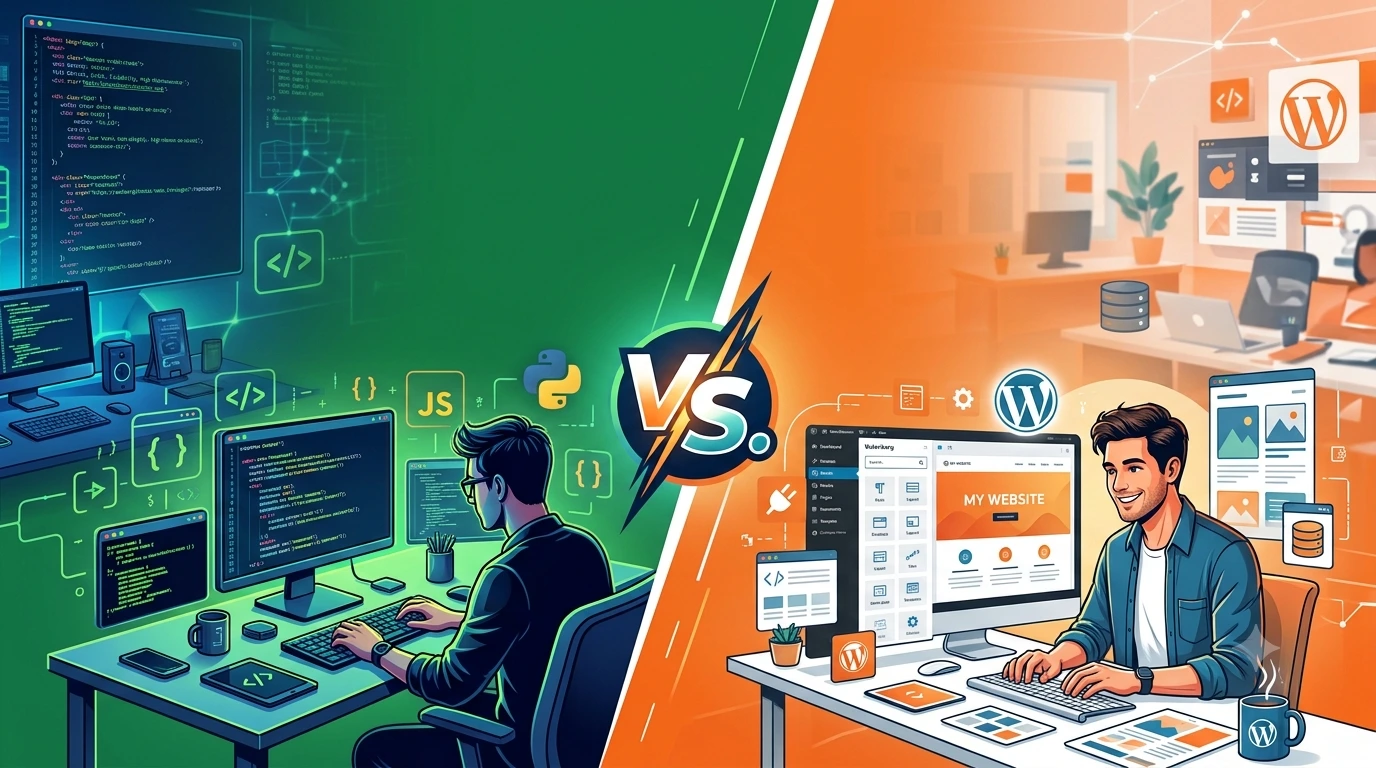
A custom web development company you don't replace.
Custom web development for UAE businesses on Next.js, React and TypeScript. We scope the CMS, integrations, security and handover around your requirements, from a company website to a connected business platform.
The wrong foundation is expensive. It just hides the cost.
A template or website builder can suit a straightforward site. The limits become clearer when you need a specific content model, custom booking rules or a connection to your CRM. Custom website development lets us build those requirements into the codebase instead of fitting your business around the platform. The decision should follow your functionality, maintenance needs and budget.
01
Platform lock-in
Proprietary CMS platforms charge monthly fees, limit customisation, and make migration painful. You're renting infrastructure, not building an asset.
02
Performance debt
Heavy scripts, oversized images and poorly configured caching can slow any website. We review the implementation and test loading, responsiveness and layout stability rather than assuming a particular platform guarantees performance.
03
Security exposure
Plugin ecosystems are a major attack vector. A single unmaintained plugin can compromise your entire site and expose customer data.
04
Costly rebuilds
When content, business rules and integrations are tightly coupled, a small change can become expensive. Clear boundaries and documented code make the website easier to extend as requirements change.
95+
Lighthouse score
Average across all NxFold-built sites
<1.5s
Load time
UAE-region testing, consistently
100%
Source code ownership
Zero lock-in on final payment
Estimated impact, ~90 days post-launch.
(✦) — What you get
A codebase built to last — not just to launch.
01
Next.js & React
The production-grade framework used by world-class technology companies. Server-side rendering, image optimisation, and API routes built in from the start.
02
TypeScript throughout
Type safety catches bugs before users find them. Every function, component, and API response defined and validated at build time.
03
Headless CMS integration
Your team updates content without touching code. We integrate Sanity, Contentful, or your preferred CMS — clean, fast, and code-independent.
04
UAE payment gateways
Network International, Tabby, Tamara, Telr, and Stripe — integrated and tested for the payment methods your UAE customers expect.
05
API-first architecture
Clean contracts between frontend and backend layers. Adding a mobile app or new integration later means extending — not rebuilding.
06
CI/CD pipeline
Automated testing, build, and deployment configured from day one. Every code change validated before it reaches production. Zero-downtime deployments.
07
Performance engineering
Image optimisation, code splitting, lazy loading, and CDN configuration. 95+ Lighthouse scores are a starting point, not a finish line.
08
Complete source handover
Full code repository, deployment documentation, and a handover session on final payment. Any competent developer can extend what we built.
(02)
Buyer's guide
How to choose a custom web development company in the UAE
05 / 05
01
Find out who writes the code
Before choosing a custom website developer for your UAE business, establish who will build and maintain the site. Four questions help: who writes the code, who reviews it, when can I see a working staging site, and can I be added to the repository during development?
Our answers do not change between projects. Every custom website developer on the build is in-house, writing Next.js, React and TypeScript. The code lives in a Git repository you can be added to. A live staging URL exists in week one, so you watch the build take shape instead of waiting for a reveal at the end.
02
An assembled site costs the same to buy and more to own
Buy a theme, install a page builder, cover the gaps it leaves with a dozen plugins, hand the result over as a custom build. On launch day everything works. The bill then arrives in instalments: a plugin update quietly breaks the enquiry form, Search Console starts reporting the site as slow, and eventually another agency looks at what is there and quotes a rebuild, because nobody can safely change it.
Hand-written code is a bet that changes stay cheap. It is also why we can put a fixed price on a change six months after launch: whoever picks it up can read what is already there.
03
What actually moves the price
Page count barely does. What moves it is everything sitting behind the pages: logins, dashboards, payments, and anything that has to stay in agreement with a system you already run. That is why the two are quoted apart instead of averaged into one misleading number. A custom website build for marketing is AED 8,000 to 20,000. A web application with custom logic, authentication and integrations starts at AED 25,000. Vague requirements are what make development expensive, so the proposal itemises what is being built and what is explicitly excluded before the price is fixed.
This service covers custom business websites and the CMS, APIs and integrations behind them. If you need visual direction, UI/UX and prototypes first, explore our web design service. For a standalone customer portal, internal dashboard or SaaS product with user roles and workflows, see our web application development service.
Every capability page in this market lists “third-party integrations”. Ask for one they have actually shipped and what was hard about it. The answer separates the people who have done it from the people who have read about it.
Ayla is a holiday-home business whose availability has to stay true across Airbnb, Booking.com, Vrbo, Expedia and Agoda at the same time, arriving through a channel manager. The API call is the easy half. The real work is deciding what the site shows during the seconds a channel is mid-sync, because the honest answer and the convenient answer are different, and only one of them survives a double booking.
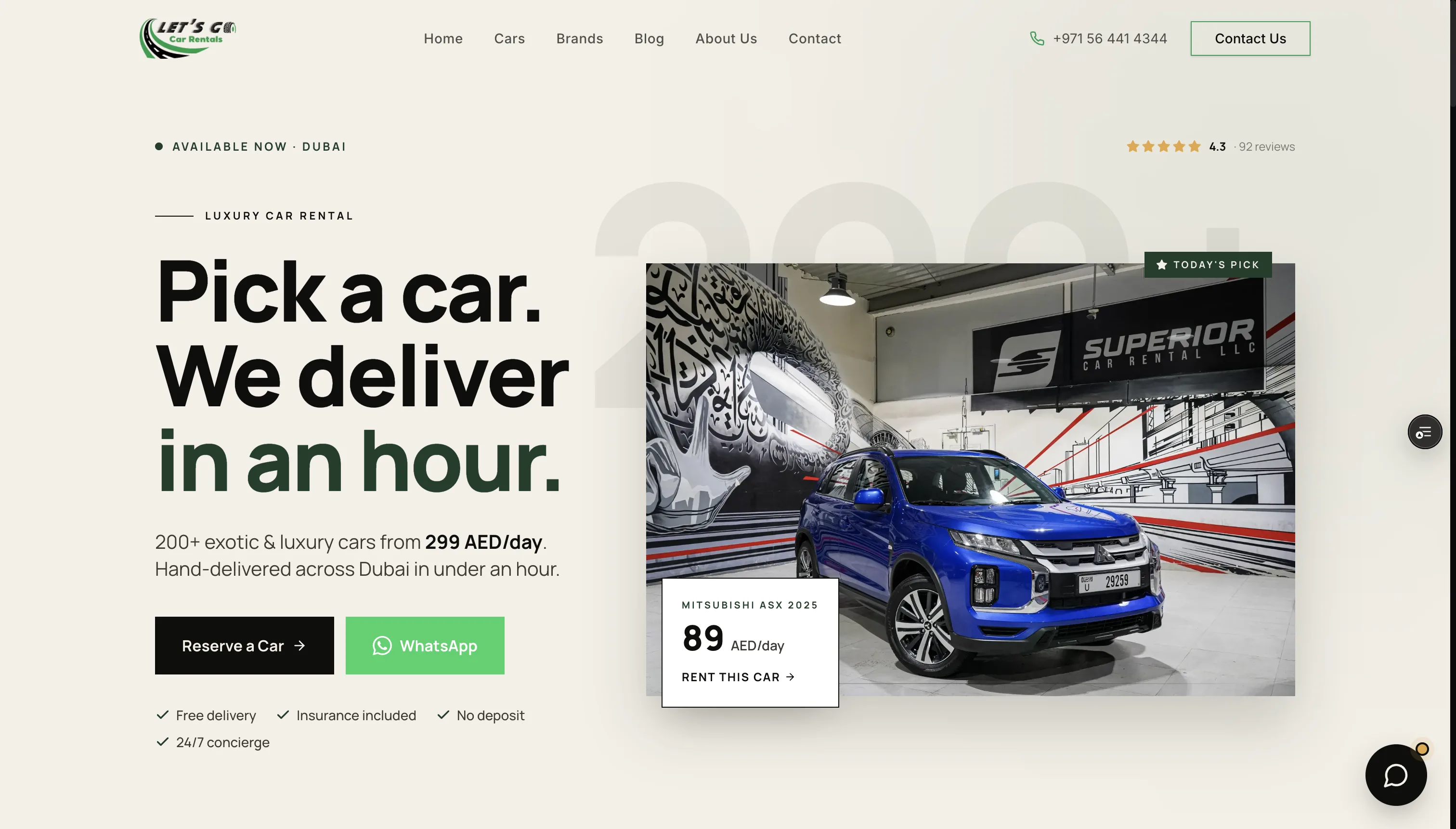
Superior sells car rental through a website and an iOS app on the App Store, which means the site is not the only thing reading the same fleet and the same availability. Any of this is straightforward to build once and difficult to keep correct for years. Keeping it correct is the part you are actually buying.
The phrase is free to say, so turn it into a list and tick it off: the repository, the environment configuration, the deployment account in your name, the domain and DNS, the analytics property, the design files, and documentation a stranger could work from. Miss one and you do not own the project. You own a copy of it that only one team can deploy.
All of it transfers at final payment: no licence, no monthly platform fee, nothing that requires us to stay involved. It also changes how the code gets written, because code written in the knowledge that somebody else will inherit it comes out with clearer names and real documentation.
(03) — How we approach it
We build everything custom, the way software should be built: clean, typed and fast by default. That means pages that load instantly, score green on Core Web Vitals, and stay easy to extend as you grow. You get weekly progress, full source code on handover, and zero lock-in to a proprietary platform.
(04) — What's included
✓Custom front-end in Next.js, React and TypeScript
✓Blazing-fast performance and Core Web Vitals
✓Accessible, responsive, SEO-ready markup
✓API and CMS integrations
✓Full source-code ownership — no lock-in
(✦) — Pricing
Published, fixed, and agreed before we start.
Two very different kinds of build sit under this service, so they are quoted separately rather than averaged into one misleading number.
Custom-coded marketing site
AED 8,000 – 20,000
Hand-built front end, no CMS bloat, bilingual, tuned for Core Web Vitals from the first commit.
Web application
AED 25,000 – 100,000+
Custom logic, authentication and integrations. The range is wide because complexity genuinely is — we scope it before quoting.
Paid in three stages: a deposit to start, a milestone payment at design approval, and the balance on launch.
Fixed price agreed before we start. No hourly billing, no scope creep, no surprise additions at the end.
Next.js, React, and TypeScript — the production-grade stack used by companies like Vercel, Netflix, and Airbnb. It provides server-side rendering, image optimisation, API routes, and automatic code splitting. No WordPress, no page builders, no drag-and-drop — just clean, maintainable code built to last.
Will I own the source code after the project?+
Yes, completely. On final payment, all source code, configuration files, documentation, and design assets are transferred to you in full. No licensing fees, no platform lock-in, no dependency on us to keep the site running.
Can you integrate with our existing business systems?+
Yes. We integrate with CRMs (Salesforce, HubSpot, Pipedrive), payment gateways (Tabby, Tamara, Network International, Stripe), booking systems, ERPs, and custom APIs. We document all integration requirements during scoping and confirm feasibility before the project starts.
How long does web development take?+
A simple marketing website takes 2–4 weeks. A feature-rich web application typically runs 6–16 weeks depending on scope, integrations, and custom functionality. We confirm the timeline after scoping and build milestones around it — then stick to them.
Do you work with UAE payment gateways?+
Yes. We have integration experience with the major UAE payment providers: Network International, Telr, Tabby (buy now pay later), Tamara, and Stripe for international transactions. We configure the payment flow that matches your customers' expectations and test thoroughly before launch.
When is custom website development worth it over a template or builder?+
A template or builder can suit a straightforward site with standard content and forms. Custom development becomes useful when you need a specific content model, booking or pricing rules, integrations with existing systems, or control over how the code evolves. Compare the required functionality, source ownership and ongoing maintenance costs before deciding. Both approaches need updates, security work and performance testing.
Can non-technical team members update the website?+
Yes. We integrate headless CMS platforms (Sanity, Contentful, or similar) that provide clean, intuitive admin interfaces for updating content — without any coding knowledge required. The front-end remains custom-built performant code; the CMS is simply the layer that manages your content.
How do you handle performance and Core Web Vitals?+
Performance is built in, not added later. We use Next.js image optimisation, automatic code splitting, lazy loading, CDN configuration, and caching strategies. Lighthouse audits are run before launch. Our average Core Web Vitals score across all built sites is 95+.
What does 'CI/CD pipeline' mean and why does it matter?+
CI/CD stands for Continuous Integration / Continuous Deployment. It means every code change is automatically tested, built, and deployed — not manually pushed by a developer. This eliminates human error in deployments, enables zero-downtime releases, and means new features or bug fixes reach production in minutes rather than hours.
How do you handle security in the codebase?+
Security is architectural, not a checklist. We use input validation, parameterised queries, authentication best practices, dependency auditing, secure headers, and HTTPS-only configurations. For higher-security applications we conduct dedicated security reviews and can engage third-party penetration testing.
What does the handover process look like?+
On final payment: you receive the full code repository, a README with setup and deployment instructions, environment variable documentation, and a 60-minute handover call where we walk through the architecture. The goal is that any competent developer can pick up the codebase without needing to call us.
Can you build a bilingual Arabic/English platform?+
Yes, and it's one of our specialisms. We implement next-intl for internationalisation, proper RTL CSS for Arabic layouts, Arabic-aware typography, and hreflang configuration so both language versions rank correctly in search.
Do you offer ongoing maintenance after launch?+
Yes. We offer monthly maintenance retainers covering dependency updates, performance monitoring, security patching, and minor feature additions. Without a retainer, we offer 30 days of post-launch support as standard.
How much does professional web development cost?+
A custom-coded marketing website typically starts from AED 8,000–20,000. Web applications with custom logic, authentication, and integrations range from AED 25,000 to AED 100,000+ depending on complexity. We provide fixed-price quotes — not hourly estimates with open-ended billing.
Do you work with international clients?+
Yes. Most of our clients are in the UAE, and we have delivered for businesses in Kuwait and Romania. Our process is built for async remote collaboration — weekly progress updates, staging environments you can access from anywhere, and clear written communication at every stage.
(✦) — Ready to build right?
Your next platform is only as good as the foundation it's built on.
Tell us what you're building. We'll review your requirements and send a fixed-price proposal within 24 hours.