Real Estate Websites
16 min read
Dubai Property Portals & Platforms: 2026 Guide
Build a real estate website in Dubai that ranks, converts leads, and stays Trakheesi-compliant. Cost tiers from AED 12K, must-have features & CRM guide.
By NxFold
Updated 6 Sept 2026
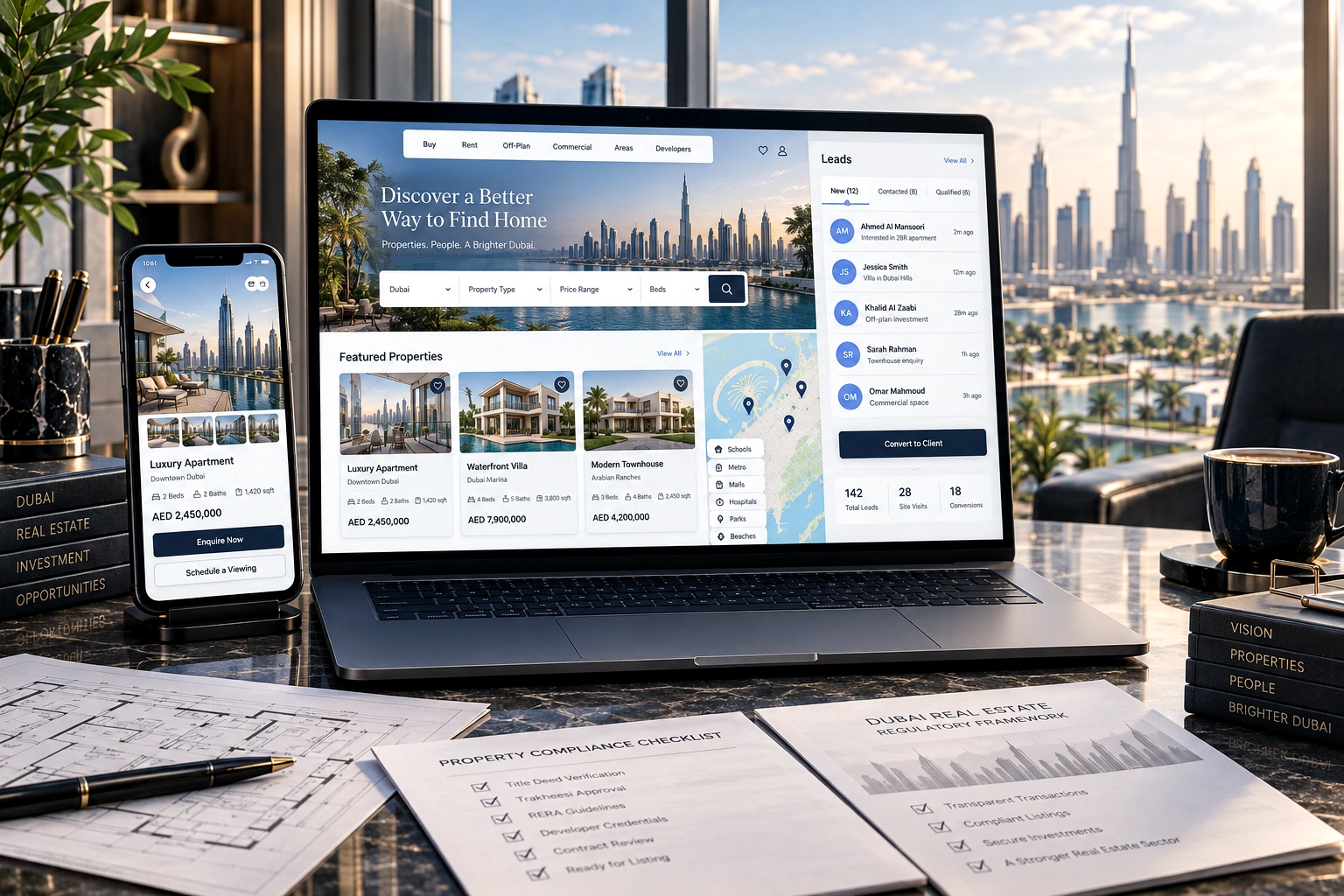
A real estate website in Dubai is a bilingual, portal-connected property platform that lists units, captures buyer and tenant leads, and proves every advertisement is licensed under the Dubai Land Department's Trakheesi system. For brokerages, developers, and property managers in the UAE, it is not a brochure — it is the lead engine that feeds the sales team and the compliance layer that keeps listings legal.
This guide breaks down what a real estate website in Dubai actually needs in 2026: the real cost, the features that matter, how DLD and RERA advertising rules shape the build, how listings syndicate to Property Finder, Bayut, and Dubizzle, and how to choose between a custom build and an off-the-shelf portal CRM. It is written for property companies that want a site that ranks, converts, and stays compliant — not one that looks good and does nothing.
What counts as a "real estate website" in Dubai
The phrase covers four distinct products, and pricing depends entirely on which one you need:
| Type | Who it's for | Core job |
|---|---|---|
| Brokerage website | Agencies and individual brokers | Showcase listings, capture leads, build trust |
| Developer website | Master developers and off-plan sellers | Present projects, payment plans, and register interest |
| Property portal / marketplace | Aggregators listing many agencies | Search, filter, and connect buyers with agents |
| Listings platform + CRM | Growing brokerages that manage inventory in-house | Publish once, syndicate everywhere, track every lead |
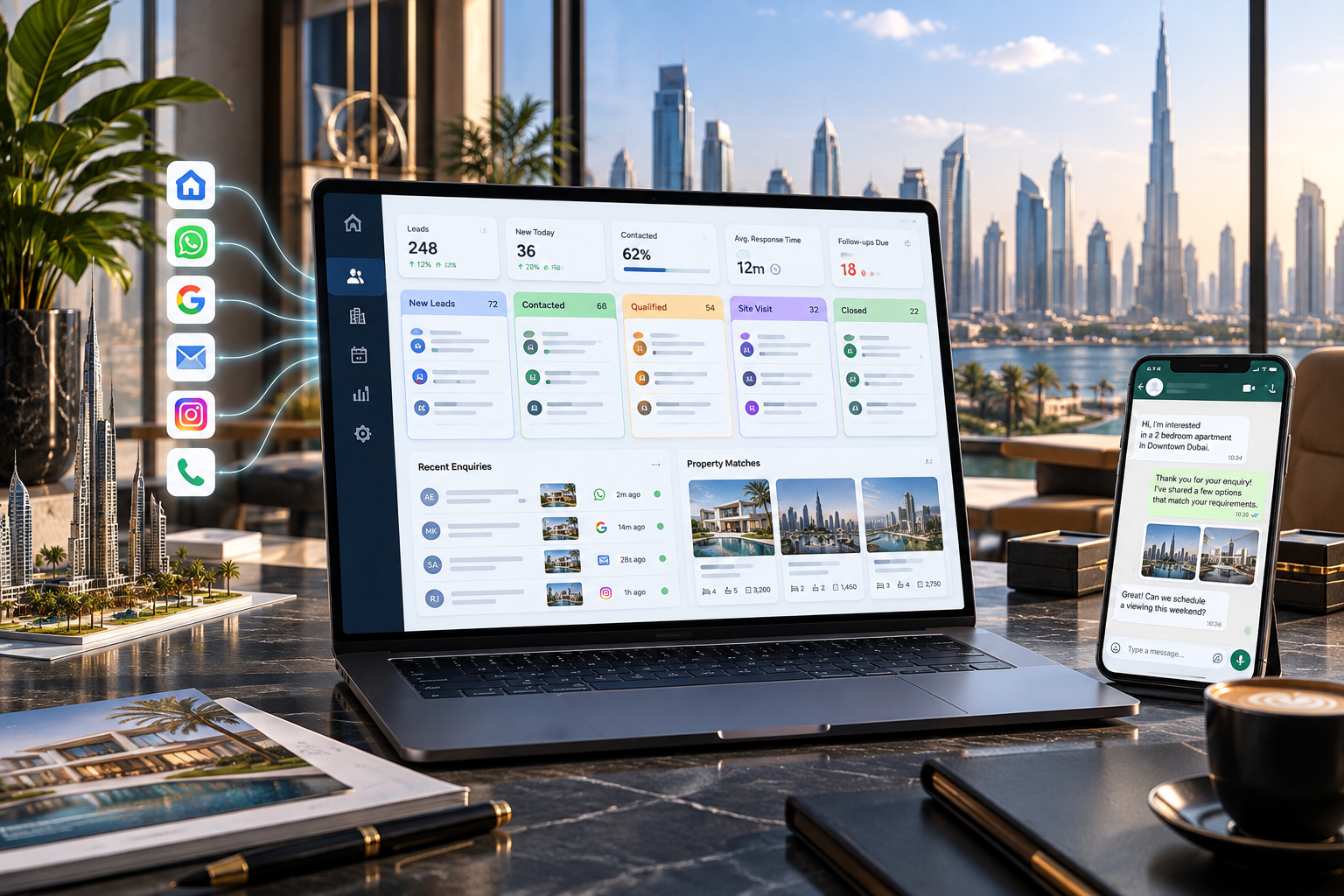
Most Dubai brokerages need the fourth: a listings platform with an integrated CRM that publishes a unit once and pushes it to the portals, the website, and social channels while tracking every enquiry back to the responsible agent. That single-source-of-truth model is what separates a modern property business from one that re-types the same listing into five different systems.
Property portal vs broker site: which one do you actually need?
The two get conflated constantly, and they are different businesses. A broker site sells your own inventory: every listing belongs to you, the visitor is a buyer or a tenant, and the job is turning an enquiry into a viewing. A property portal sells access to other people's inventory: listings belong to many agencies, the visitor may be a buyer or an agent, and the job is matching the two and monetising the connection — subscriptions, featured placement, or per-lead fees.
The technical consequence is where the cost sits. A broker site's hard part is presentation and speed of response. A portal's hard part is multi-tenancy: agency accounts, per-agency permissions, listing moderation, duplicate detection across agencies, and billing. That is a platform build rather than a website build, which is why the two sit in different tiers in the pricing table above.
The practical test is one question: will every listing on the site be yours? If yes, you need a broker site with a real CRM behind it. If you intend to publish other agencies' listings, you need a portal — and you should budget for the account, moderation and billing layer before the search interface, because that is the half that decides whether the thing works.
How much does a real estate website cost in Dubai?
A brochure-style brokerage website in Dubai typically costs between AED 12,000 and AED 35,000. A listings platform with search, filtering, and a lightweight CRM ranges from AED 40,000 to AED 120,000. A custom property portal with portal syndication, agent management, and automated lead routing usually starts around AED 150,000 and scales with feature depth.
The number is driven by four things: how many properties you manage, whether listings are entered manually or synced from portals, how much automation sits behind lead capture, and whether the platform is bilingual with proper Arabic support. A single-agent brochure site and a multi-branch brokerage platform are different orders of magnitude. For a full breakdown of what moves the price, see our guide on how much a website costs in Dubai.
| Build tier | Typical range (AED) | Best for |
|---|---|---|
| Brochure brokerage site | 12,000 – 35,000 | Solo agents, small teams |
| Listings platform + basic CRM | 40,000 – 120,000 | Growing brokerages |
| Custom portal with syndication | 150,000+ | Multi-branch firms, developers |
These are market ranges, not fixed quotes — the right figure depends on scope. Treat any agency that quotes a real estate platform before understanding your inventory size and portal setup with caution.
The features a Dubai real estate website actually needs
A property website earns its cost through the features that shorten the path from listing to closed deal. The essentials, in order of impact:
Advanced property search. Buyers in Dubai search by community (Dubai Marina, Downtown, JVC, Business Bay), by developer, by handover date for off-plan, and by price in AED. Search that mirrors how the local market actually thinks is the single biggest conversion lever on the site.
Map-based discovery. Communities matter more than street addresses in the UAE. An interactive map with community polygons and nearby-amenity context outperforms a plain list for buyers who are choosing an area first and a unit second.
Lead capture on every unit. Each listing needs a WhatsApp button, a call button, and a short enquiry form. WhatsApp is the default channel for Dubai property enquiries, so wiring it directly into the listing — pre-filled with the reference number — measurably lifts response rates. See our guide on WhatsApp Business API integration.
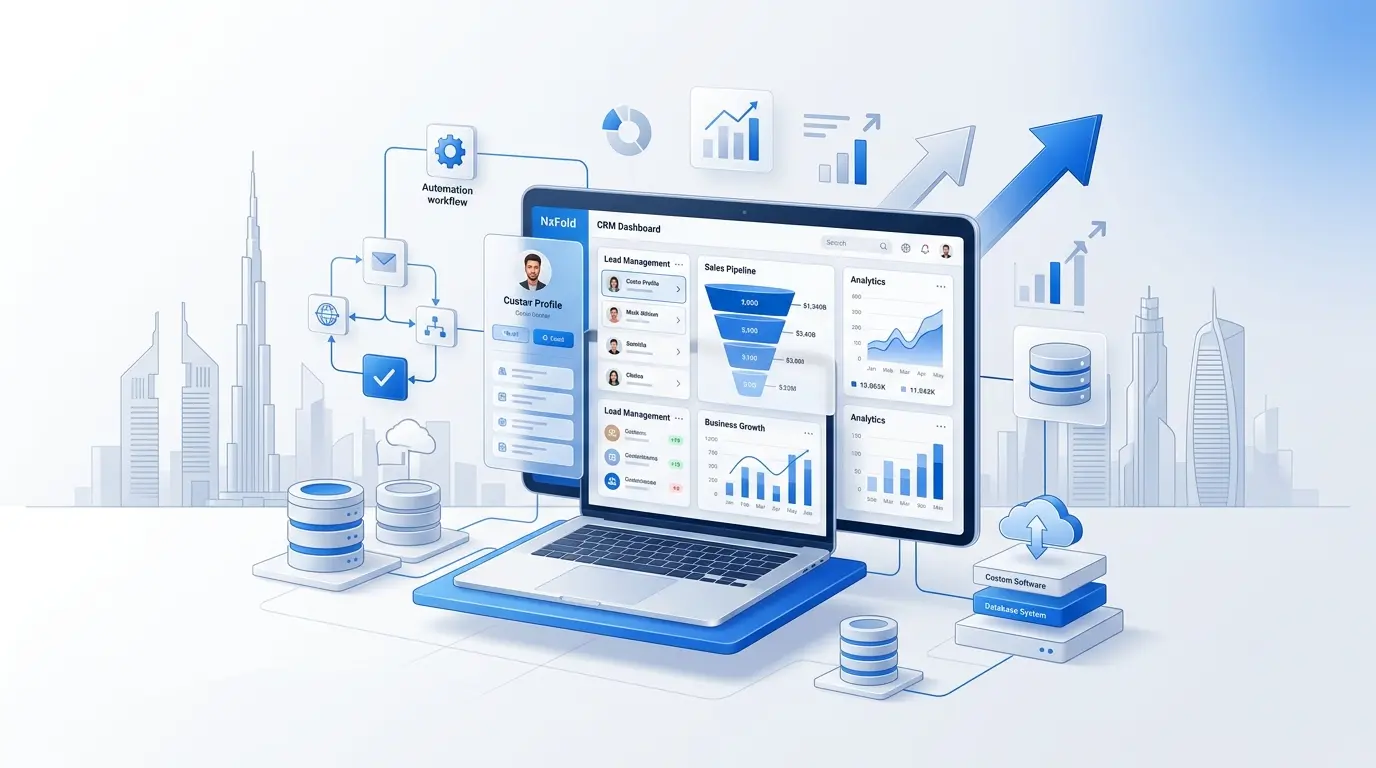
A real CRM behind the site. Leads that land in an inbox get lost. Leads that route to the right agent, trigger an auto-response, and sit in a pipeline get closed. A custom CRM — or a CRM integration — is what turns a website into a sales system.
Bilingual English/Arabic with true RTL. A large share of UAE buyers and the entire Gulf investor market read Arabic. A correctly built right-to-left interface — not an English template with Arabic pasted over it — signals credibility. Our Arabic website design guide covers what proper RTL requires.
Off-plan and payment-plan presentation. Off-plan is a huge part of the Dubai market. Projects need dedicated pages showing the developer, payment milestones, handover date, and escrow details — which, as we'll see, are also a legal requirement.
Fast, Core Web Vitals-clean pages. Property pages are image-heavy. Without disciplined image optimisation they load slowly on mobile, where most searches happen, and Google penalises them. Our Core Web Vitals guide for UAE businesses explains the thresholds that matter.
Compliance is a build requirement, not an afterthought
This is where most real estate websites in Dubai quietly break the law, and where a knowledgeable agency earns its fee. Every property advertisement in Dubai must be licensed through the Trakheesi system, operated by the Dubai Land Department (DLD).
A Trakheesi permit is a mandatory advertising authorisation issued by the DLD. Every advertisement must prominently display the unique Trakheesi permit number assigned to that specific listing. A standard permit costs AED 1,020 (AED 1,000 plus a AED 20 Knowledge and Innovation fee) and is typically approved within one working day.
The consequences of ignoring this are not theoretical. Fines start at AED 50,000 and escalate; using another listing's permit number, or an expired one, is treated as a distinct violation, and repeat breaches can put a brokerage licence at risk. That means your website cannot simply be a place to paste listings. It has to enforce compliance structurally:
- A permit-number field on every listing that renders visibly on the public page, so no unit can be published without one.
- Off-plan disclosure fields — developer name, escrow account number, completion date, and service charges — because DLD rules require them for project advertisements.
- Expiry handling so a listing with a lapsed permit is flagged or unpublished automatically rather than continuing to advertise illegally.
- Awareness of Madhmoun, Dubai's listing-verification layer, and the QR-verified listing standards the market is moving toward.
An agency that has built for Dubai real estate designs these constraints into the data model from day one. One that hasn't will hand you a beautiful site that exposes you to five-figure fines. Where a build touches DLD or RERA processes, the platform's job is to make the compliant path the easy path — not to leave permit numbers as a free-text field the sales team forgets to fill in.
Portal syndication: Property Finder, Bayut, and Dubizzle
No Dubai brokerage lives on its own website alone. The portals — Property Finder, Bayut, and Dubizzle — are where the search demand is, and your platform has to work with them in two directions.
Outbound: listing syndication. You want to enter a unit once on your own system and have it publish to the portals automatically. In practice this means a feed that maps your listing fields to each portal's schema. Bayut and Dubizzle share the same EMPG advertiser backend, so they are typically handled together; Property Finder is a separate integration. Getting the field mapping right — especially the Trakheesi permit number, which the portals require — is the technical heart of the job.
Inbound: lead capture. When a buyer enquires on a portal, that lead should arrive in your CRM in seconds, not sit in an email inbox. Modern integrations use OAuth-authenticated webhooks: the portal sends an HTTP POST to your system the moment an enquiry is submitted, and your platform routes it to the right agent and fires an automated WhatsApp or email response. The difference between a 30-second response and a 15-minute one is the difference between winning and losing the enquiry in a market this competitive.
| Portal | Backend | Integration pattern |
|---|---|---|
| Property Finder | Independent | OAuth + webhook leads; listing feed |
| Bayut | EMPG | Shared EMPG advertiser backend |
| Dubizzle Property | EMPG | Shared EMPG advertiser backend |
Building this well is broker portal development and web development work, not a template problem — which is why brokerages that outgrow off-the-shelf tools move to custom platforms.
Integrating with DLD's API Gateway
Portal syndication is only half of the systems-integration picture. The Dubai Land Department runs its own API Gateway, a separate layer from the portals, that exposes twelve government real estate services directly to registered software providers: Trakheesi licensing, Ejari tenancy-contract management, Mollak service-charge data (plus a Mollak Budget feed for banks), Oqood/TAS trust-account integration for developer escrow, Dubai Brokers real-time broker-card verification, and a Rental Index feed of market rental data, among others.
Access is not automatic. A software provider needs a valid Dubai Trade licence, has to meet the prerequisites for its specific role (software provider, developer, bank, or management company), and pays an annual subscription — published at AED 30,000 plus 5% VAT, support included — through the API Gateway's own registration portal. That is a materially different cost line from the AED 1,020 per-listing Trakheesi advertising permit covered above: the permit fee licenses a single advertisement, while API Gateway access licenses your platform to talk to DLD's systems directly, at scale, rather than through manual entry.
Whether a given platform needs this level of integration depends on scope. A brokerage syndicating listings to the portals does not need DLD API Gateway access — Trakheesi compliance there is a data-field problem, not an integration one. A developer automating escrow reporting through Oqood/TAS, a management company reconciling service charges through Mollak, or a proptech platform verifying broker credentials in real time through Dubai Brokers is the kind of buyer for whom this is the actual build.
What generic portal-integration guides tend to leave thin — and where a build should not: OAuth 2.0 token refresh and expiry handling (a stale token silently drops leads rather than failing loudly), documented rate limits per portal so a bulk listing sync does not get throttled mid-run, structured error handling and retry logic for webhook payloads rather than a bare try/catch, and a data-residency and compliance review for anything storing tenant, buyer, or broker personal data under UAE data protection law. These are the details that separate a demo integration from one a brokerage can depend on during a portal outage or a DLD schema change.
Custom build vs off-the-shelf portal CRM
Not every brokerage needs a custom platform. The honest comparison:
| Option | Strengths | Limits |
|---|---|---|
| Off-the-shelf portal CRM (e.g. portal-provided tools) | Fast to start, low monthly cost | Generic workflows, limited branding, your data lives in their system |
| WordPress + real estate plugin | Cheap, familiar | Slow with large inventories, fragile portal feeds, weak Arabic RTL |
| Custom platform | Fits your exact workflow, owns the data, scales | Higher upfront cost, needs a capable partner |
A small agency running a few dozen listings is well served by an off-the-shelf tool. A brokerage managing hundreds of units across branches, syndicating to three portals, and wanting its own brand, its own automation, and ownership of its lead data will hit the ceiling of packaged tools quickly. That is the point at which a custom real estate platform pays for itself — the recurring cost of lost leads and manual re-entry exceeds the cost of building the right system once.
Technology, performance, and SEO for real estate websites
The stack matters because property sites are large, image-heavy, and search-dependent. A modern build uses a framework with server-side rendering so listing pages are fast and indexable, disciplined image handling (correct sizing, modern formats, lazy loading) to keep Core Web Vitals green, and structured data so individual listings can surface as rich results.
SEO for a Dubai real estate site is won at the community and project level. Pages targeting "apartments for rent in Dubai Marina" or "[developer] off-plan Business Bay" capture high-intent local search that the big portals rank for but rarely with the depth a specialist agency page can offer. Pairing that with strong SEO fundamentals and genuine bilingual content is how an independent brokerage competes for traffic against portals with far bigger budgets.
For platforms that add booking, short-term rental management, or an agent mobile app, the same foundation extends into ecommerce-grade transaction flows and mobile app development.
How long does it take to build?
A brochure brokerage site takes three to five weeks. A listings platform with search, CRM, and one portal integration typically runs eight to fourteen weeks. A full custom portal with multi-portal syndication, agent management, and compliance tooling is a three-to-six-month engagement. Portal integrations and DLD compliance logic are usually the critical path — not the visual design.
How NxFold approaches real estate builds
NxFold is a Dubai-based custom software and web development agency that has delivered real estate work in the UAE market, including Zain, a real estate brand, and Leadora, a real-estate lead and CRM platform. That experience shapes how we build: compliance modelled into the data layer, portal syndication treated as a first-class integration rather than a plugin, and bilingual Arabic support built natively rather than bolted on.
The pattern we follow is single-source-of-truth listings, structural Trakheesi compliance, real CRM-backed lead routing, and Core Web Vitals discipline from the first commit. The goal is a platform the sales team actually uses and the compliance team never worries about.
Five mistakes that sink Dubai real estate websites
The failures are predictable, and every one of them is avoidable at build time:
Treating compliance as content, not structure. When the Trakheesi permit number is a free-text field an agent can skip, some listings go live illegally. The permit must be a required, validated field that blocks publishing when empty.
Building for a laptop, not a phone. The overwhelming majority of Dubai property searches happen on mobile. A site designed desktop-first with heavy images loads slowly on a phone and loses the buyer before the gallery finishes rendering.
Manual re-entry across systems. Typing each unit into the website, Property Finder, and Bayut separately wastes hours and guarantees inconsistent data. One listing record should feed every channel.
Ignoring Arabic until the end. Retrofitting right-to-left support onto an English-only build is expensive and usually looks wrong. Arabic and RTL belong in the design system from the first screen.
No pipeline behind the form. A contact form that emails a shared inbox is where leads go to die. Every enquiry needs an owner, an automated first response, and a status.
Avoiding these five is less about budget than about choosing a partner who has built for this market before and designs the constraints in rather than discovering them in production.
Frequently asked questions
How much does a real estate website cost in Dubai? A brochure brokerage site runs AED 12,000–35,000, a listings platform with a basic CRM AED 40,000–120,000, and a custom portal with syndication AED 150,000 and up. The main cost drivers are inventory size, portal integration, and automation depth.
Do I need a Trakheesi permit to advertise property online? Yes. Any property advertisement in Dubai — including on your own website — must be licensed through the DLD's Trakheesi system, and the permit number must be displayed on the listing. A standard permit costs AED 1,020, and fines for advertising without one start at AED 50,000.
Can my website automatically post to Property Finder and Bayut? Yes, with portal syndication. Your platform maps each listing to the portals' feed formats and publishes automatically. Bayut and Dubizzle share the EMPG backend and are handled together; Property Finder is a separate integration.
Should I build a custom platform or use an off-the-shelf tool? Small agencies with a few dozen listings are well served by off-the-shelf portal tools. Brokerages managing hundreds of units across branches, syndicating to multiple portals, and wanting to own their lead data reach the limits of packaged tools and benefit from a custom platform.
Does my real estate site need to be in Arabic? For the Gulf investor market, yes. A properly built right-to-left Arabic interface — not a translated English template — is a credibility signal with UAE and wider GCC buyers and widens your reach considerably.
How do I stop leads from getting lost? Route every portal and website enquiry into a CRM that assigns it to an agent, triggers an automated WhatsApp or email response within seconds, and tracks it in a pipeline. Speed of first response is the strongest predictor of conversion in Dubai real estate.
What is the DLD API Gateway, and do I need it? It is the Dubai Land Department's own integration layer — separate from Property Finder, Bayut, and Dubizzle — exposing 12 government real estate services (Trakheesi, Ejari, Mollak, Oqood/TAS, Dubai Brokers, Rental Index, and others) directly to registered software providers for AED 30,000 plus 5% VAT a year. Most brokerages syndicating listings to the portals do not need it; developers automating escrow reporting, management companies reconciling service charges, and proptech platforms verifying broker data in real time usually do.
Turn your listings into a lead engine
A real estate website in Dubai is worth building only if it does three jobs: ranks for the searches your buyers actually make, syndicates cleanly to the portals, and stays compliant with DLD advertising law without slowing your team down. If your current site does none of these, it is costing you leads every week.
If you are planning a real estate platform — a brokerage site, a developer portal, or a custom listings-and-CRM system — request a quote for a real estate website build and we will map the right scope to your inventory, your portals, and your compliance requirements.
Have a project in mind?
Ideas to put into practice.
Turn what you have learned into a clearer plan for your website or product. Tell us what you want to build.
Start your project