Web Apps
12 min read
Custom CRM Development in Dubai: Cost & ROI (2026)
How much does custom CRM development cost in Dubai? A 2026 guide to pricing, build-vs-buy, integrations, PDPL compliance, and ROI for UAE businesses.
By NxFold
Updated 4 Sept 2026
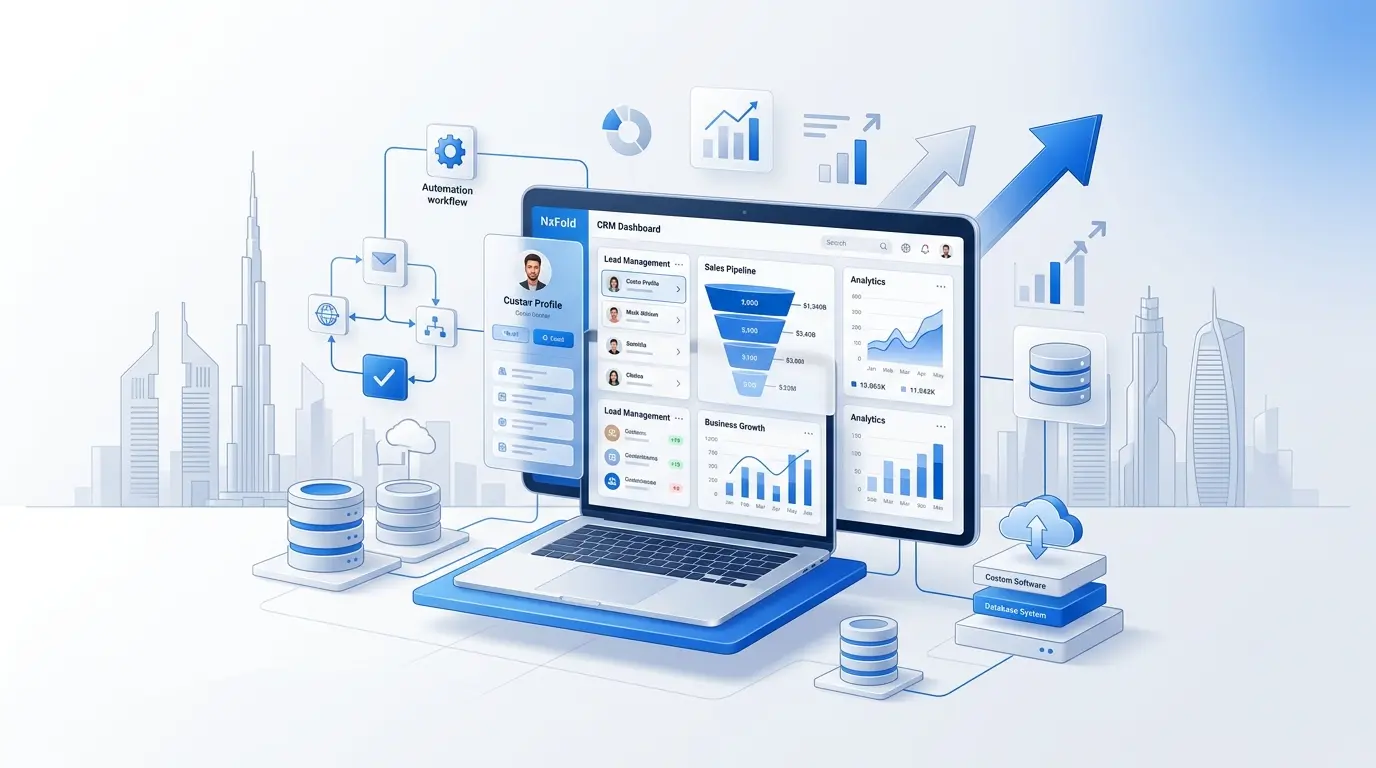
Most businesses in Dubai do not have a "CRM problem." They have a fit problem. They pay for a global CRM built for a market that isn't theirs, then spend months bending their sales process to match the software — instead of the other way around. Custom CRM development flips that. This guide explains what a custom CRM actually is, what it costs in the UAE in 2026, when it beats an off-the-shelf tool like Salesforce or Zoho, and how to calculate whether the investment pays for itself.
What is a custom CRM? (short answer)
A custom CRM (Customer Relationship Management) system is a sales and customer-data platform built specifically around one company's process — its pipeline stages, its data fields, its automations, its integrations — rather than a subscription product every other company also uses. Instead of paying a per-user licence for features you'll never touch, you own a system that does exactly what your team does, and nothing it doesn't.
In the UAE, that difference matters more than in most markets, because so much of local business runs through channels — WhatsApp, bilingual Arabic/English communication, cash and local payment methods, and free-zone entity structures — that global CRMs treat as an afterthought.
Custom CRM vs off-the-shelf (Salesforce, Zoho, HubSpot, Odoo)
This is the decision that saves or wastes the most money, so start here before you think about cost. The honest answer is that most small teams should start with an off-the-shelf CRM, and a custom build only wins under specific conditions.
| Factor | Off-the-shelf CRM (Salesforce, Zoho, HubSpot, Odoo) | Custom CRM |
|---|---|---|
| Upfront cost | Low — subscription | Higher — one-time build |
| Cost at scale (50+ users) | Rises every year, per user | Flat after build |
| Time to launch | Days to weeks | 1–4 months |
| Fit to your process | You adapt to the tool | The tool fits you |
| Data ownership | Vendor's cloud | Fully yours (incl. UAE hosting) |
| Deep integrations | Limited by the vendor | Unlimited |
| Ongoing dependency | Locked to vendor pricing | You control the roadmap |
Choose an off-the-shelf CRM when: your sales process is fairly standard, you have a small team, you need to launch this month, and you don't need unusual integrations. Tools like Zoho and HubSpot are excellent starting points and there is no shame in using them.
Build a custom CRM when at least one of these is true:
- Your workflow is a competitive advantage. If how you qualify, route, and close leads is part of why you win, a generic tool flattens that advantage.
- Per-user licensing has become a tax. Once you're paying for dozens of seats — especially at Salesforce or Dynamics pricing — a one-time build often costs less over three years.
- You need integrations the vendor won't give you. Deep two-way sync with your accounting system, WhatsApp Business, a booking engine, or an e-commerce platform is where off-the-shelf CRMs quietly fail.
- Data ownership and residency matter. Regulated industries and government-adjacent work in the UAE increasingly require data to stay under your control (more on the PDPL below).
If you're weighing this trade-off more broadly, our guide on custom software development in Dubai covers the same build-vs-buy logic across other systems.
How much does custom CRM development cost in Dubai?
Cost depends almost entirely on complexity. Based on prevailing agency pricing in the UAE market in 2026, custom CRM projects generally fall into three tiers:
| Tier | Typical cost (AED) | What you get |
|---|---|---|
| Basic CRM | 15,000 – 40,000 | Contact & lead management, pipeline, basic reporting, one or two users' roles |
| Mid-level CRM | 40,000 – 120,000 | Workflow automation, email/WhatsApp integration, role-based access, dashboards, mobile-friendly |
| Enterprise CRM | 120,000 – 500,000+ | AI automation, multi-department workflows, ERP/accounting integration, advanced analytics, custom apps |
Integrations are often costed separately, because they're the part that varies most: a simple email connection might add a few thousand dirhams, while a deep, two-way integration into an ERP or accounting system can run into the tens or even hundreds of thousands, depending on the target system's API quality.
These are market ranges to set expectations, not a quote — the only honest number comes from scoping your actual process. For a wider view of how software is priced locally, see how much a website costs in Dubai and our custom software cost guide.
What actually drives the cost
Nine factors move the number more than anything else:
- Number and depth of features — a pipeline is cheap; a quoting engine, commission calculator, or forecasting module is not.
- User roles and permissions — granular, multi-department access control adds real engineering.
- Workflow automation complexity — simple triggers are easy; multi-branch logic with approvals is not.
- Integrations — the single biggest swing factor. Each external system is its own mini-project.
- UI/UX and mobile — a polished, responsive interface your team actually enjoys using costs more, and is worth it.
- Bilingual Arabic/English with correct right-to-left layout (see below).
- Data security and compliance — PDPL-aligned consent, audit logs, and access controls.
- Data migration — importing messy historical data from spreadsheets or an old CRM.
- Reporting and analytics depth — from basic lists to real-time executive dashboards.
How long does it take to build?
| Scope | Typical timeline |
|---|---|
| Basic CRM | 4–8 weeks |
| Mid-market CRM (automation + integrations) | 2–4 months |
| Enterprise platform | 4–6 months+ |
Timelines stretch most often because of integrations and unclear process, not because of the CRM itself. The single fastest way to blow a schedule is to start building before the sales process is written down.
UAE-specific factors most CRM guides ignore
This is where a Dubai-built CRM earns its keep, and where global tools consistently fall short.
WhatsApp is the sales channel. In the UAE, a huge share of B2C and SME sales happens over WhatsApp — not email. A custom CRM can integrate the WhatsApp Business API to log every conversation against the right contact, trigger automated follow-ups, and attribute leads to source. Most off-the-shelf CRMs bolt this on awkwardly or charge heavily for it. Building it in properly changes how a UAE sales team actually works.
Arabic and RTL are not a translation toggle. A CRM used by an Arabic-speaking team needs genuine right-to-left layout, correct Arabic typography, and bilingual data entry — not an English interface with Arabic pasted over it. This is the same discipline we cover in Arabic website design in Dubai, and it's a real differentiator in local adoption.
The PDPL applies to your CRM. A CRM is, by definition, a database of personal data. Under the UAE's Federal Decree-Law No. 45 of 2021 (PDPL), that brings obligations around consent, purpose limitation, access, and deletion. A custom CRM lets you build consent capture, audit trails, data-residency (hosting inside the UAE), and "right to be forgotten" workflows directly into the system rather than retrofitting them. Our UAE PDPL compliance guide covers the requirements in full.
VAT and e-invoicing tie CRM to finance. As the UAE moves toward mandatory e-invoicing under the Federal Tax Authority, the link between the CRM (where the deal closes) and the finance system (where the invoice is raised) becomes something you want to own. A custom CRM can hand a closed deal straight to invoicing with the right tax treatment already attached.
Local payments and multi-currency. From payment gateway integration to multi-currency deals across the GCC, a custom CRM can reflect how money actually moves in the region.
Must-have features of a modern CRM (2026)
A CRM worth building includes, at minimum: contact and company records; a visual, customizable sales pipeline; lead capture from your website and ad channels; task and activity management; email and WhatsApp integration; role-based permissions; automated follow-ups and reminders; quoting or proposal generation; reporting dashboards; and a mobile-friendly interface for a team that sells on the move.
Beyond the basics, the features that separate a real competitive tool from a digital address book are automation and integration — which is why they deserve their own sections.
Automation: the real reason to build
The point of a CRM is not to store data — it's to make sure nothing falls through the cracks and no one wastes time on manual admin. A custom CRM lets you automate exactly the steps your team repeats: routing new leads to the right salesperson, sending follow-up sequences, escalating stalled deals, updating stages when a payment lands, and notifying finance when a deal closes. This is the same operational thinking behind business process automation in Dubai — a CRM is often the first place that automation pays off.
AI in CRM: what's real in 2026
AI has moved from buzzword to genuine CRM feature. The useful applications today are: lead scoring (ranking prospects by likelihood to close), AI drafting of replies and follow-ups, conversation summarization so reps don't lose context, forecasting based on pipeline behavior, and AI agents that handle first-line qualification. If you're exploring this, our guide to AI agent development in Dubai explains what these agents can and can't do. The advantage of a custom CRM is that AI can be trained on your data and process, not a generic model that doesn't know your business.
Integrations that matter in the UAE
A CRM is only as good as what it connects to. The integrations that consistently deliver value for UAE businesses are: WhatsApp Business API; accounting and ERP systems (for invoicing and revenue); email and calendar; payment gateways; website and landing-page lead forms; call and telephony systems; and, increasingly, e-invoicing/FTA reporting. Each integration is effectively its own small project, which is why they dominate both cost and timeline — and why they're where custom builds decisively beat off-the-shelf tools.
An illustrative ROI framework
Numbers below are an illustrative model, not a client result — use it to structure your own calculation with your real figures.
Imagine a sales team of 10 that currently loses track of roughly 15% of inbound leads because follow-ups slip. If the business handles 400 leads a month with an average deal value of AED 8,000 and a 20% close rate, recovering even half of those dropped leads — 30 leads a month at a 20% close — is 6 extra deals, or roughly AED 48,000 in additional monthly revenue. Against a mid-level CRM build in the AED 40,000–120,000 range, the system pays for itself in a matter of months on lead recovery alone, before counting the time saved on manual admin.
The lesson isn't the specific figure — it's the method. A CRM's ROI comes from three levers: leads recovered (fewer dropped follow-ups), cycle time compressed (faster stage progression), and admin eliminated (hours returned to selling). Model those three with your own numbers before you commit.
Common custom CRM mistakes to avoid
The projects that fail tend to share the same causes: building before the sales process is documented; scoping every feature at once instead of shipping a core system first; underestimating integration effort; ignoring adoption (the best CRM is the one your team actually uses); skipping data migration planning; and treating PDPL compliance as an afterthought instead of a design input. A good partner will push back on all six.
How to choose a CRM development partner in Dubai
Look for a partner who starts with your process, not their tech stack; who can show real custom systems they've built (not just templated websites); who understands UAE-specific realities like WhatsApp, Arabic/RTL, and the PDPL; who is honest about when you don't need a custom build; and who will support the system after launch. The same evaluation discipline applies as when you choose an SEO agency in Dubai — ask for evidence, not adjectives.
At NxFold, custom business systems are core to what we do: our own platform runs an internal engine that turns an accepted quotation into a live project and a drafted contract automatically — the same custom-workflow thinking we bring to a client's CRM. We build on a modern, maintainable stack (see our approach to multi-tenant SaaS architecture and web app development), with Arabic and English as first-class citizens.
Frequently asked questions
How much does custom CRM development cost in Dubai? Roughly AED 15,000–40,000 for a basic system, AED 40,000–120,000 for a mid-level CRM with automation and integrations, and AED 120,000 to 500,000+ for enterprise builds. The final number depends on features, roles, integrations, and compliance.
Should I build a custom CRM or use Salesforce, Zoho, or HubSpot? Use off-the-shelf when your process is standard and you need to launch fast. Build custom when your workflow is a competitive advantage, per-user licensing gets expensive at scale, or you need deep integration and full data ownership under UAE law.
How long does it take to build a custom CRM in Dubai? A basic CRM takes 4–8 weeks, a mid-market system 2–4 months, and an enterprise platform 4–6 months or more, depending on scope and integrations.
Does a CRM used in the UAE need to comply with the PDPL? Yes. Any CRM storing personal data of individuals in the UAE falls under Federal Decree-Law No. 45 of 2021. A custom CRM lets you build consent, data-residency, access control, and deletion workflows into the system.
Can a custom CRM integrate with WhatsApp Business? Yes — and in the UAE it should. WhatsApp is a primary sales channel, and the WhatsApp Business API can be integrated to log conversations, trigger automations, and attribute leads far more tightly than most off-the-shelf CRMs allow.
Is a custom CRM worth it for a small business? Often not, at first. Small teams with a standard process are usually better served by an affordable off-the-shelf CRM, and should move to custom only once fit, licensing cost, or integration needs justify it.
Build a CRM that fits how you actually sell
If your team is fighting its CRM instead of selling with it — or paying rising per-seat fees for a tool that still doesn't fit — a custom system built around your process is worth costing out properly. NxFold designs and builds custom CRM and business systems for UAE companies, with WhatsApp, Arabic/RTL, and PDPL compliance built in from day one. Book a free CRM scoping call with NxFold and we'll map your process, size the build honestly, and tell you if you'd be better off with an off-the-shelf tool instead.
Have a project in mind?
Ideas to put into practice.
Turn what you have learned into a clearer plan for your website or product. Tell us what you want to build.
Start your project