Holiday Home Websites
12 min read
Direct Booking vs OTA Commission in the UAE
What Airbnb and Booking.com really cost a UAE operator, when a direct-booking site pays for itself, and how to grow direct without leaving the channels.
By NxFold
Updated 6 Sept 2026
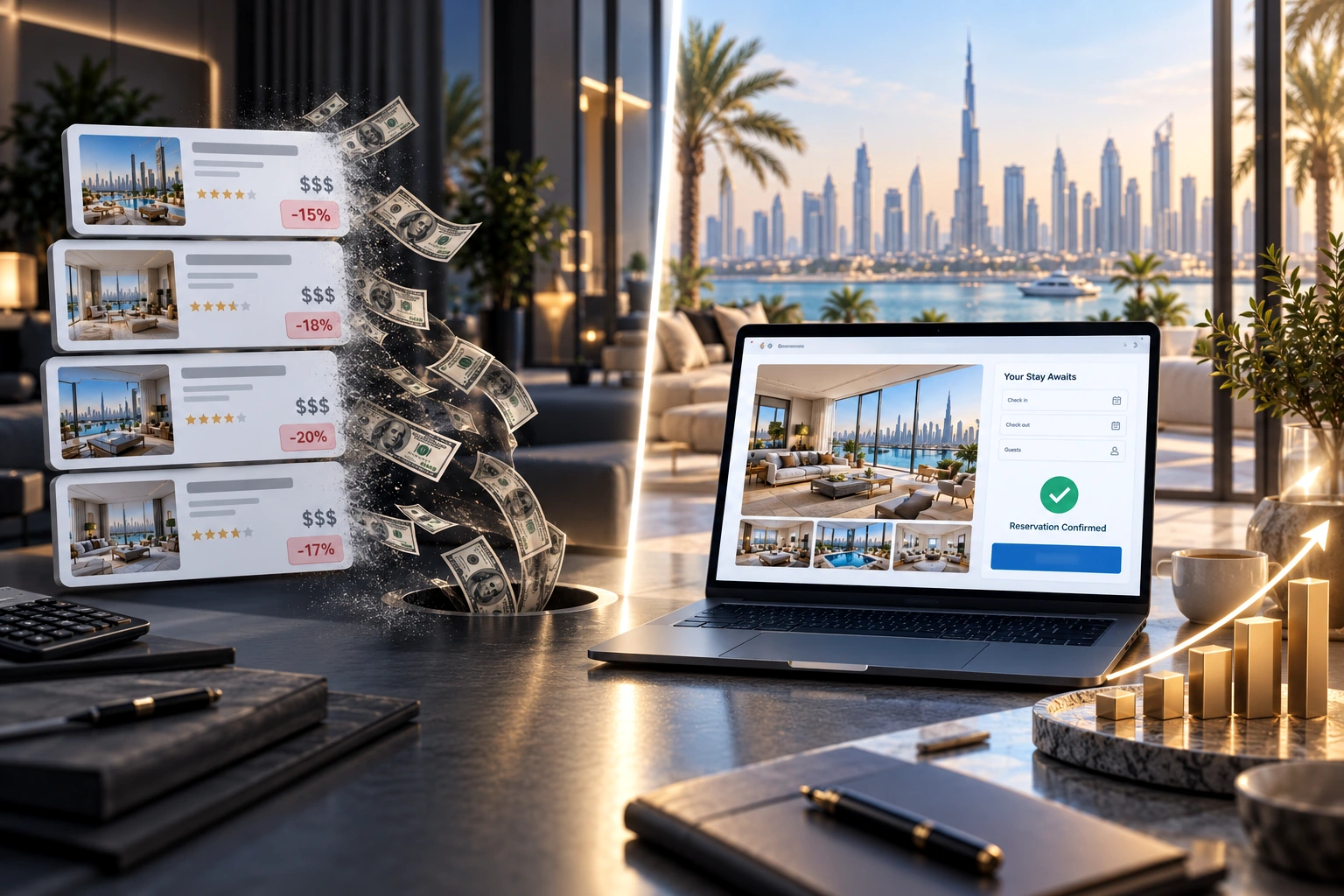
Every holiday-home operator in the UAE has done this arithmetic on the back of an envelope at least once: if the platforms take fifteen to thirty per cent of everything, what would it cost to stop paying that?
The envelope usually gets thrown away, because the question is harder than it looks. The commission is not the only cost, leaving the channels is not the only option, and "build a website" is not the same thing as "take direct bookings." This guide works the numbers properly — what the platforms actually charge, where the break-even sits for a portfolio of a given size, and what a direct-booking channel has to do before a guest will trust it.
This is the money side of the decision. If you are further back and still choosing the system that runs your units, read holiday homes management software in Dubai first — that guide covers the build-versus-buy question for the platform itself, and this one assumes you have a platform and are deciding what to do about distribution.
The Short Answer
For most UAE operators, the commission is worth paying at first and stops being worth paying somewhere between fifteen and twenty-five units. Below that, the platforms are buying you something you cannot buy more cheaply yourself: strangers. Above it, you are paying a percentage of every booking for an audience you have already met.
The move that works is not leaving. It is staying listed everywhere and building a direct channel alongside, then letting the repeat guests — the ones who already know the property, already trust you, and would have rebooked anyway — arrive through the door that costs nothing. That is the only part of the funnel where the platform is genuinely adding no value, and it is usually a quarter to a third of a mature operator's bookings.
What You Are Actually Paying
The headline number is the least interesting part. Add up the whole picture:
The host commission. Booking.com typically charges the property 15–20% depending on market and programme. Airbnb offers two structures: a split fee where the host pays roughly 3% and the guest is charged a service fee on top, or a host-only fee in the mid-teens where the guest sees no separate charge. Vrbo and Expedia sit in similar territory. Call it 15–20% as a working figure for the channel mix most UAE operators run.
The payment processing. Usually bundled into the above on the platform side, but you pay it again on any direct channel — so it is not a saving, it is a cost that moves. Budget 2–3% for card acquiring.
The discounting you did not choose. Platform-driven promotions, mobile rates, genius or preferred-partner tiers, last-minute discounts that the ranking algorithm rewards. These are rarely counted as commission and often cost more than the commission does.
The guest you never met. This is the real one, and the hardest to put a number on. When a guest books through a platform, the platform owns the email address, the review, and the reason to come back. A guest who loved the villa and wants it again next Eid searches the platform, not your brand. You pay full commission on that second booking too — and on the third.
That last cost is why the break-even calculation is not simply "commission versus build cost." It compounds.
The Break-Even, Worked
Take a realistic mid-sized portfolio: 12 units, average daily rate AED 600, 70% occupancy.
That is roughly 12 × 365 × 0.70 = 3,066 occupied nights, at AED 600 = AED 1.84m in gross booking value per year. At a blended 17% commission, you are paying about AED 313,000 a year to the platforms.
Now the honest part. A direct channel does not capture all of that. In the first year, a well-built direct site on an established brand with a real repeat base tends to take somewhere between 10% and 25% of bookings — and the higher end assumes you are actively pushing returning guests toward it. Take the conservative end: 10% of bookings moving direct saves roughly AED 31,000 in year one, against a build that costs meaningfully more than that.
So on a one-year view, it does not pay back. On a three-year view, with the direct share growing as the repeat base grows and the site earning its own organic traffic, it usually does — and it does so faster for operators with high ADR, long stays, or a strong brand, because all three raise the value of a booking you do not pay commission on.
Which is why the answer changes with size. At four units the maths never closes. At forty it closed a while ago.
You Do Not Have to Leave the Channels
This is the misconception that stops operators who should be building. Going direct is framed as a divorce, and nobody wants to lose the top of their funnel to prove a point about fees.
You do not have to. A direct-booking site sits on the same availability your channel manager already maintains, so the calendar is shared. A booking on your own site blocks the dates on Airbnb within seconds; a booking on Booking.com blocks them on yours. The channels keep doing what they are genuinely good at — putting your property in front of someone who has never heard of you — and the direct site takes the traffic that was already coming to your brand.
When we built the direct-booking platform for Ayla, an Abu Dhabi holiday-home operator, that was the entire design constraint: grow direct without losing marketplace presence. The units stay live across the major OTA channels the operator already listed on, kept in sync through its channel manager, while the brand's own site takes the repeat guests. Nothing was given up to build it.
The mechanics of that sync are what actually decide whether an approach like this works, and they are worth stating plainly: one internal calendar holds the truth, every channel is a projection of it, and updates are pushed on webhooks rather than polled on a timer. That is what makes a booking anywhere block the dates everywhere within seconds instead of at the next sync interval — and it is an architectural decision rather than a feature you can add later.
What About Rate Parity?
Operators usually ask whether they can simply undercut the platforms on their own site. Mostly, no — and mostly, it does not matter.
Rate parity clauses in platform agreements generally prevent you from publishing a lower headline nightly rate on your own channel. What they typically do not restrict is everything around the rate: a free late checkout, a stocked fridge on arrival, a fifth night free, a returning-guest benefit, a package that bundles airport transfer. These are worth more to a guest than a 5% discount and cost you less than a 17% commission.
And the fundamental point survives regardless: the same nightly rate booked direct is worth 15–20% more to you. You do not need to compete on price to win on margin. Most operators who try to undercut are solving the wrong problem — the guest is not choosing your direct site to save money, they are choosing it because they already know the property and it is the obvious place to go.
What a Direct Channel Has to Get Right
The reason most direct-booking sites fail is not traffic. It is trust. A guest booking through Airbnb has a review history, a cancellation policy they recognise, a dispute process, and a company standing behind the transaction. Your site has none of that by default, and it has to earn each one back explicitly.
Real-time availability, not an enquiry form. If the guest has to ask whether the dates are free, you have built a lead form, not a booking channel. The whole advantage of arriving direct is that it is easier — a form makes it harder than the platform.
The terms, before the payment step. House rules, the cancellation policy in plain language, what is included, the deposit, the check-in window. On a platform these are standardised and the guest skims them. On your own site they are the thing that decides whether they complete, so they belong before the card field and not after it.
Proof that you are real. The DET permit number displayed, the licence, photography that is obviously of the actual unit, reviews if you can surface them, and a phone number a human answers. UAE guests in particular check for the permit.
Payment that behaves like a hotel, not a transfer. Card acquiring with 3-D Secure, a clear authorisation-versus-charge distinction, and an emailed confirmation that arrives immediately. If you are working out what that stack looks like, payment gateway integration in Dubai covers the options and the compliance line.
A phone-shaped booking flow. Stay research starts on a phone. It often finishes on a laptop, but if the phone step is painful there is no laptop step.
Where the Direct Traffic Comes From
Building the channel is half of it. Filling it is the half operators underestimate, and it is mostly not SEO.
Your existing guests, deliberately. The checkout message, the review request, the welcome book in the unit, the WhatsApp thread that already exists. A returning guest who books direct is the highest-margin booking in the business and the easiest to win — they simply need to be told the direct site exists.
Brand search. People who heard about you and search your name. If your own site does not rank first for your own brand, the platforms are collecting traffic you generated.
Long-tail property search. "Holiday home Saadiyat with pool", "serviced apartment Al Reem monthly". This is slow, real, and compounding — and it is where the site earns traffic the platforms never sent you. It needs the same technical groundwork as any other commercial site; see holiday homes website development for how we structure it.
Paid, carefully. Brand-defence campaigns are usually worth it. Broad discovery campaigns usually are not, because you are bidding against platforms with far deeper pockets and better conversion data.
When Not to Build This
An honest list, because the wrong answer here is expensive:
- Under about ten units. The commission you would save does not cover the build, and your time is better spent on occupancy and reviews.
- No repeat guest base. If your stays are one-off tourist bookings with no reason to return, you are asking a stranger to trust an unknown brand over Airbnb. That is a much harder sell than it looks.
- You are not ready to run it. A direct channel means you own guest support, payment disputes, and cancellations. The platform was doing that work.
- Your channel manager cannot expose clean availability. Without a reliable real-time feed, you will oversell. Fix that before building anything guest-facing.
Frequently Asked Questions
Do I have to leave Airbnb and Booking.com to take direct bookings? No, and you should not. A direct-booking site shares the same availability calendar as your channel manager, so units stay listed everywhere while the direct channel grows alongside. The platforms keep supplying first-time guests; the direct site takes the repeat ones.
How much commission do the platforms actually charge in the UAE? Typically 15–20% for the host depending on channel and programme — Booking.com generally in that band, Airbnb offering either a low split fee with a guest-side service charge or a host-only fee in the mid-teens. Add card processing on any direct channel, and factor in platform-driven discounting, which often costs more than the commission.
At what portfolio size does a direct-booking site pay for itself? Usually somewhere between fifteen and twenty-five units, and faster for operators with high nightly rates, long stays or a strong repeat base. Below about ten units the saving rarely covers the build.
Can I charge less on my own site than on the platforms? Generally not on the headline nightly rate — parity clauses usually prevent it. You can compete on inclusions instead: late checkout, transfers, returning-guest benefits. And you do not need to discount, because the same rate booked direct is already worth 15–20% more to you.
Will it work with the channel manager I already use? Usually. A direct-booking platform is built to sync against whatever channel manager the operator already runs rather than replace it — mainstream channel managers such as Lodgify, Smoobu, Uplisting, Hostfully, Guesty and OwnerRez all expose comparable availability APIs. The integration is the part worth confirming before you commit to a build.
How long does a direct-booking site take to build? Four to eight weeks for a portfolio of a dozen or so units, depending on how many properties need photography and how clean your channel manager's availability API is. The sync work usually sets the pace, not the pages.
What stops a double booking between my site and Airbnb? One internal calendar as the single source of truth, with every channel treated as a projection of it, and webhook-driven updates so a booking anywhere blocks the dates everywhere within seconds. It is an architectural decision, not a feature.
Do I need to show my DET permit number on my own site? Yes — the platforms already require it on listings, and UAE guests look for it. Treat the permit number, classification and renewal date as first-class data on every unit rather than a note in a spreadsheet.
The Bottom Line
The commission is not a scandal; for a small operator it is a fair price for an audience you cannot otherwise reach. It becomes a problem when you are paying it on guests you already earned — the returning ones, the brand searches, the referrals — and that share grows every year you operate.
The move is not to leave the channels. It is to stop paying a percentage on the bookings the channels are not actually winning for you, while keeping them for the ones they are. That is a distribution decision before it is a website decision, and it is worth doing the arithmetic on your own numbers before anyone builds anything.
If you want that arithmetic run properly against your portfolio — units, ADR, occupancy, channel mix and repeat rate — get in touch. We have built direct-booking platforms for UAE operators and can tell you honestly whether yours is at the size where it pays back, or whether you are two years early.
Have a project in mind?
Ideas to put into practice.
Turn what you have learned into a clearer plan for your website or product. Tell us what you want to build.
Start your project