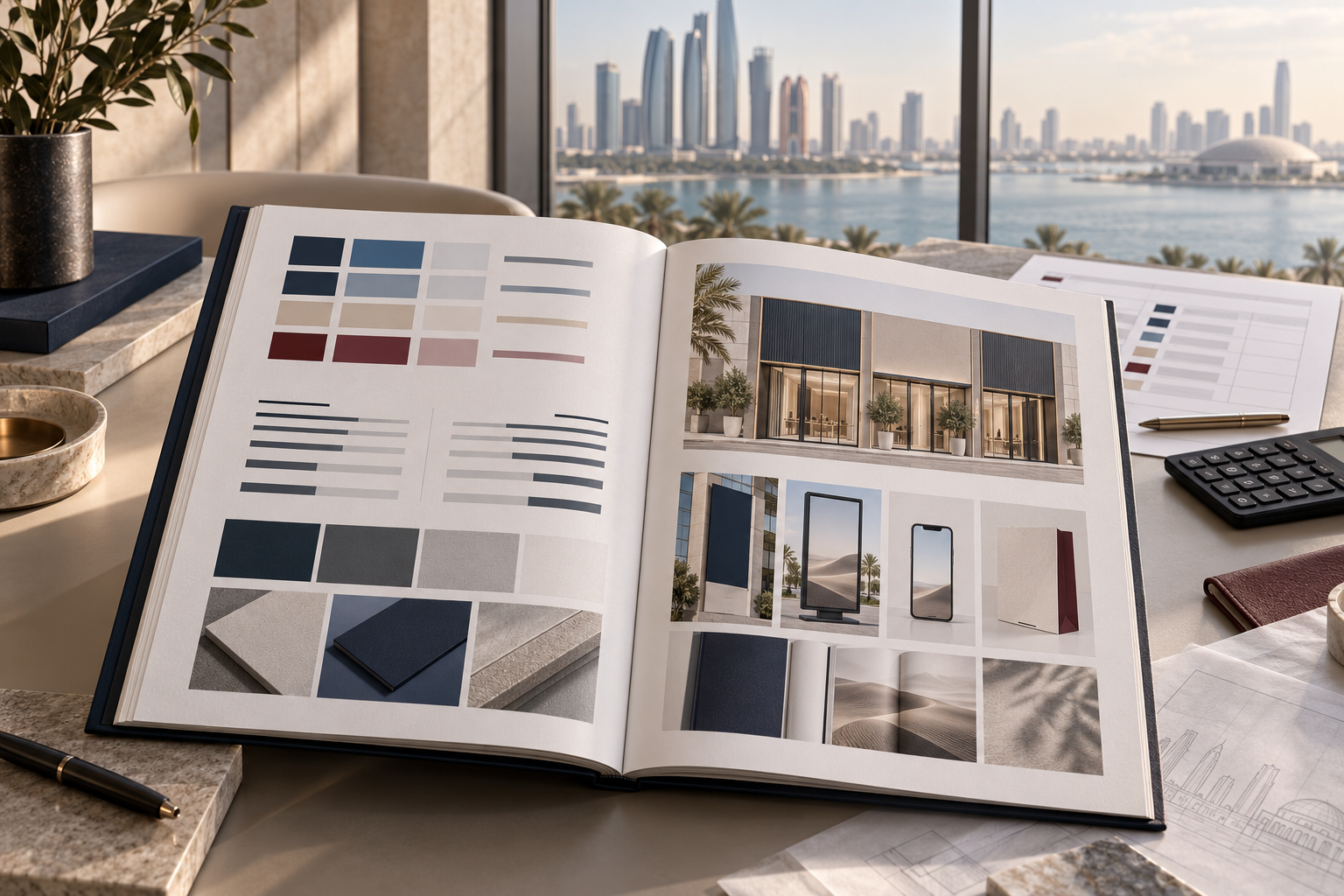
Brand design in Abu Dhabi, built to read as credible.
Abu Dhabi buys differently to Dubai. Deals run through procurement, decisions involve more people, and the work gets read closely before it gets approved. That rewards a site that is genuinely well documented, accessible, and credible in Arabic — not just visually impressive. We build to that standard.
Explore the project, the thinking and the work behind it.
Dubai HQ · Serving Abu Dhabi · Bilingual EN / AR
100%
Custom — never templated
Every mark built from your positioning
2
Scripts designed simultaneously
Arabic and English, both primary
∞
Brand consistency
Guidelines your team hands to anyone
Estimated impact, ~90 days post-launch.
16 brands and products shipped — across the UAE and beyond
(✦) — The market
What delivering digital work in Abu Dhabi actually involves
01
Arabic as the primary language
Arabic carries more weight in Abu Dhabi than it does in Dubai — for public-sector-adjacent audiences it is often what gets read first. Names, documents, content and interfaces are written and designed to the same standard as English rather than treated as a secondary version.
02
Accessibility and clarity that hold up
Interfaces use semantic structure, keyboard navigation, tested contrast and screen-reader support. Brand and document assets remain legible at the sizes and in the formats reviewers actually receive.
03
Documented and handover-ready
Procurement asks for things many agencies do not prepare: scoped deliverables, architecture or design notes, clear ownership and the licence position of every asset. You get work another team can take over without archaeology.
04
Sector fit
Energy, public sector, real estate and professional services dominate here. Those buyers value restraint, clarity and evidence over visual noise, so the work has to read as substantial because the organisation is.
(01)
Building a brand here
What brand design in Abu Dhabi actually has to do
04 / 04
01
Credibility here is institutional, not fashionable
A brand in a crowded market often works by standing out — sharper, louder, more confident than the four competitors beside it. In Abu Dhabi the buyer is more often an organisation, and the signal that matters is not distinctiveness but seriousness: looking like a company that can be handed a large contract and a long timeline.
That changes the work. Restraint reads better than energy, a considered typographic system outlasts a memorable logo, and consistency across genuinely dull surfaces — a document template, a submission cover, a signage plate — carries more weight than a striking social presence.
02
The Arabic identity is not the secondary lockup
Here the Arabic version of your name is frequently the one on the document, the entrance and the contract. An Arabic logotype traced from Latin letterforms is visible instantly to the people it was meant for, and it reads as a company that did not think this market was worth the effort.
We draw the Arabic as its own piece of lettering rather than a mirror of the Latin, pair it with an Arabic typeface chosen for reading at document sizes, and write the guidelines to cover both directions explicitly — which lockup goes where, how the two sit together when both appear, and what happens in a single-colour application.
03
Guidelines exist because you will not be in the room
The larger the buyer, the more the brand gets applied by people you never meet: a printer, an events contractor, a department building its own slides. Whatever the guidelines do not answer, they will decide for themselves, and the brand degrades one reasonable decision at a time.
So the document is written to be used rather than admired — clear rules, real examples of correct and incorrect application, colour values for every medium, and the awkward cases spelled out: small sizes, single colour, over photography, and on a form somebody has to complete with a pen.
04
What it costs, and what you own
A brand identity project runs AED 5,000 to 20,000 over three to five weeks. The lower end is logo, typography, colour and a guidelines document; the upper end is a full system — bilingual lockups, document and presentation templates, collateral, and the identity carried through to the website rather than handed over and hoped for.
You own every file: master vectors, editable artwork, the guidelines document, and a written note of which typefaces are licensed and how. That last detail is what stops a brand quietly breaking the first time it is handed to an external supplier.
(02) — What's included
Government-adjacent and enterprise buyers apply scrutiny that loosely specified digital work does not survive. These are the areas that decide whether it clears review.
They genuinely understood how our guests browse. Direct bookings come straight through the site now, and I spend far less time going back and forth on WhatsApp.
Our office is in Dubai and we serve Abu Dhabi from there — it's a ninety-minute drive, so we come on site for kickoffs, workshops and key reviews. We're straight about this rather than claiming a presence we don't have.
Can you work with procurement and tender requirements?+
Yes. We can supply scoped proposals, documented deliverables, accessibility statements and a clear breakdown of what's included — the material procurement typically asks for before sign-off.
Is the Arabic work handled properly?+
Yes. Arabic writing and typography are handled as primary deliverables, with right-to-left layouts and separate indexed URLs where the project includes an interface or website. We do not machine-translate English work and call it bilingual.
What is the cost of Logo & Brand Identity Design in Abu Dhabi?+
Published prices for Logo & Brand Identity Design: Brand identity: AED 5,000 – 20,000. The final quote depends on the agreed scope and integrations. Send your brief for an itemised proposal.
Can you meet accessibility requirements for work that gets reviewed?+
Yes. For digital products that means semantic structure, keyboard navigation, tested contrast and screen-reader support. For brand and document deliverables it means legibility, usable formats and clear application rules. The applicable requirements are documented in the scope.