Branding
18 min read
Branding Cost in Abu Dhabi: 2026 Price Guide
What branding costs in Abu Dhabi in 2026: price bands by scope, DMT signage rules, ADDED trade-name reservation, and how to compare three quotes.
By NxFold
Updated 7 Sept 2026
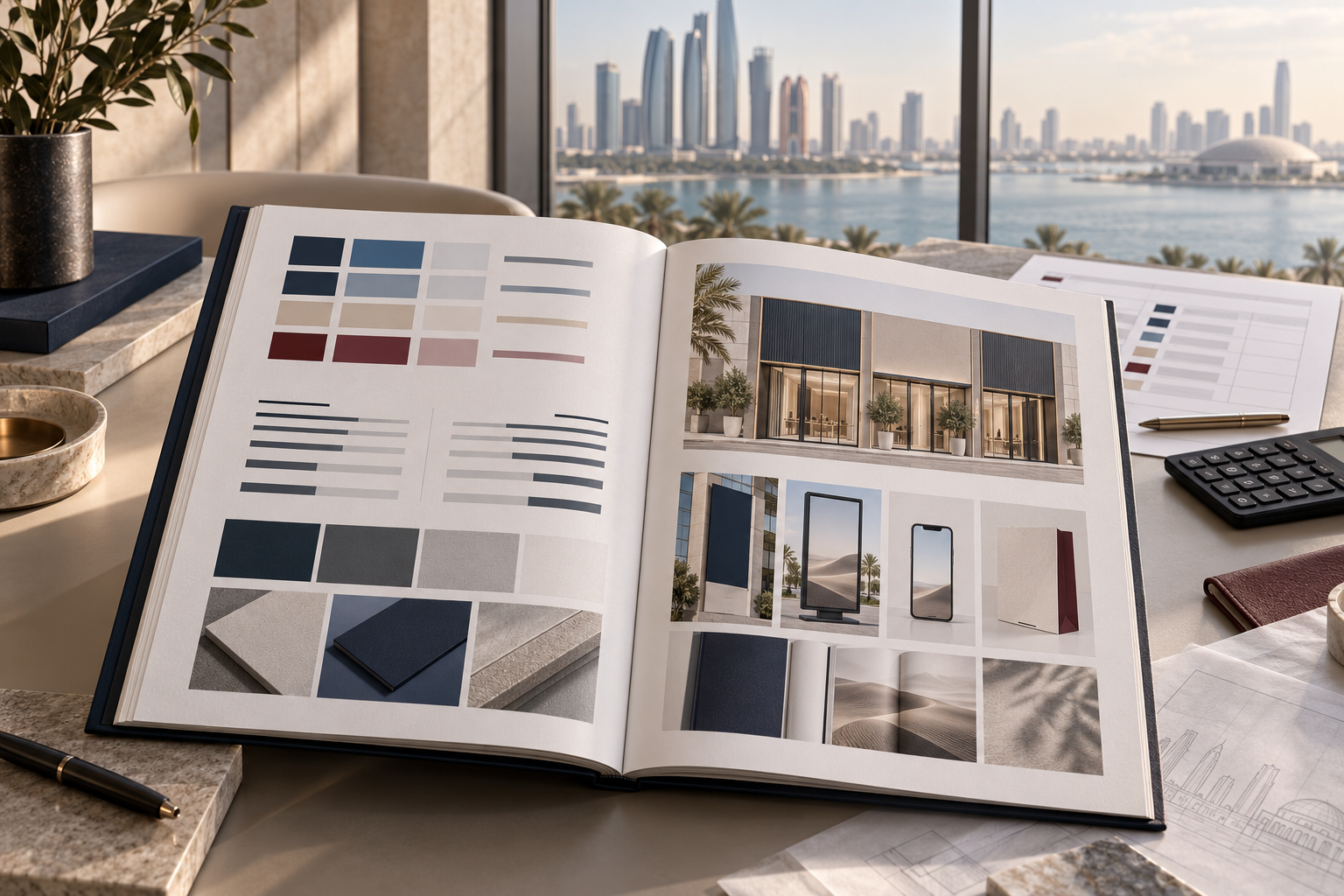
Branding in Abu Dhabi costs roughly AED 1,500 for a freelance logo and AED 150,000+ for a multi-market identity system — but the number that actually decides your budget is not the logo tier. It is whether your identity has to survive a signage approval from the Department of Municipalities and Transport (DMT), a trade-name reservation through TAMM, and a website that works properly in Arabic. Most Abu Dhabi branding quotes price the logo and quietly leave you the other three.
This guide breaks down what each price band actually buys in 2026, what Abu Dhabi's specific signage and licensing rules add to the number, how long the work realistically takes, and how to compare three quotes that look identical on paper.
What Branding Costs in Abu Dhabi in 2026
Direct answer: In 2026, Abu Dhabi designers and agencies publish rates from roughly AED 300–2,000 for freelance logo work, AED 8,000–20,000 for a core identity from a local studio, AED 20,000–55,000 for a full identity system from a mid-size agency, and AED 55,000–150,000+ for enterprise, multi-market or ADGM-facing identity work.
| Tier | Typical published range (AED) | What it usually covers |
|---|---|---|
| Freelance logo | 300 – 2,000 | A logomark and one or two file formats, little to no documentation |
| Local agency logo/identity | 1,500 – 8,000 | Logo plus a basic colour and font reference, sometimes a short guideline |
| Core identity | 8,000 – 20,000 | Logo system, palette, typography, essential stationery, a real guideline PDF |
| Full identity system | 20,000 – 55,000 | Everything above plus brand strategy, tone of voice, an extended asset library, signage artwork, a proper brand book |
| Enterprise / multi-market / ADGM-facing | 55,000 – 150,000+ | Naming, research, architecture across sub-brands, multi-language systems, rollout governance |
Those bands reflect what agencies and freelancers serving Abu Dhabi publish on their own pricing pages in 2026 — a published range from one agency alone runs as high as AED 14,000–150,000+ for a full brand identity, which sits inside the same spread. Treat the table as the market's shape, not as a quote: the same brief priced by three providers routinely varies several times over, and the reason is almost always deliverable count, not design quality.
Two things distort the low end of the range specifically in Abu Dhabi. First, a meaningful share of the market is freelancers and one- or two-person studios competing purely on price, which pulls the bottom far below what a full-service agency will quote for the same brief. Second, anything that has to ship in Arabic properly — which in Abu Dhabi means almost everything with a physical presence — moves the true cost up a tier, because Arabic is a second design system, not a translation pass.
What You Are Actually Buying at Each Price
The most common way to overpay in Abu Dhabi is to buy a tier by its name rather than by its deliverable list. "Full branding package" means nothing on its own — ask any provider for the exact file count.
A defensible identity, one a web team, a signage contractor and a printer can all build from without coming back to ask questions, contains roughly this:
- Logo system: primary mark, horizontal lockup, stacked lockup, icon/favicon, monochrome and reversed versions — in both the Arabic and Latin lockups. That is closer to ten files than one.
- Colour: primary, secondary and neutral palettes with HEX, RGB, CMYK and Pantone values. A colour system defined only for screens will fail at the printer and on a fabricated sign.
- Typography: a display face and a text face, licensed for web and desktop, in a Latin and an Arabic pairing that actually match in weight and texture. Font licensing is a genuine line item people forget to ask about.
- Application artwork: business card, letterhead, email signature, social profile and cover sizes, and — for any Abu Dhabi business with a physical location — signboard artwork sized to what your landlord and the DMT will ask for.
- Guidelines: clear spacing, minimum sizes, misuse rules, and how the Arabic and Latin lockups relate to each other. A ten-page PDF is fine. A three-slide moodboard is not a guideline.
If a quote does not enumerate these, the gap becomes a change request later, priced by the hour.
The Bilingual Signage Requirement Most Quotes Ignore
This is where Abu Dhabi branding genuinely diverges from a generic UAE quote, and it is the single most common source of surprise cost.
Commercial signage in Abu Dhabi is regulated by the Department of Municipalities and Transport (DMT), under its Commercial Signage Regulations — a distinct authority and a distinct rulebook from Dubai Municipality's signage process, even though the two emirates share a border and, often, the same landlord chains. DMT recognises a defined set of sign typologies (3D stencil-cut letters, 3D letters with a background, 3D letters without a background, internal window signs, banners, and projecting signs), and the rules are specific rather than a general aesthetic guideline: no exposed light bulbs anywhere on a sign, with all lighting and wiring contained inside it; only 3D signs without a background and banners may be externally illuminated, and any external fixture is capped at 15 cm of protrusion; contact details (a phone number, a website) may cover at most 10% of the sign face; and a sign may not advertise a third party's product — it has to promote only the business actually operating in that unit.
The practical brand-design consequence is the same one Dubai operators face, arrived at through a different rulebook: your logo needs an Arabic lockup that is designed, not typed. A Latin wordmark with a machine-translated Arabic phrase pasted underneath in a default system font is the most common failure mode in this market. Arabic is cursive and connected, its letterforms change by position in a word, it has no capitals, and its optical weight and baseline behave differently from Latin. A properly drawn Arabic wordmark is a second design exercise, not a localisation step — usually 30–50% of the Latin logo effort on its own.
Budget for these bilingual line items explicitly:
| Bilingual item | Why it costs extra | Skipping it costs you |
|---|---|---|
| Arabic logo lockup (drawn, not typed) | Custom letterform work, not translation | A sign that reads as an afterthought to half the market |
| Arabic type pairing with a licence | Few Arabic families match a given Latin face in weight and texture | Mismatched, amateur-looking Arabic across every asset |
| RTL application artwork | Layouts mirror; logos, icons and alignment all move | Broken stationery, ads and social templates in Arabic |
| Signboard artwork to DMT typology and sizing rules | The typology, illumination and content-area limits are specific and enforced | A rejected sign, a reprint, and a fabrication delay |
If you are also building a bilingual site, the same discipline carries into the digital layer — mirrored layouts, Arabic typography and RTL component behaviour are design decisions made once and inherited everywhere. Our Arabic website design guide covers the RTL build in depth, and the Arabic SEO guide covers how the Arabic half actually gets found.
How Long Branding Takes in Abu Dhabi
Timelines are quoted less often than prices and cause more friction when they slip. Realistic durations, assuming a client who turns around approvals within two working days:
| Scope | Typical duration | Main delay risk |
|---|---|---|
| Logo only | 1 – 2 weeks | Round-count creep with no cap in the contract |
| Core identity | 3 – 5 weeks | Stakeholder committee with no single decision-maker |
| Full identity system | 7 – 11 weeks | Arabic lockup approval; guideline sign-off |
| Enterprise / multi-market | 3 – 6 months | Naming and trademark clearance |
Two Abu Dhabi-specific scheduling notes. First, if the business is ADGM-registered or otherwise institution-facing, expect an extra approval layer inside the client organisation itself — a compliance or brand-governance sign-off that a small owner-operated business simply does not have. Second, if a signboard is in scope, add the DMT approval and fabrication window after design sign-off, not in parallel with it; the typology and content-area rules mean a sign built ahead of formal approval is a real risk of a costly rework.
Trade Name, Trade Licence and Trademark in Abu Dhabi
A brand identity is a design asset. A brand name is a legal one, and in Abu Dhabi the two run on separate tracks with separate authorities.
Mainland trade name reservation and licensing in Abu Dhabi is handled by the Abu Dhabi Department of Economic Development (ADDED), with registration processed through the Abu Dhabi Registration Authority (ADRA), and the whole flow now runs through TAMM, the emirate's unified government-services platform, rather than a separate paper process. A reserved name is generally held for a limited window — commonly around three months — with longer terms available at extra cost, so reserve the name close to when design work actually starts rather than months in advance.
Name reservation rules are specific: the name must be unique across the UAE, cannot include "Abu Dhabi", "UAE" or "Emirates", must avoid offensive, religious or politically sensitive language, and must reflect the legal form of the business. Standard Arabic or English names cost less to reserve than foreign or premium-styled names. If the business sits in a free zone instead — ADGM for financial services, Hub71 for the wider tech ecosystem, KEZAD for logistics and industry, or twofour54 for media — licensing runs through that zone's own authority rather than ADDED directly, and the naming and identity considerations can differ by zone.
A design agency does not control any of this, and no identity work should begin before the name is actually reserved — a logo built around a name that fails reservation is wasted design time.
Trademark protection is a separate track again, handled federally by the UAE Ministry of Economy and Tourism, registered per class of goods and services, with fees published on the ministry's own portal and revised periodically — budget from the official MoET trademark pages rather than from an agency blog, including this one. Registration is per class, so a business operating across several categories pays several times, and the process includes a publication and objection window that adds months to the calendar regardless of which emirate the business is based in.
The sequencing that avoids wasted money: reserve the trade name through TAMM, run a trademark clearance search before committing to a mark, then commission the identity.
Abu Dhabi vs Dubai: Does the Market Change the Price?
Short version: not the price bands, but the mix. Abu Dhabi and Dubai draw on largely the same pool of freelancers, studios and agencies, so a like-for-like brief — same asset count, same bilingual scope — tends to land in a similar range in either emirate; our own Dubai branding cost guide uses effectively the same bands. The same bands apply again in Sharjah, the third of NxFold's three active UAE markets.
What differs is who is asking. A larger share of Abu Dhabi's branding demand comes from finance, energy, government-adjacent contractors and ADGM- or Hub71-linked companies than the retail- and hospitality-heavy mix that shapes Dubai's market, and that pulls the realistic scope for many Abu Dhabi briefs toward the full-identity-system and enterprise bands rather than the logo-only end — an ADGM-registered asset manager introducing itself to institutional counterparties has different brand-governance needs than a café opening its first branch. And the signage and trade-name rules are genuinely different rulebooks (DMT versus Dubai Municipality; ADDED/ADRA versus DET), so a quote copied from a Dubai project without re-checking Abu Dhabi's specifics is a real source of rework, not a rounding error.
Brand Plus Website: The Number That Actually Matters
Very few Abu Dhabi businesses buy branding in isolation. In practice the brand exists to make a website, a signboard, an app and a set of ads work — and the useful budget question is the launch number, not the identity number.
That matters commercially because the two are cheaper together than apart. An identity commissioned without the digital application in mind almost always needs a second round of work when it meets a real interface: the logo has no small-size behaviour, the palette has no accessible text contrast, the type has no web licence, and the Arabic lockup does not exist yet. Sequencing identity and site together removes that rework entirely.
For the digital half of the number, our Abu Dhabi website cost guide breaks down what a site itself runs in 2026, and the web development company selection guide for Abu Dhabi covers vetting a build partner. NxFold has not yet published a dedicated Abu Dhabi brand-identity case study we can point to by name for the design deliverables themselves, and we would rather say that plainly than imply otherwise. What we can point to is the platform work actually delivered in Abu Dhabi — the direct-booking system built for Ayla, an Abu Dhabi holiday-home operator — and identity work delivered elsewhere in the UAE for Superior and Summit in vehicle rental and chauffeur services. The same team and process apply to both; see brand identity design in Abu Dhabi and web design in Abu Dhabi.
When You Should Not Rebrand
A guide written by an agency has an obvious incentive to tell you to rebrand. Here is the honest version: most Abu Dhabi businesses asking about branding cost do not need a full rebrand, and buying one is the most expensive way to solve a problem that usually sits elsewhere.
Do not rebrand if:
- Your real problem is traffic or conversion. A new logo does not fix a site nobody finds or a form nobody completes. That is an SEO and UX problem with a different, usually cheaper, fix.
- The identity is fine but the application is inconsistent. If your logo is sound and the mess is in how it is used, you need guidelines and an asset clean-up — a fraction of a rebrand's cost.
- You have equity in the current mark. Recognition built over years, including with ADGM or government-adjacent counterparties, is an asset. Refresh it; do not discard it.
- A major change is coming within 12 months. A pivot, a new market or a merger will invalidate the work. Wait.
Do rebrand when the name or mark actively blocks you: a name that cannot clear trademark, a mark that is illegible at app-icon size, an identity with no properly designed Arabic equivalent, or a positioning that no longer matches what you sell or who you now sell to.
What Moves Your Quote Up or Down
Two businesses with the same revenue get quoted very differently in Abu Dhabi. These are the variables that actually move the number, in rough order of impact:
| Driver | Effect on price | Why |
|---|---|---|
| Asset count | Largest single driver | Every additional lockup, template and application is production hours |
| Arabic scope | +30–50% on the identity | A drawn Arabic system is a parallel design exercise |
| Institutional / ADGM audience | Moderate to large | Brand-governance and compliance sign-off adds review cycles |
| Naming | Adds a distinct phase | Generation, linguistic screening in two languages, and clearance |
| Sub-brands | Multiplies | Architecture, rules and per-brand assets |
| Revision structure | Hidden but real | Uncapped rounds are priced in somewhere |
| Signage | Moderate | DMT-spec artwork, typology and illumination compliance |
| Speed | +15–30% | Compressed timelines mean parallel resourcing |
The two that surprise people most are Arabic scope and revision structure. Both are usually invisible in the headline price and both are where the gap between a cheap quote and a workable one actually lives.
Typical Scope by Business Type
| Business type | Usual band (AED) | What drives it |
|---|---|---|
| Solo consultant / freelancer | 1,500 – 6,000 | Logo, one lockup, minimal application |
| Early-stage startup (incl. Hub71-linked) | 8,000 – 22,000 | Core identity plus digital application; Arabic often deferred until launch |
| Retail or F&B with a physical location | 15,000 – 40,000 | DMT signage artwork and a drawn Arabic lockup are non-negotiable |
| Real estate, rental or hospitality operator | 25,000 – 55,000 | Bilingual system, heavy application across listings, fleet or property assets |
| Financial services, asset manager or ADGM entity | 40,000 – 100,000+ | Institutional brand governance, naming and trademark clearance, multi-audience messaging |
| Multi-brand group or regional expansion | 60,000+ | Architecture, naming and governance across markets |
The verticals in the middle rows are worth calling out, because they are where branding and software stop being separable. A real estate operator's brand has to survive inside a property portal and a CRM. A car rental brand lives on a fleet, a booking flow and an invoice. A holiday homes brand appears on listings you do not control, next to competitors, at thumbnail size. In each case the identity is consumed inside a product, so it has to be specified for a product — exactly the constraint a logo-only quote ignores.
How to Compare Three Branding Quotes
Quotes in this market are deliberately hard to compare. Normalise them before deciding.
- Demand a deliverable count, not a package name. Ask for the exact file list.
- Ask what happens on round four. Unlimited revisions are either priced in or a trap; a capped, named round structure is the healthier signal.
- Confirm Arabic is in scope and drawn. Ask to see Arabic work the provider has actually produced. This one question filters most of the market.
- Confirm font licensing is included for web and desktop, and in whose name.
- Confirm you own the source files. Editable vector source and full IP assignment on final payment should be written into the agreement.
- Check the signage path. If a signboard is coming, ask specifically who prepares DMT-compliant typology, illumination and content-area artwork.
Red flags: a price quoted before any question about your business; "unlimited concepts"; a portfolio with no Arabic work; and a refusal to put the deliverable list in the contract.
Frequently Asked Questions
How much does a logo cost in Abu Dhabi? Freelance logo work in Abu Dhabi typically runs AED 300–2,000, and a logo from a local studio or small agency runs AED 1,500–8,000 in 2026. Below the freelance band you are usually buying template or stock work; above the local-studio band you are usually buying an identity system rather than a single logo.
Is Arabic required on signage in Abu Dhabi? Business signage in Abu Dhabi is governed by the DMT's Commercial Signage Regulations, which set out approved sign typologies, illumination limits and content-area rules. Any business with a physical sign needs artwork that meets those specifications, and a properly designed Arabic lockup belongs in the identity scope from the start rather than being added after a rejection.
How much does branding cost for a small business or startup in Abu Dhabi? Most early-stage Abu Dhabi businesses, including Hub71-linked startups, land in the AED 8,000–22,000 core-identity band: a complete logo system, palette, typography, a short guideline and the handful of applications they actually use at launch.
How long does branding take in Abu Dhabi? One to two weeks for a logo, three to five weeks for a core identity, seven to eleven weeks for a full identity system, and three to six months where naming, trademark clearance or institutional sign-off are involved.
Where do I reserve a trade name in Abu Dhabi? Through TAMM, the emirate's unified government-services platform, for mainland businesses licensed via ADDED and registered through ADRA. Free zone businesses — ADGM, Hub71, KEZAD, twofour54 and others — reserve names through their own zone authority instead.
Can I trademark my brand in the UAE from Abu Dhabi? Yes, through the federal Ministry of Economy and Tourism, registered per class of goods and services, with a publication and objection window before final registration. Run a clearance search before commissioning the design, not after.
Should I do branding and my website at the same time? Usually yes. Doing them together removes a predictable second round of work — small-size logo behaviour, accessible colour contrast, web font licensing and the Arabic lockup are all cheaper to solve once, in one process, than to retrofit after launch.
Is Abu Dhabi branding more expensive than Dubai? The published price bands are broadly the same. What differs is the typical mix of clients — more institutional, ADGM- and government-adjacent work in Abu Dhabi — which pushes many real Abu Dhabi briefs toward the higher end of the same bands rather than the market itself charging a premium.
The Short Version
Abu Dhabi branding pricing is legible once you stop shopping by tier name. Ask for the deliverable count, confirm Arabic is drawn rather than typed, reserve the trade name through TAMM before any design work starts, budget the DMT signage path separately from the identity itself, and price the launch rather than the logo.
If you are planning a brand and a bilingual site together and want the deliverable list and timeline for your specific scope, request a quote — we will scope the identity and the digital application as one piece of work, in English and Arabic, rather than pricing a logo and leaving you the rest.
Have a project in mind?
Ideas to put into practice.
Turn what you have learned into a clearer plan for your website or product. Tell us what you want to build.
Start your project