Web design in Abu Dhabi, built to survive close reading.
Abu Dhabi buys differently to Dubai. Deals run through procurement, decisions involve more people, and the work gets read closely before it gets approved. That rewards a site that is genuinely well documented, accessible, and credible in Arabic — not just visually impressive. We build to that standard.
Explore the project, the thinking and the work behind it.
Dubai HQ · Serving Abu Dhabi · Bilingual EN / AR
+38%
Booking enquiries
Superior Rental — 90 days post-launch
+43%
Direct bookings
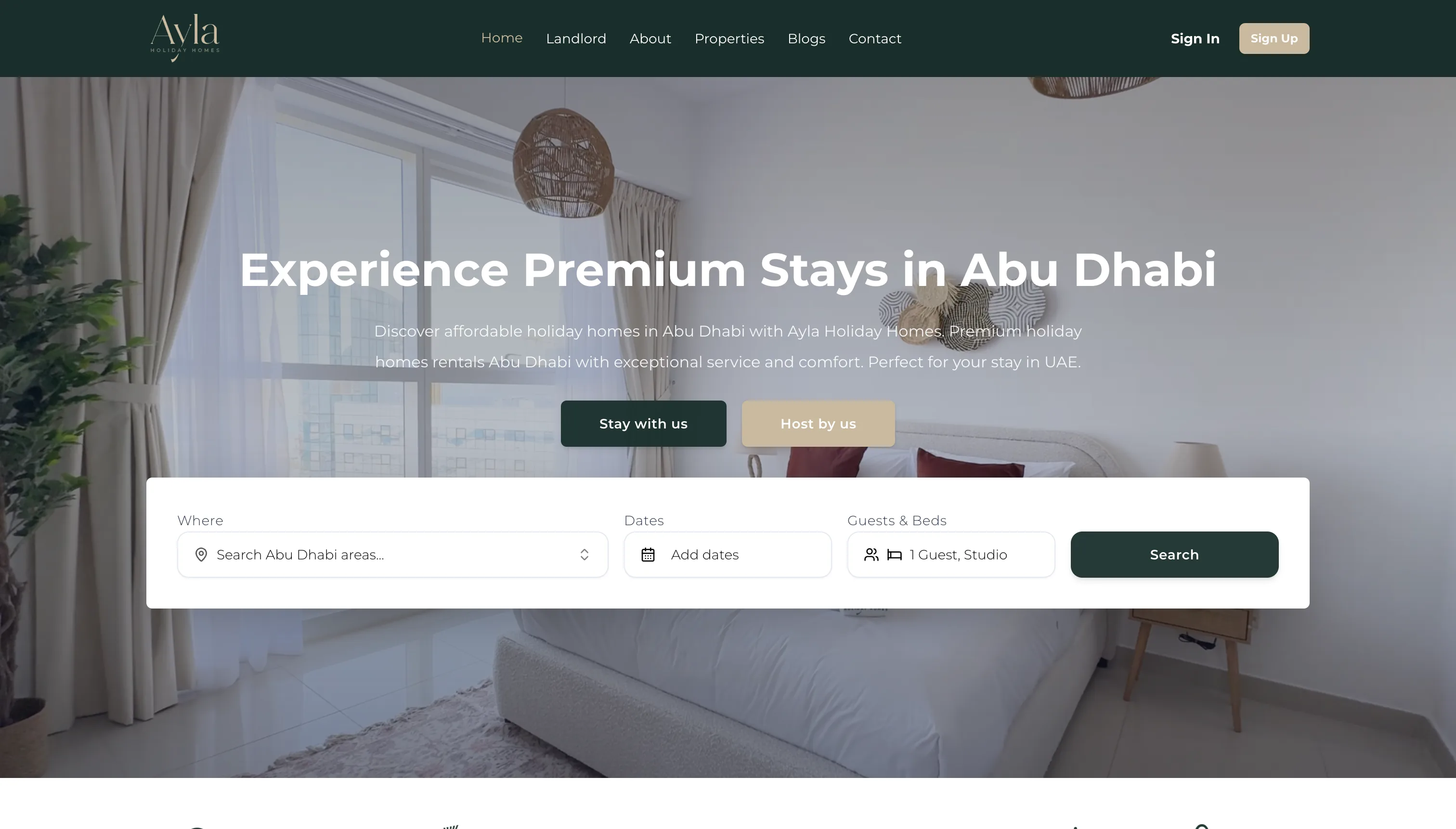
Ayla — 90 days post-launch
+27%
Chauffeur requests
Summit Limo — 90 days post-launch
Estimated impact, ~90 days post-launch.
16 brands and products shipped — across the UAE and beyond
(✦) — The market
What delivering digital work in Abu Dhabi actually involves
01
Arabic as the primary language
Arabic carries more weight in Abu Dhabi than it does in Dubai — for public-sector-adjacent audiences it is often what gets read first. Names, documents, content and interfaces are written and designed to the same standard as English rather than treated as a secondary version.
02
Accessibility and clarity that hold up
Interfaces use semantic structure, keyboard navigation, tested contrast and screen-reader support. Brand and document assets remain legible at the sizes and in the formats reviewers actually receive.
03
Documented and handover-ready
Procurement asks for things many agencies do not prepare: scoped deliverables, architecture or design notes, clear ownership and the licence position of every asset. You get work another team can take over without archaeology.
04
Sector fit
Energy, public sector, real estate and professional services dominate here. Those buyers value restraint, clarity and evidence over visual noise, so the work has to read as substantial because the organisation is.
(01)
Designing here
What web design in Abu Dhabi has to get right
04 / 04
01
The site gets read, not skimmed
A Dubai buyer often decides alone and quickly. In Abu Dhabi the site gets circulated — forwarded to a manager, opened in a meeting, checked by someone whose job is to find the gap. Design that wins a five-second comparison is not the same skill as design that holds up on the third reading.
So structure matters more than flourish. Every claim needs its evidence nearby, scope and process need to be legible without a call, and the pages people actually forward — capability, credentials, contact — have to stand on their own out of context. A site that only works when you are in the room is not doing its job here.
02
Arabic is the primary language, not the second version
In Abu Dhabi the Arabic version is frequently the one that matters, and treating it as a translation layer bolted onto an English design shows immediately: line breaks in the wrong places, a typeface with no real Arabic weight range, numerals and dates in the wrong convention, and a right-to-left layout that was mirrored rather than laid out.
Where the audience is Arabic-first we design the Arabic first, choose a typeface for reading at body size rather than for a logo, and lay out right-to-left properly. Both versions get their own URLs and metadata, so neither is a second-class citizen to a visitor or to a search engine.
03
Accessibility and documentation are review criteria here
In this market accessibility is not the nice-to-have that gets dropped when the deadline moves. It appears in requirements and someone checks it: contrast ratios, keyboard navigation, visible focus states, alt text that says something, headings in a real order, and form labels actually attached to their fields.
The same applies to documentation. We hand over a site with its structure explained, its content model written down and its deployment reproducible — because "what happens if you disappear" gets asked here far more often than it does across the border, and it deserves a better answer than reassurance.
04
What it costs, and how the number survives approval
A marketing website runs AED 5,000 to 20,000 and launches in three to five weeks. That range covers a lot of variation, so the quote arrives itemised — design, build, content structure, bilingual setup, handover — rather than as a single figure with a signature line under it.
Itemised is the point. A number that has to clear internal approval or procurement must be defensible line by line, and "AED 18,000 for a website" is not defensible to a finance reviewer who has never commissioned one. You own every file at the end, which is usually the second question that gets asked.
(02) — What's included
Government-adjacent and enterprise buyers apply scrutiny that loosely specified digital work does not survive. These are the areas that decide whether it clears review.
They genuinely understood how our guests browse. Direct bookings come straight through the site now, and I spend far less time going back and forth on WhatsApp.
Our office is in Dubai and we serve Abu Dhabi from there — it's a ninety-minute drive, so we come on site for kickoffs, workshops and key reviews. We're straight about this rather than claiming a presence we don't have.
Can you work with procurement and tender requirements?+
Yes. We can supply scoped proposals, documented deliverables, accessibility statements and a clear breakdown of what's included — the material procurement typically asks for before sign-off.
Is the Arabic work handled properly?+
Yes. Arabic writing and typography are handled as primary deliverables, with right-to-left layouts and separate indexed URLs where the project includes an interface or website. We do not machine-translate English work and call it bilingual.
What is the cost of Web Design in Abu Dhabi?+
Published prices for Web Design: Marketing website: AED 5,000 – 20,000. The final quote depends on the agreed scope and integrations. Send your brief for an itemised proposal.
Can you meet accessibility requirements for work that gets reviewed?+
Yes. For digital products that means semantic structure, keyboard navigation, tested contrast and screen-reader support. For brand and document deliverables it means legibility, usable formats and clear application rules. The applicable requirements are documented in the scope.