Web Apps
15 min read
UAE E-Invoicing Integration in Dubai (2026)
What the UAE FTA e-invoicing mandate requires: the phased timeline, the 5-corner PEPPOL model, PINT AE format, ASP integration, and how to prepare your systems.
By NxFold
Updated 4 Sept 2026
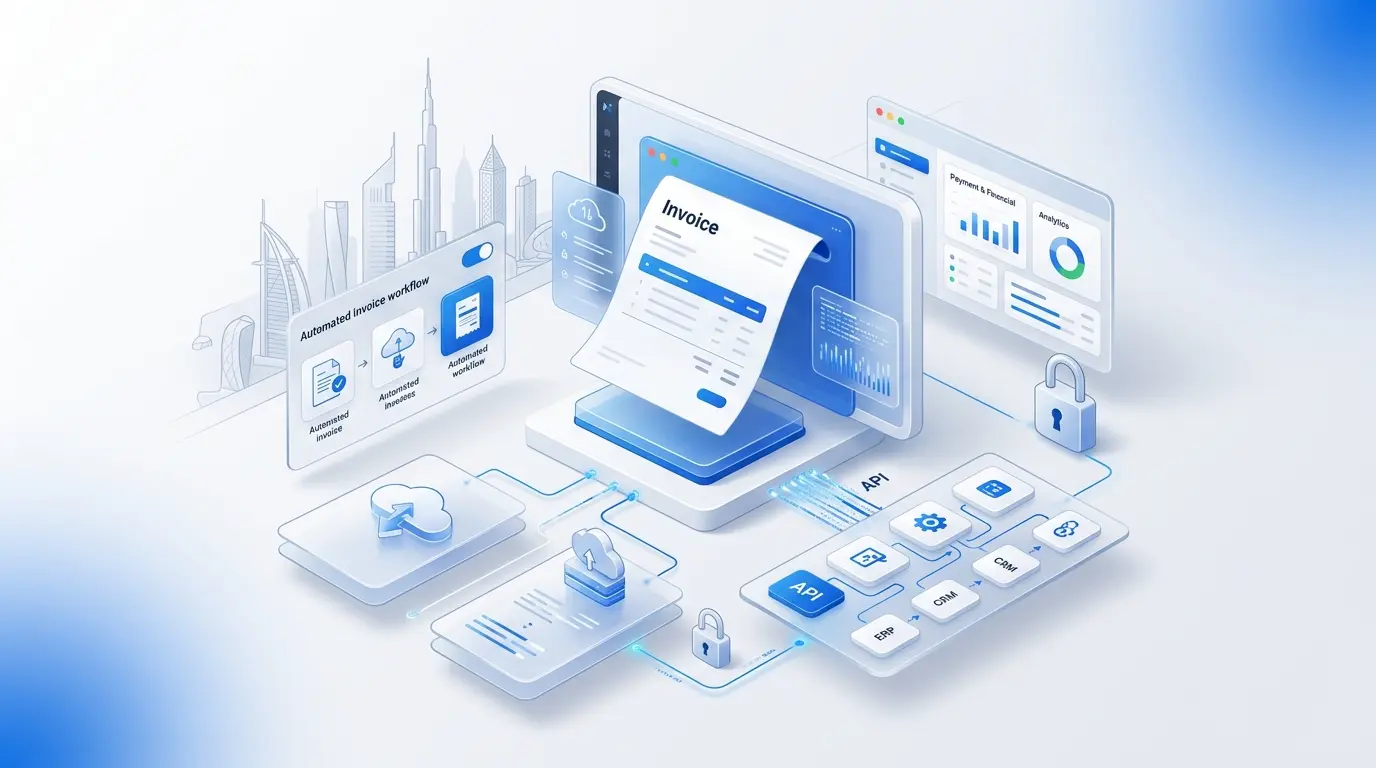
For years, "e-invoicing" in the UAE meant emailing a PDF instead of printing one. That definition is about to become legally obsolete. The Federal Tax Authority's new mandate replaces the PDF-and-email habit with a structured, machine-readable system that routes every qualifying invoice through an accredited intermediary and reports it to the tax authority in near real time. A PDF is a picture of an invoice; what the FTA now requires is invoice data — and the difference is the entire integration project most businesses are about to discover they need.
This guide is written for the people who actually have to make their systems comply: founders, finance leads, and the developers who own the billing code. It covers what the mandate requires, the phased timeline and who's in scope when, how the five-corner PEPPOL model actually moves an invoice from your system to your customer and the FTA, what integrating your ERP or custom billing software genuinely involves, and the mistakes that turn a manageable compliance project into a scramble weeks before a deadline.
The Short Answer
If your business is VAT-registered in the UAE and issues business-to-business (B2B) or business-to-government (B2G) invoices, you will need to issue those invoices as structured electronic documents through an Accredited Service Provider (ASP), in a specific XML format (the PINT AE data dictionary), routed over the PEPPOL network, with the data reported to the FTA. This isn't optional software modernization — it's a legal mandate with monthly penalties for non-compliance, rolling out in phases through 2026 and 2027.
The single most important thing to understand: your accounting or ERP system almost certainly cannot produce a compliant invoice on its own today. Nearly every system needs an integration layer to an ASP that transforms your invoice data into the required format, validates it, and handles the reporting. The businesses that treat this as an early, planned integration project will absorb it cleanly. The ones that wait until the deadline month will be integrating under pressure, which is where compliance projects go wrong.
What the Mandate Actually Is
The UAE e-invoicing framework rests on a set of decisions issued in 2025 — principally Ministerial Decision No. 243 of 2025 (establishing the electronic invoicing system), Ministerial Decision No. 244 of 2025 (implementation requirements), Ministerial Decision No. 64 of 2025 (the ASP accreditation scheme), and Cabinet Decision No. 106 of 2025 (the penalties). Together they define a mandatory, structured e-invoicing regime, not a voluntary best practice.
"Structured" is the operative word. A compliant e-invoice is not a PDF, a scanned image, or a Word document. It is a machine-readable XML file conforming to the PINT AE data dictionary — the UAE's localized version of the international PEPPOL invoice standard. The receiving system (and the FTA) parse it as data, field by field, not as a document a human reads. That is precisely why existing "we email PDF invoices" workflows don't satisfy the mandate, no matter how professional the PDF looks.
The Five-Corner Model: How an Invoice Actually Moves
Most international e-invoicing runs on a "four-corner" model: seller, seller's service provider, buyer's service provider, buyer. The UAE adds a fifth corner — the FTA itself — so the tax authority receives the invoice data as part of the same flow. Understanding this flow is the key to understanding what you actually have to build.
The journey of a single invoice looks like this:
- Corner 1 — Your system (the supplier's ERP or billing software) generates the invoice data.
- Corner 2 — Your Accredited Service Provider (ASP) receives that data, transforms it into PINT AE-compliant XML, runs technical and VAT validations, and routes it onward.
- Corner 3 — The buyer's ASP receives the invoice on the customer's behalf.
- Corner 4 — The buyer's system ingests the invoice as structured data.
- Corner 5 — The FTA platform receives the reported invoice data for VAT compliance and monitoring.
The PEPPOL network is the secure exchange infrastructure connecting these corners. The critical implication for a business: both you and your customer need an ASP. You don't control your customer's side, but you are responsible for getting your invoice correctly into the network from your end — which is the integration this whole guide is about.
The Timeline: Who Complies When
The rollout is phased by business size, and the dates are staggered so larger businesses go first. As currently published, the structure looks like this:
| Phase | Who | Revenue threshold | Go-live (as published) |
|---|---|---|---|
| Pilot / voluntary | Any business that opts in | None | From mid-2026 |
| Phase 1 | Large businesses | AED 50 million+ annual revenue | Early 2027 |
| Phase 2 | Smaller businesses | Below AED 50 million | Mid-2027 |
| Phase 2 | Government entities | N/A | Later in 2027 |
Before each go-live, in-scope businesses must have appointed an ASP — the appointment deadlines sit a few months ahead of each mandatory start date. One honest caveat worth building into your planning: UAE e-invoicing dates have been refined more than once across successive guidance versions, so treat these as the current published structure rather than immovable fixtures, and confirm the exact dates for your revenue band against the latest FTA guidance. What is not likely to change is the sequence — large businesses first, smaller businesses and government following — or the direction of travel. If you're above the AED 50 million line, you are in the first mandatory wave and should be treating this as a 2026 project, not a 2027 one.
What's In Scope and What Isn't
The mandate does not cover every transaction. As currently defined:
In scope: Business-to-business (B2B) and business-to-government (B2G) transactions by VAT-registered businesses.
Out of scope (for now): Business-to-consumer (B2C) transactions, VAT-exempt or zero-rated financial services, and certain international airline transactions. Businesses that fall outside the mandate can generally still opt in voluntarily, without exposure to the non-compliance penalties.
This B2B/B2G-first scoping matters for how you build. If you run a B2B SaaS product or a services business invoicing other companies, you're squarely in scope. If you run a pure B2C e-commerce store, the mandate doesn't hit your customer invoices yet — but it may still affect the invoices your suppliers send you, and the scope has a clear direction of expansion, so building your systems to handle structured invoicing now is a defensible bet rather than premature work.
What Integration Actually Involves
Here's the part most "what is e-invoicing" articles skip: the actual engineering. Your accounting or ERP system produces invoice data in its own internal format. The FTA requires PINT AE XML, validated and routed through an ASP. Bridging that gap is the integration project, and there are three broad approaches depending on your volume and system landscape.
API-based integration connects your system directly to your ASP's API, so invoices flow in real time as they're created. This is the right fit for higher-volume businesses and for anyone building on custom software, because it keeps the whole process automated end to end — an invoice created in your system is validated, converted, transmitted, and reported without a human touching it. This is the same class of systems-integration work covered in our custom software development guide, and if you've already built a custom billing or subscription system, adding an ASP integration is a well-bounded extension of it rather than a rebuild.
Middleware / connector layer sits between your systems and the ASP, mapping and enriching data along the way. This suits businesses running multiple systems (say, one ERP for finance and a separate platform for a specific business line) that all need to feed the same compliance pipeline. It's more moving parts, but it centralizes the transformation logic in one place.
File-based batch processing — generating XML or structured files and uploading them to the ASP in batches — is the lowest-tech option, appropriate for lower-volume businesses that don't need real-time flow. It's the least automated and the most prone to manual error, but it's a legitimate starting point for a small operation.
For most businesses building on modern custom software or a SaaS product, API-based integration is the right target, because it makes compliance an invisible background process rather than a recurring manual task. This connects directly to the kind of workflow automation covered in our business process automation guide — e-invoicing is, at its core, a compliance workflow that should run itself once built correctly.
The Data Problem Nobody Budgets For
The technical integration — connecting to an ASP's API — is usually the smaller part of the project. The larger, consistently underestimated part is master data quality.
PINT AE XML is strict. Every invoice needs correctly structured data: valid tax registration numbers for both parties, correct tax treatment codes, properly formatted line items, accurate customer identifiers, and more. Systems that have been quietly tolerating messy data — a customer record missing a TRN, inconsistent product codes, free-text fields where structured codes belong — will start failing validation the moment invoices have to be machine-readable and validated at the ASP.
This is why the preparation checklist that tax advisors publish always includes a data-quality audit, and why the businesses that sail through are the ones that cleaned up their customer and product master data before wiring up the integration. A validation rejection at the ASP isn't a suggestion — it's an invoice that didn't get issued, which is both a business problem and, past the deadline, a compliance one.
Storage, Archiving, and the Audit Trail
Compliant e-invoices and related documents (credit notes, and so on) must be stored within the UAE, in line with the Tax Procedures Law. For a business build, this reinforces a point from our data protection and PDPL guide: where your data physically lives is a compliance decision, not just an infrastructure convenience. Financial and tax records carry their own residency and retention expectations that sit alongside the general data-protection rules, and an e-invoicing system needs to keep a durable, auditable record of every invoice, its validation status, and its acknowledgements across all five corners.
Building this properly means designing the audit trail up front — logging each invoice's journey (created, validated, transmitted, acknowledged, reported) so that if the FTA ever queries a transaction, you can produce the full lifecycle rather than reconstructing it from scattered logs. That's a design decision made cheaply at the start and expensively later.
The Penalties, and Why the Math Favors Early Action
The penalty schedule is what turns this from a nice-to-have into a board-level deadline. The published penalties include a monthly charge for failing to implement the system or appoint an ASP, a per-invoice penalty for failing to issue e-invoices on time (capped monthly), a daily penalty for failing to report system failures, and a daily penalty for failing to notify your ASP of relevant data changes within the required window (five business days).
The specifics matter less than the shape: these are recurring penalties — monthly and daily — not one-off fines. A business that misses its deadline isn't paying a single fee; it's bleeding a monthly amount until it complies, while also doing the integration under exactly the time pressure that produces bugs. The math is lopsided in favor of building early: the cost of a planned integration done calmly is fixed and known, while the cost of a late one is the integration plus accumulating penalties plus the operational disruption of invoices that can't be legally issued.
Common Mistakes We See
Treating it as an accounting problem instead of a systems problem. E-invoicing touches tax, but the work is integration engineering. Finance can select an ASP; someone has to actually connect it to the systems that generate invoices.
Assuming the accounting software vendor will "just handle it." Some platforms will offer ASP integrations or built-in compliance; many custom or older systems won't, and even vendor solutions need configuration and data cleanup. "Our software will update" is an assumption to verify, not rely on.
Leaving master data cleanup to the end. As above — this is the part that actually determines whether invoices pass validation, and it takes longer than the API integration itself. Starting it late is the single most common way these projects slip.
Forgetting the receiving side. Being able to issue compliant invoices is only half of it. As a buyer, your systems also need to ingest structured invoices from suppliers — which is its own (usually smaller) integration, but one that's easy to forget until a supplier's invoice arrives in a format your system can't read.
Waiting for perfect clarity on dates. Because the timeline has been refined across guidance versions, some businesses treat every date as provisional and do nothing. The sequence and direction are clear enough to start preparing now; the data cleanup and system assessment are valuable regardless of exactly which month the mandate bites.
How to Prepare: A Practical Sequence
The businesses that handle this well follow roughly this order:
First, confirm which phase you're in based on revenue, and note the appointment and go-live dates for your band. Second, run a gap assessment on your current invoicing systems — can they output structured data, and how cleanly? Third, audit and clean your customer and supplier master data, because this is the long pole. Fourth, select an Accredited Service Provider from the FTA's published list, evaluating them on integration method (API vs. file), support quality, and fit with your systems. Fifth, build and test the integration — ideally during the voluntary/pilot window, so you're validating against the real network before it's mandatory. Sixth, train the finance and operations teams on the new flow, including how to handle rejections and re-issuance.
If you're building or already run custom software for billing, invoicing, or a SaaS subscription product, the ASP integration is a well-scoped addition — but it's genuinely worth doing during the pilot window rather than the deadline month, for the same reason you test any integration before it carries production load.
Frequently Asked Questions
Does the e-invoicing mandate apply to my business? If you're VAT-registered in the UAE and issue B2B or B2G invoices, yes — you'll be in scope in one of the rollout phases based on your revenue. Pure B2C invoicing is currently out of scope, though your supplier invoices may still be affected, and voluntary opt-in is available.
Can I just keep emailing PDF invoices? No. A compliant e-invoice is structured machine-readable XML (PINT AE format) exchanged through an accredited provider and reported to the FTA. A PDF, however polished, is not a compliant e-invoice under the mandate.
What is an Accredited Service Provider (ASP) and do I really need one? An ASP is an FTA-accredited intermediary that validates your invoice data, converts it to the required format, transmits it over the PEPPOL network, and reports it to the FTA. Both the issuer and the recipient of an invoice need an ASP — you cannot connect to the network directly as an ordinary business.
Will my existing accounting software work? Possibly, with an integration or update — but don't assume it. Most systems need an integration layer to an ASP, and even vendor-provided compliance features require configuration and clean master data. Verify your specific software's roadmap rather than assuming it's covered.
How long does e-invoicing integration take to build? The API integration to an ASP is usually a well-bounded piece of work; the longer pole is almost always master data cleanup and validation testing. Businesses that start during the voluntary window and clean their data early absorb it comfortably; those that start in the deadline month tend to struggle.
What data format is required? Structured XML conforming to the PINT AE data dictionary — the UAE's localized version of the international PEPPOL invoice standard. This is a specific, validated format, not a generic XML export.
What are the penalties for non-compliance? The published penalties are recurring — monthly charges for failing to implement or appoint an ASP, per-invoice penalties for late issuance (capped monthly), and daily penalties for failing to report system failures or notify your ASP of data changes. Because they accrue over time, delay is expensive.
Where does e-invoicing data have to be stored? Compliant e-invoices and related records must be stored within the UAE in line with the Tax Procedures Law, which is a data-residency requirement to design into your system from the start rather than discover later.
The Bottom Line
The UAE e-invoicing mandate turns invoicing from a document-generation task into a systems-integration one. For any VAT-registered business issuing B2B or B2G invoices, the question isn't whether to comply but when — and the businesses that treat it as a planned integration project, cleaning their data and testing against the network during the voluntary window, will absorb it far more cheaply than those integrating under deadline pressure while penalties accrue. The technical work (connecting to an ASP) is bounded and well understood; the data quality and the timing are where projects succeed or slip.
If you're building or running custom software that generates invoices — an ERP, a billing system, or a SaaS subscription product — and want the e-invoicing integration handled as a clean, tested piece of engineering rather than a last-minute scramble, get in touch and we'll help you scope the ASP integration, the data cleanup, and the audit trail before the deadline gets close.
Have a project in mind?
Ideas to put into practice.
Turn what you have learned into a clearer plan for your website or product. Tell us what you want to build.
Start your project