Mobile Apps
8 min read
Marketplace App Development in the UAE
Building a two-sided marketplace for a GCC audience — cold start, trust, Arabic-first architecture, and what an MVP realistically costs.
By NxFold
Updated 7 Sept 2026
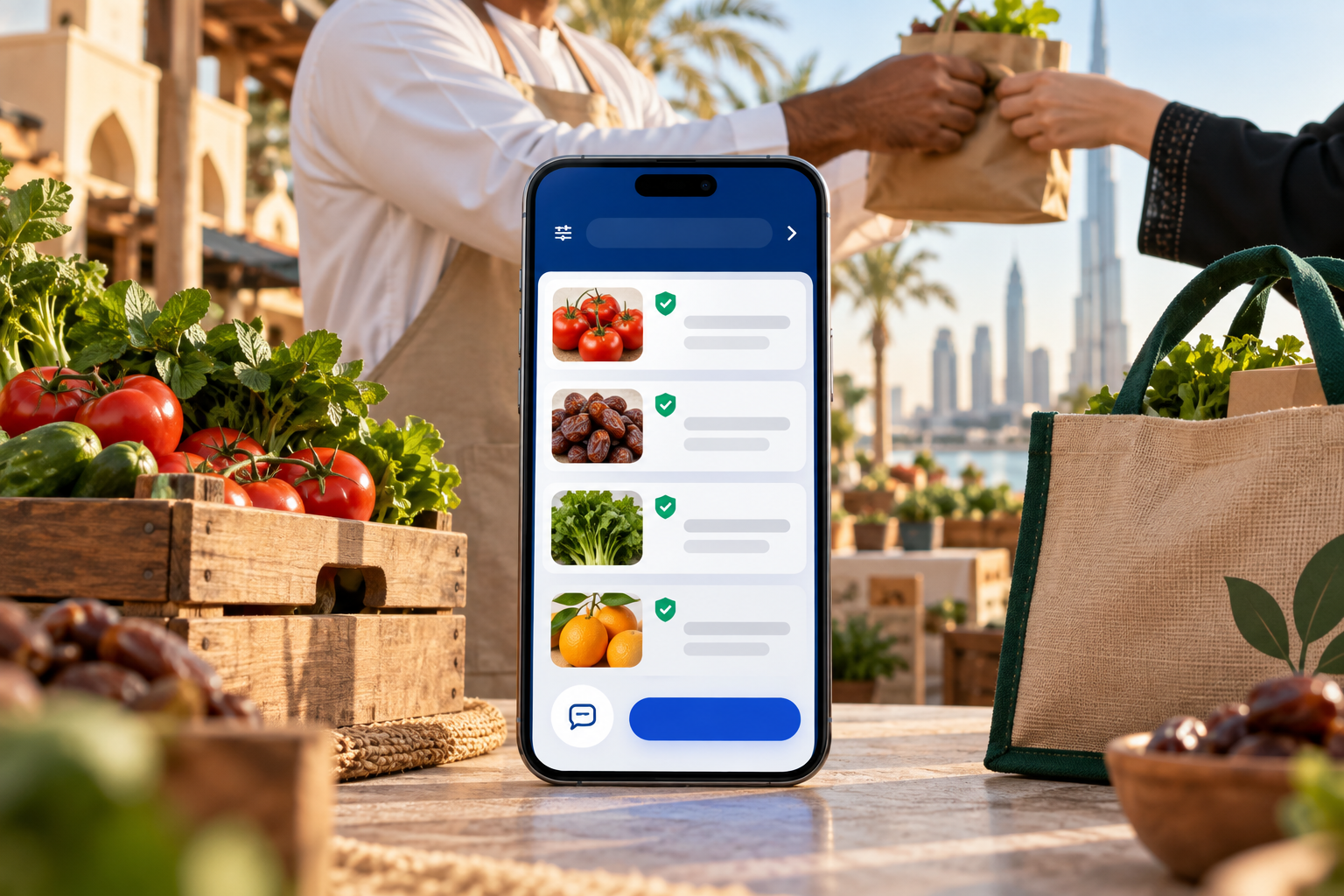
Most marketplace ideas in this region start from the same observation: a trade that already happens, happening badly. Farm produce sold through WhatsApp groups. Equipment rented by phone call. Services arranged through a cousin who knows someone.
The trade is real, the demand is proven, and the software is obviously missing. That is a much better starting point than inventing demand — and it still fails most of the time, because the hard parts of a marketplace are not the app.
The Short Answer
A two-sided marketplace has two problems that software does not solve: cold start (an empty marketplace is useless to both sides, so who shows up first and why) and trust (strangers transacting without the social guarantees that made the WhatsApp version work).
Everything technical — listings, search, messaging, payments — is well-understood and buildable. Whether your marketplace survives depends almost entirely on how you answer those two, and they are answered with business decisions, not features.
When we built Halaly, an Arabic-first marketplace for farm products and services, the trade was already happening in WhatsApp groups and physical markets. The build was Arabic-first and right-to-left from the architecture up, with verified profiles and category-specific discovery doing the trust work.
Cold Start: Pick a Side
The mistake is launching to both sides equally and getting a thin version of each.
Build for supply first when the sellers are identifiable and few. If you can name two hundred farms, workshops or suppliers, go and onboard them by hand before the app is finished. Supply that exists is a reason for buyers to come; buyers browsing an empty catalogue never come back.
Build for demand first when supply will follow money. If sellers are numerous and will list anywhere there is a buyer, aggregate demand first — even manually, even in a spreadsheet — and sellers arrive on their own.
Narrow the market until it is dense. This is the single most reliable move and the one founders resist. A marketplace that is thin across the whole UAE is dead; one that is dense in a single category in a single emirate is alive. Halaly worked because it started with a specific community and a specific category rather than "an app for everything agricultural."
The test: could a user open the app on a random Tuesday and find something worth having? If not, you are not ready to launch to that side.
Trust: Replacing What WhatsApp Provided
The informal version worked because everyone was in the same group, someone vouched for someone, and reputation was social. An app removes all of that and has to rebuild it explicitly.
Verified profiles. Not a blue tick — verification proportionate to the risk. Phone verification is the floor. Trade licence, Emirates ID or a physical address matters where transactions are large.
Structured listings. Free-text listings are where fraud and confusion live. Category-specific fields — quantity, grade, location, availability window — make listings comparable, searchable and much harder to fake convincingly.
In-app messaging. Keeping the conversation in the app is not about control; it is that a dispute you cannot see is a dispute you cannot resolve. Expect users to try to move to WhatsApp immediately, and design for the ones who do not rather than fighting the ones who do.
A dispute path that exists. Even a manual one. Users will forgive a problem; they will not forgive having nowhere to take it.
Ratings, carefully. Two-sided ratings work when there is enough volume for them to mean something. In a thin marketplace they are noise, and a single bad rating can end a seller's participation. Introduce them when density justifies it.
Arabic-First Is an Architecture Decision
If your audience reads Arabic first, this is not a translation task and it is not something to add in phase two.
Right-to-left affects the layout system, navigation direction, gesture direction, icon mirroring, number and date formatting, and typography metrics — Arabic needs different line heights and weights than Latin at the same nominal size. Retrofitting it into a finished app means revisiting every screen, which routinely costs more than building it in from the start would have.
The detail worth stating plainly: some things mirror and some must not. Layout and navigation mirror. A play button does not. A logo does not. Getting this wrong is the most visible sign an Arabic app was built in English first.
Halaly was built right-to-left from the architecture up, which is why it feels native rather than translated. The web equivalent of this argument is in Arabic website design in Dubai.
The MVP Feature Set
What v1 needs:
- Listing creation that takes under two minutes on a phone, with photos.
- Discovery — category browse plus search plus location filter. In a thin marketplace, browse matters more than search.
- Messaging between buyer and seller.
- Verification at whatever level the transaction value justifies.
- A basic admin to remove listings, resolve disputes and see what is happening.
What to leave out deliberately: in-app payments (unless the transaction genuinely completes in-app), ratings, recommendations, saved searches, social feeds, and anything described as "like Instagram but for X."
Payments deserve their own decision. Many marketplaces in this region work perfectly well with the transaction happening offline — the app makes the match, the parties settle between themselves. That is not a failure; for high-value or negotiated goods it is what users want. Taking payments in-app means handling escrow, payouts to sellers and dispute-driven refunds, which is a significant compliance and engineering commitment. Do it when you can name the reason. The landscape is covered in payment gateway integration in Dubai.
Technology
Cross-platform native — React Native or Flutter — is right for almost every marketplace. Halaly is React Native with Expo and Supabase, which is a fast and entirely adequate stack for this shape of product.
The part worth engineering properly from the start is data modelling for categories. Marketplaces expand by category, and a schema that hard-codes the fields of your first category makes the second one a rewrite. Category-specific attributes should be data, not code.
Multi-tenancy generally does not apply here — a marketplace is one tenant with many users — but the scaling questions overlap, and multi-tenant SaaS architecture for UAE startups covers the adjacent territory.
What It Costs and How Long It Takes
A marketplace MVP with listings, discovery, messaging, verification and an admin panel is typically twelve to twenty weeks, including store submission. Arabic-first adds design and QA time but far less than retrofitting would.
The cost that surprises founders is after launch: moderation, dispute handling, and the manual work of keeping supply and demand in balance while the network is thin. Budget operational capacity, not just build cost. For broader ranges, mobile app development in Dubai and custom software development in Dubai both apply.
Frequently Asked Questions
Which side do we build for first? Supply, if sellers are identifiable and few enough to onboard by hand. Demand, if sellers are numerous and will follow buyers. Either way, narrow the category and geography until the marketplace is dense enough that a visitor finds something worth having on a random day.
How do we handle trust between strangers? Verification proportionate to transaction value, structured listings rather than free text, in-app messaging so disputes are visible, and a dispute path that exists even if it is manual. Ratings only once volume makes them meaningful.
What does Arabic-first actually change? The layout system, navigation and gesture direction, icon mirroring, number and date formatting, and typography metrics. It is an architecture decision, not a translation, and retrofitting it into a finished app costs more than building it in.
Do we need in-app payments in v1? Often no. Many regional marketplaces work well with the match happening in-app and settlement offline, particularly for negotiated or high-value goods. In-app payments mean escrow, seller payouts and refunds — real compliance work. Do it when you can name the reason.
What does an MVP cost and how long does it take? Twelve to twenty weeks for listings, discovery, messaging, verification and an admin panel, including store review. Post-launch moderation and balancing supply and demand are the costs founders most often forget to budget.
How do we stop users moving the conversation to WhatsApp? You largely do not, and fighting it is a poor use of energy. Make the in-app experience good enough that some stay, keep enough of the transaction in-app that you can help when something goes wrong, and accept that a chunk of every marketplace leaks to chat.
Can one app serve several categories? Yes, if the data model treats category attributes as data rather than hard-coded fields. That single decision is what makes the second category a configuration change instead of a rewrite.
React Native or Flutter? Either. Halaly is React Native with Expo. Choose on team familiarity rather than on benchmarks — both are more than adequate for a marketplace, and the differences will not decide whether the product succeeds.
The Bottom Line
The app is the easy part. What decides a marketplace is whether you picked a market narrow enough to become dense, and whether you rebuilt the trust the informal version got for free.
Start with a category and a community you can name. Onboard the first side by hand. Build the trust mechanisms deliberately rather than assuming reputation will emerge. And if your users read Arabic first, build it that way from the architecture up — that decision is difficult to reverse and cheap to make correctly at the start.
If you are scoping a marketplace for a GCC audience, get in touch. We have built one that real communities use daily, and we will tell you honestly if the cold-start plan is the weak part. The build side sits under mobile app development and the product context under SaaS and startup product development.
Have a project in mind?
Ideas to put into practice.
Turn what you have learned into a clearer plan for your website or product. Tell us what you want to build.
Start your project