Sports Booking Apps
8 min read
Sports Booking App Development in Dubai
What a padel, football or fitness booking app needs in the UAE — sessions, spot counts, payments and cancellations — and what an MVP costs to build.
By NxFold
Updated 7 Sept 2026
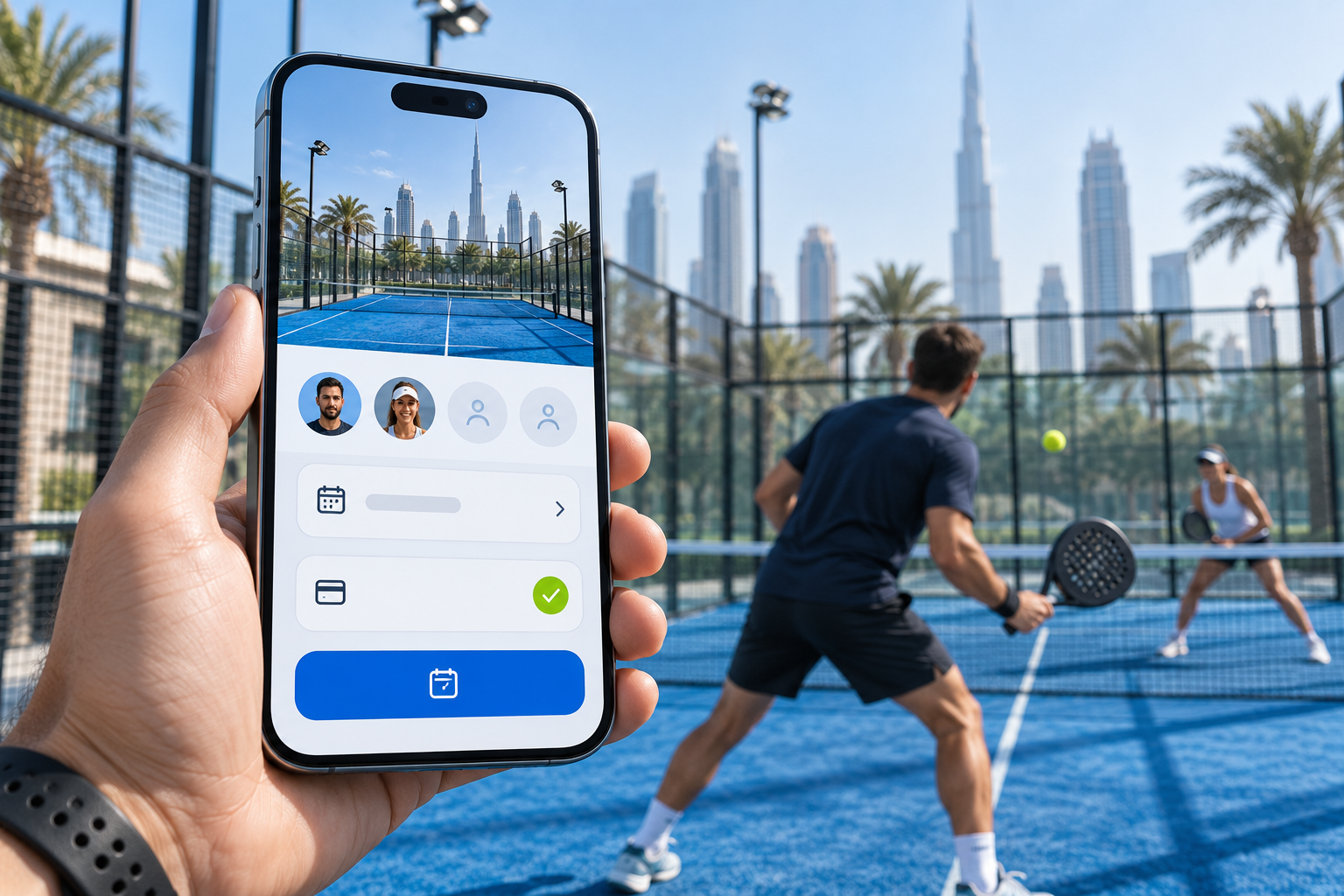
Almost every recreational sports community in Dubai runs on WhatsApp groups, and almost every one of them has outgrown it.
The pattern is identical whether it is padel, football, volleyball or a running club. Someone posts a session. Replies scroll past. Nobody is sure how many spots are left. Payment is chased individually. Half the people who would have come never find out in time, and the organiser spends their evening doing admin instead of playing.
That gap between interest and a confirmed booking is where the demand leaks, and it is the thing a booking app actually fixes.
The Short Answer
A sports booking app is not a calendar. It is three things working together: a session feed with live spot counts, a payment that clears in the app, and a cancellation policy the system enforces so the organiser does not have to.
Everything else — profiles, chat, leaderboards, streaks — is optional and usually a distraction in v1. The apps that die are the ones that shipped social features before they solved "how many spots are left and can I pay for one right now."
When we built PlanDXB for the Kite Beach volleyball community, the entire design ran through the moment of decision: browse by sport and level, see who is already in, confirm a spot in two taps. Sessions, courts and cancellations are managed from one place, and payment clears in-app through Ziina.
The Features That Actually Fill Courts
A single session feed. Every open session, sorted by time, with the spots remaining visible without tapping in. This one screen replaces the entire WhatsApp scroll and is most of the product's value.
Live spot counts. Not "limited spaces" — the actual number, updating as people book. Scarcity that is real and visible converts; scarcity that is vague does not.
Visible player lists. Who is already in, and at what level. This matters more in recreational sport than founders expect: people join sessions because of who else is going, and a beginner who can see it is a mixed-level session is far more likely to book than one who is guessing.
Recurring slots and series. Most communities play on a rhythm — Tuesday evenings, Saturday mornings. If the organiser has to recreate the session every week, they will drift back to WhatsApp. Recurring sessions with per-instance booking is the feature that keeps organisers on the platform.
A waitlist. Popular sessions fill. A waitlist that auto-promotes when someone cancels turns a cancellation from a loss into a fill, and it is the single highest-ROI feature after payments.
Cancellation rules the app enforces. Free cancellation up to X hours, partial or no refund after. The point is not to be strict — it is that the organiser stops negotiating individually with people they play sport with every week.
Payments in the UAE
This is where international guidance stops being useful.
Card payments work, but a meaningful share of UAE users prefer local wallets, and friction at the payment step is what kills conversion on a AED 50 session booking — the amount is small enough that any hassle makes people decide it is not worth it.
PlanDXB runs on Ziina, with Apple Pay and card as the methods users see. A regional processor matters for more than user preference: settlement, refunds and dispute handling all behave differently, and a stack built for a market with a different banking system will surface those differences at the worst moment.
The details worth scoping explicitly:
- Refunds tied to the cancellation policy, issued automatically rather than by the organiser doing manual transfers.
- No-show handling. Charging for a no-show is a policy decision with real community consequences — decide it before building it.
- Organiser payouts. If sessions are run by individuals rather than a facility, money is moving to third parties, which changes the compliance picture. Use a licensed processor's connected-accounts tooling rather than moving funds yourself.
The general landscape is covered in payment gateway integration in Dubai.
Native, Cross-Platform or Web?
For this category, cross-platform native is almost always right. PlanDXB is React Native and Expo, which is the pattern we would recommend for the majority of booking apps: one codebase, both stores, and access to push notifications — which matter enormously here, because a session with two spots left at 6pm is a notification, not an email.
A web app is tempting for cost reasons and usually wrong for a habit product. Booking a session is a repeat behaviour, and the friction of finding a browser tab is enough to lose it. If budget forces a choice, a well-built mobile web app that people bookmark is survivable — but plan for the app.
Fully native iOS and Android separately is justified only if you need deep platform integration this category does not typically require. For the cost comparison across approaches, mobile app development in Dubai has the current ranges.
Who Actually Buys This
Three distinct buyers, with different requirements:
Facility operators — padel clubs, football pitches, courts. They want utilisation: fill off-peak slots, reduce no-shows, stop taking bookings by phone. Their metric is court hours sold, and dynamic pricing by time slot matters to them.
Community organisers — someone running sessions on public or rented facilities. They want the admin to stop. Their metric is time saved and sessions filled, and they care far more about the waitlist and payments than about analytics.
Multi-venue operators and chains — wanting one app across locations, with per-venue permissions and consolidated reporting. This is closer to a platform build.
The reason to be clear about which you are is that the roadmaps diverge quickly. A facility wants pricing and utilisation; a community wants social visibility and simple money.
What It Costs and How Long an MVP Takes
An MVP with a session feed, spot counts, player lists, payments, cancellations and a basic organiser panel is a contained project — typically eight to fourteen weeks including store submission. The variables that move it most are payment complexity (single operator versus payouts to many organisers) and whether you need a venue-facing admin from day one.
What costs more than founders expect is the second phase — recurring sessions, waitlists, notifications tuned so they are useful rather than ignored. Budget for it rather than treating launch as the finish line.
Common Mistakes
Building social before booking. Chat, feeds and profiles are what people ask for and not what makes them book. Ship the transaction, then earn the social layer.
Hiding the spot count. The number is the reason to act now.
No waitlist. Every cancellation on a full session becomes an empty spot instead of a filled one.
Organiser tools as an afterthought. If creating a session takes longer than posting in WhatsApp, the organiser will post in WhatsApp.
Notifications that are not tuned. Over-notify and they get switched off, at which point your retention mechanism is gone permanently.
Assuming an international payment stack transfers. Local wallets and local settlement behave differently, and on a small transaction any friction is fatal.
Frequently Asked Questions
Can it handle padel courts and recurring slots? Yes, and recurring slots are usually the feature that decides whether organisers stay. Most communities play on a weekly rhythm, so sessions need to repeat with per-instance booking rather than being recreated each week.
Which payment methods work best in the UAE? Card plus local wallets. PlanDXB uses Ziina with Apple Pay and card as the visible methods. On a small session fee, payment friction is the main cause of abandonment, so the local option matters more than it would on a large purchase.
What does an MVP cost and how long does it take? Eight to fourteen weeks for a feed, spot counts, payments, cancellations and an organiser panel, including store review. Payment complexity and whether you need venue admin from day one are what move the estimate.
iOS and Android together? Yes — React Native or similar gives you one codebase and both stores. For this category the cross-platform trade-off is almost always worth it, and push notifications, which matter enormously here, are fully supported.
Can members book without downloading an app? You can offer a mobile web path for first-time users and it will convert some of them. But booking a session is a repeat habit, and habits live on a home screen. Treat web as the on-ramp, not the destination.
How do we stop no-shows? A cancellation window the app enforces, a waitlist that auto-promotes, and — if the community accepts it — a charge for late cancellation. The enforcement matters more than the penalty; organisers stop having the conversation.
Do we need player levels and ratings? Levels, usually yes — they help people pick the right session and reduce mismatched games. Competitive ratings, usually not in v1; they add complexity and can discourage the casual players who make up most of the volume.
Can one app cover several venues? Yes, with per-venue permissions and consolidated reporting, but that is a platform build rather than an MVP. Get one venue working properly first.
The Bottom Line
The problem is not that people do not want to play. It is that the distance between "I might" and "I am booked" is currently a WhatsApp thread, and most of the interest never survives the trip.
Close that distance — one feed, a real spot count, payment in the app, and rules the system enforces — and the sessions fill themselves. Everything else is a second-phase decision.
If you run a padel club, a facility, or a community that has outgrown its group chat, get in touch. We built exactly this for a Dubai beach volleyball community and can scope what yours needs. The vertical sits under sports and fitness booking app development, and the build side under mobile app development.
Have a project in mind?
Ideas to put into practice.
Turn what you have learned into a clearer plan for your website or product. Tell us what you want to build.
Start your project