Holiday Home Websites
8 min read
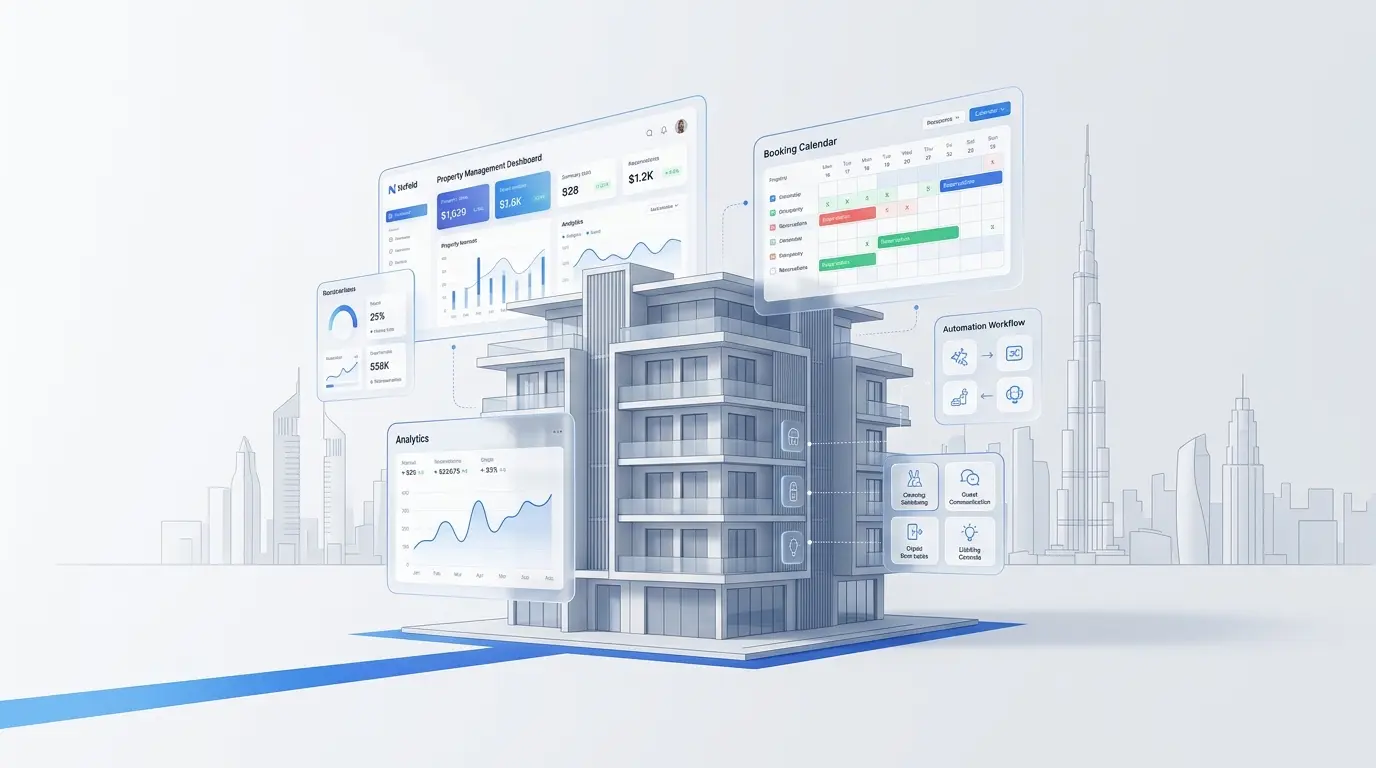
Channel Manager Integration for UAE Rentals
How a direct-booking site stays in sync with Airbnb, Booking.com, Vrbo and Expedia — via Hostfully, Guesty or a direct API — without double bookings.
By NxFold
Updated 7 Sept 2026
The day a short-term rental operator oversells a villa is the day they start caring about sync architecture. Until then it is an abstraction — a checkbox in a PMS, something the software presumably handles.
It mostly does. But the failure mode is expensive and public: an angry guest at 11pm, a refund, a one-star review, and a listing whose ranking takes months to recover. This guide is about the plumbing that prevents it, and about the decisions worth making deliberately rather than inheriting from whatever tool you signed up for first.
If you have not yet decided whether to build a direct channel, direct booking vs OTA commission in the UAE is the argument. If you are still choosing the platform that runs your units, holiday homes management software in Dubai is the buying guide. This one assumes both are settled and you are wiring it together.
The Short Answer
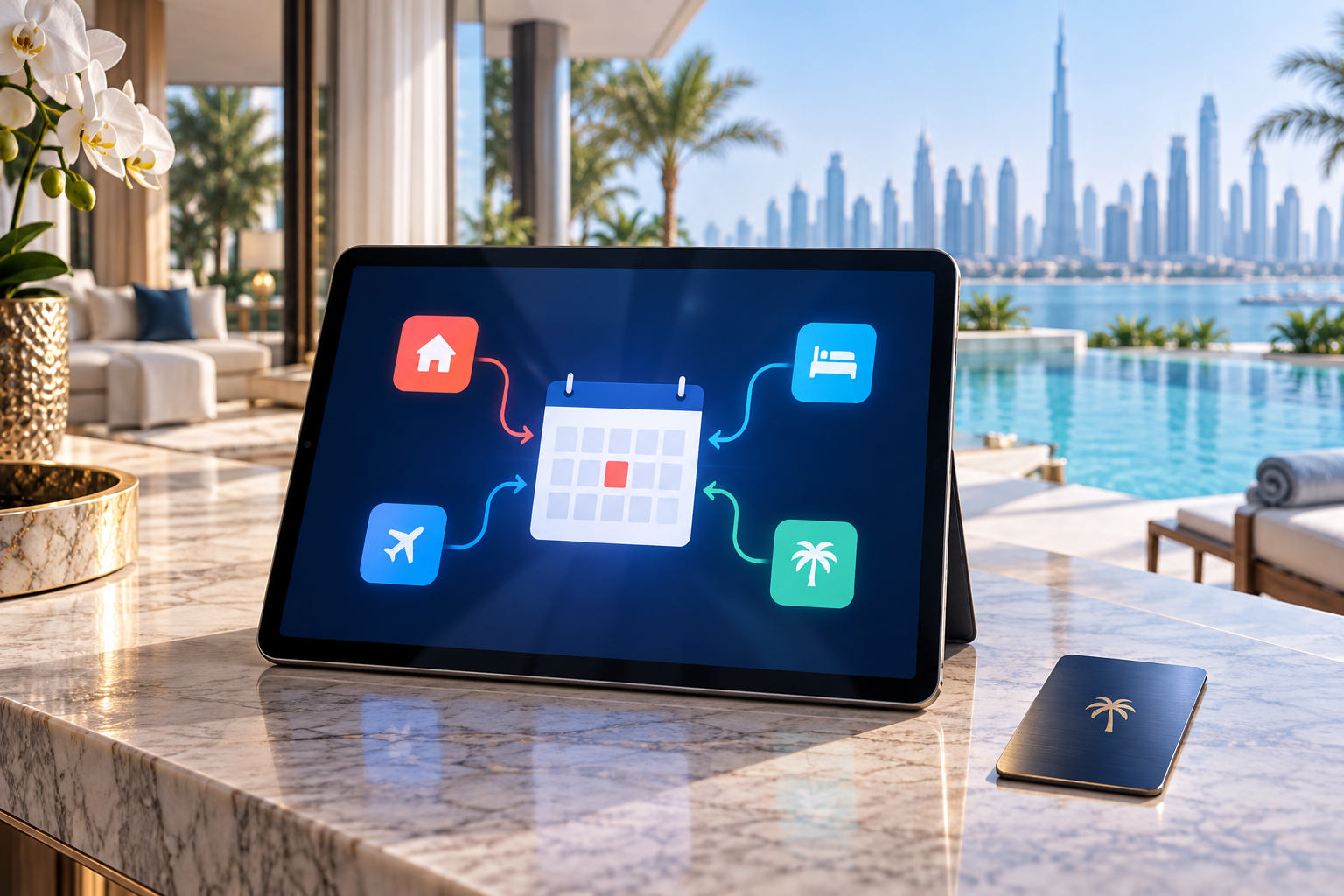
A channel manager keeps availability, rates and restrictions consistent across every channel you sell on. The engineering that matters is not the connection — those are standard — but three decisions:
- One calendar owns the truth. Every channel is a projection of it, never a peer.
- Updates are pushed, not polled. Webhooks propagate a block in seconds; a periodic sync propagates it in whatever your interval is, and the gap is where double bookings live.
- Failure is expected and reconciled. Channel APIs go down. The system must queue, retry, and detect divergence rather than drifting silently.
Get those right and the specific vendor matters much less than the sales pages suggest.
The Three Integration Shapes
PMS-led. You run a property management system — Hostfully, Guesty, Lodgify, Smoobu, Uplisting, OwnerRez — and it owns the channel connections. Your direct-booking site integrates with the PMS, not with the channels. This is the right default for almost everyone: the PMS maintains the connections, absorbs API changes, and you have one integration to build instead of nine.
When we built Ayla's direct-booking platform, this was the shape: the site reads availability from Hostfully and Guesty, which keep the major channels — Airbnb, Booking.com, Vrbo, Expedia, Agoda, Wego, Tripadvisor, Trip.com and Google Vacation Rentals — in step. One integration, many channels live.
Direct API to each channel. You connect to Airbnb, Booking.com and the rest individually. This gives maximum control and is almost always the wrong choice for an operator: it is several integrations to build, each with its own certification process, rate limits and breaking changes, and you inherit permanent maintenance. It makes sense if you are building a platform that others will use — which is a different business from running rentals.
iCal sync. The cheap option, and the one that causes the oversells. iCal is a file that gets fetched periodically — often every few hours — and carries availability only, not rates or restrictions. For a two-unit operator with low occupancy it is survivable. Above that, the polling interval is a window in which two channels can both sell the same night. Do not build a commercial direct-booking channel on iCal.
Preventing the Double Booking
The mechanism is simple to state and easy to get wrong.
One internal calendar is authoritative. Not "the PMS and the website stay in sync" — one of them is the source and the other reads. Two systems that each believe they own availability will eventually disagree, and the disagreement surfaces as a booking you cannot honour.
Webhooks drive updates. When a booking lands anywhere, the event should push outward immediately. Polling on a five-minute timer means a five-minute window; on an hourly timer, an hour. In peak season on a popular unit, that window is not theoretical.
Event processing is idempotent. Webhooks arrive late, out of order, and twice. A retried "new booking" event must never create a second reservation. This is the single most common source of data corruption in booking systems and it is entirely preventable with an idempotency key on every inbound event.
Divergence is detected, not assumed away. A reconciliation job that periodically compares your calendar against each channel's and flags mismatches is not optional at scale. Things will drift; the question is whether you find out from the job or from the guest.
Rates, Restrictions and the Bits People Forget
Availability gets the attention, but the other fields cause quieter problems.
Rates need to push outward from one place. If a manager updates a rate in the PMS and someone else updates it in the Airbnb extranet, you now have two truths and the next sync will silently overwrite one.
Minimum stay and changeover rules are frequently the thing that does not map cleanly. Channels model these differently, and a two-night minimum that translates into no minimum on one platform will produce bookings your operations cannot service.
Cancellation policies generally do not sync. They are configured per channel and drift apart over time. Audit them; a policy mismatch between your direct site and the OTAs is a dispute waiting to happen.
Which Channels Are Worth Being On
More is not better — every channel adds a surface that can break, and long-tail channels frequently deliver a handful of bookings a year for the same maintenance burden as a major one.
For the UAE, Airbnb and Booking.com carry the volume, and for most operators that is 80% of channel-sourced revenue. Vrbo and Expedia earn their place for larger units and family travel. Agoda and Trip.com matter for Asian source markets, which for Dubai is significant. Wego and Tripadvisor are worth having if the PMS supplies them for free. Google Vacation Rentals is increasingly worth the setup because it feeds the search surface directly.
The honest test: if a channel produces fewer bookings a year than it costs in reconciliation time, turn it off.
Where the Direct Site Fits
Your direct-booking site is a channel like any other, with one difference: you own it, so it can be the one that reads truth rather than one more thing to be synced.
The pattern that works is the site querying live availability at the moment the guest picks dates, rather than caching a copy. That is one API call on a page nobody loads casually, and it removes an entire class of stale-data bugs. Where you must cache for performance, cache short and always re-validate before payment — taking money for a night you cannot supply is the worst failure in the system.
On the manager side, the same architecture is what Superhomes runs on: channel-synced bookings and pricing across a large multi-channel portfolio, with a single plan holding it together. The operator-facing and manager-facing versions of this problem are the same problem at different scales.
Frequently Asked Questions
Do I need a PMS, or can I integrate with the channels directly? Use a PMS unless you are building a platform for others. Direct integration means several certifications, several sets of rate limits, and permanent maintenance as each channel changes its API. One integration to a PMS gets you every channel it supports.
How fast is sync in practice? With webhooks, seconds. With polling, whatever your interval is — and that interval is your double-booking exposure. With iCal, potentially hours, which is why it is not suitable for a commercial direct channel.
Will Airbnb penalise a lower rate on my own site? Rate parity terms generally prevent publishing a lower headline nightly rate. They typically do not restrict inclusions — late checkout, transfers, returning-guest benefits — which is where you compete without breaching anything.
What happens when a channel's API goes down? A well-built integration queues the updates and reconciles on recovery. A poorly built one drops them silently and drifts. Ask any vendor what happens during an outage; the answer tells you a lot.
Can it push to Google Vacation Rentals? Most major PMS platforms support it, and it is increasingly worth enabling because it places inventory directly into the search surface rather than behind an OTA.
How do I stop the same night selling twice? One authoritative calendar, webhook-driven propagation, and idempotent event handling so retries never duplicate. It is an architectural decision made once, not a feature toggled on later.
Do rates sync as well as availability? They should, in one direction only. Editing a rate in a channel extranet while the PMS also manages it creates two sources of truth and the next sync will overwrite one of them without warning.
How long does the integration take to build? For a direct-booking site reading from an established PMS, typically two to four weeks of the overall project. The variable is how clean the PMS's availability API is — that, not the page count, usually sets the timeline.
The Bottom Line
Channel integration is unglamorous infrastructure that decides whether everything above it works. The decisions are few and they are architectural: one calendar owns truth, updates push rather than poll, events are idempotent, and divergence is detected on purpose.
Get those right and you can add or drop channels as commercial decisions rather than engineering projects. Get them wrong and you will be refunding a guest at 11pm and wondering why the calendar said the villa was free.
If you are wiring a direct-booking site to an existing PMS, or your current setup has produced an oversell you cannot explain, get in touch — we have built this for UAE operators and can tell you where the gap is before it costs you another review. The vertical context sits on our holiday homes website development page, and the platform side under web app development.
Have a project in mind?
Ideas to put into practice.
Turn what you have learned into a clearer plan for your website or product. Tell us what you want to build.
Start your project