Web Design
8 min read
Restaurant and Cafe Website Design in Dubai
What an F&B site in Dubai needs to earn a walk-in — a readable menu, live hours, one-tap directions and the local SEO that puts you on the map.
By NxFold
Updated 7 Sept 2026
Most independent cafes and restaurants in Dubai have an Instagram account and no website, and for a while that works. Instagram is where the photography lives, where regulars follow along, and where a new opening gets noticed.
What Instagram cannot do is answer the question someone asks thirty seconds before deciding where to go: are you open, what do you serve, how much is it, and how do I get there. That question gets asked in Google Maps and in a search bar, and if the answer is not there, the visit goes somewhere else.
The Short Answer
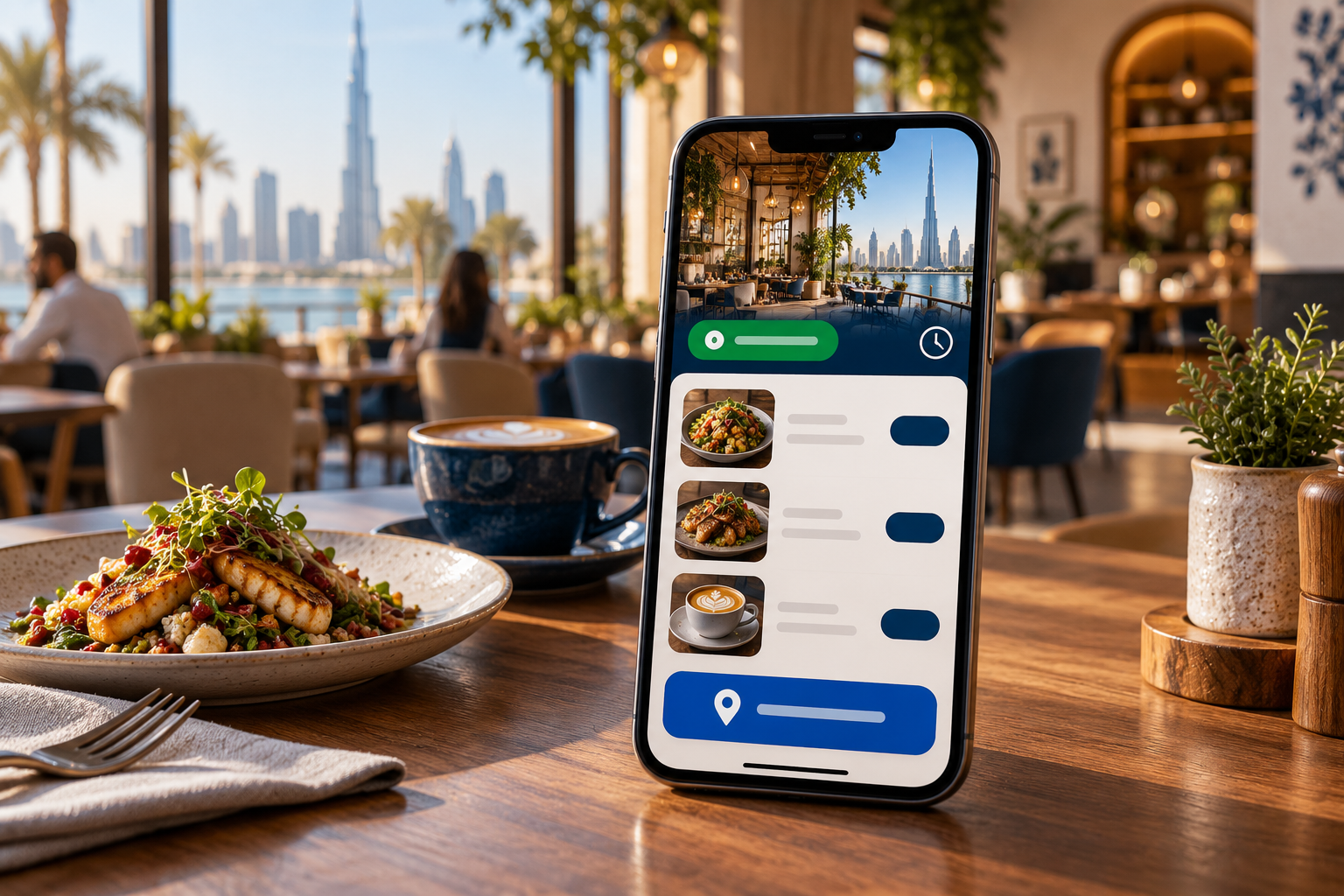
An F&B website in Dubai has one job — turn a nearby person deciding right now into someone walking through the door. That means four things, in this order:
- The menu, readable on a phone. Not a PDF.
- Live opening hours, including today's.
- One-tap directions, because parking is usually the real obstacle.
- Photography of the room, not only the food — people are choosing an environment.
Everything else is optional. A site that does those four well beats a beautiful one that hides the menu behind a download.
When we built Buna Labs, a specialty coffee shop in Jumeirah roasting Ethiopian beans in-house, the whole site is a single scroll: hero storytelling, a clear menu, live opening hours, one-tap directions, and a light/dark toggle, with a design language drawn from the shop's own materials. That is the right amount of website for a cafe.
The PDF Menu Problem
This is the most common and most costly mistake in F&B web design.
A PDF fails in every way that matters. It does not reflow on a phone, so the visitor is pinching and dragging. It is invisible to search, so "flat white Jumeirah" cannot find you. It is usually out of date, because updating it means going back to whoever made it. And it takes a tap and a wait before anyone sees a single item.
The menu should be HTML, on the page, with sections a thumb can scroll. Prices included — hiding them in F&B signals expensive without the benefit of actually being positioned as expensive. And it should be editable by the person who changes the specials, not by a developer.
Hours Are a Conversion Feature
Opening hours are the highest-traffic content on an F&B site and almost always the worst maintained.
Show today's hours prominently, not a table of seven rows the visitor has to parse. Handle the cases that matter here: Ramadan hours, public holidays, and the Friday pattern. A site that says "Open until 11pm" during Ramadan when you are closed until iftar is worse than no site — it sends people to a locked door and they do not come back.
The same information needs to be right on your Google Business Profile, and the two should agree. When they disagree, Google generally believes its own data and your website looks wrong.
Local SEO Is Most of the Work
For a single-location cafe, the website is supporting infrastructure; Google Business Profile is the main channel. Most people find you through Maps, not through a web search, and the profile is what wins that.
What the website contributes:
- Consistent name, address and phone matching the profile exactly.
LocalBusinessstructured data so search engines can read your hours, location and price range without guessing.- A neighbourhood page or section — Jumeirah, JLT, Al Quoz, Business Bay. "Specialty coffee in Jumeirah" is a real search with real intent and low competition.
- Speed. Someone standing outside deciding will not wait six seconds. Core Web Vitals for UAE businesses covers what to measure.
If you have multiple branches, each gets its own page with its own hours, directions and profile. A single "Locations" page listing three addresses ranks for none of them.
Delivery Apps and Your Own Ordering
Most F&B businesses in Dubai are on Deliveroo, Talabat and Careem, and those platforms take 25–30% per order.
Building your own ordering is tempting and usually premature. The delivery apps are not just a payment mechanism — they are the discovery, the rider fleet and the customer service. Replicating that is a serious undertaking, and a self-service ordering page with no riders behind it is not a substitute.
The move that does work: use the site to push pickup and dine-in, which the apps do not own. Publish the menu, make ordering-ahead-for-collection easy if volume justifies it, and treat delivery apps as an acquisition channel rather than a competitor. If you get to the point where a meaningful share of orders are repeat customers who would come direct, then the maths changes — the same argument as direct booking vs OTA commission in short-term rentals.
Do You Need Arabic?
For F&B in Dubai, it depends on where you are and who eats there. A specialty coffee shop in Jumeirah serving a largely expat crowd may function fine in English. A restaurant in Deira, Sharjah or Al Ain generally should not be English-only.
The menu is the part that matters most — dish names and descriptions in both languages. Arabic website design in Dubai covers doing it properly rather than machine-translating.
What It Costs and How Long It Takes
A single-location cafe or restaurant site — menu, story, hours, directions, gallery, contact — is a small project, typically three to five weeks. Photography is almost always the long pole, and it matters more here than in most categories: bad food photography actively costs you visits.
Multi-branch, online ordering or a table-booking integration all push it up. For ranges across project sizes, how much a website costs in Dubai is the current guide, and the design side sits under web design in Dubai.
Common Mistakes
A PDF menu. Invisible to search, unreadable on a phone, always out of date.
No prices. In F&B this reads as evasive rather than exclusive.
Stale hours. Especially during Ramadan. This one costs you actual customers who arrived and found you closed.
Only food photography. People choose a room as much as a dish. Show where they will sit.
A splash page or heavy animation. The visitor is standing on a pavement on mobile data.
No structured data. You are asking search engines to guess your hours and location instead of telling them.
Address inconsistent with Google Business Profile. The two must match exactly, including formatting.
Frequently Asked Questions
Do we need a website if we are on Deliveroo and Talabat? Yes, for a different job. The apps own delivery discovery; they do not own the person nearby deciding where to sit, or the one checking whether you are open. Your site handles pickup, dine-in, hours and directions, which the platforms do not do for you.
Can we update the menu ourselves? You should be able to, and it is worth making that a requirement rather than an afterthought. Menus change with seasons and supply, and a menu that needs a developer to edit will drift out of date within months.
How much does a cafe website cost? It is a small project — typically three to five weeks for a single location with menu, hours, directions and gallery. Photography and finalising the menu usually set the date rather than the build.
Do we need Arabic? It depends on the neighbourhood and the clientele. A Jumeirah specialty coffee shop may function in English; a restaurant in Deira or Sharjah generally should not be English-only. The menu is the part that matters most.
Should we build our own online ordering? Usually not at first. The delivery apps provide discovery, riders and support, not just checkout. Use the site to push pickup and dine-in, and revisit ordering when enough of your volume is repeat customers who would come direct anyway.
Why not just use Instagram? Instagram is excellent at photography and audience and poor at the practical questions. It does not appear in a Maps search for "coffee near me", does not reliably show today's hours, and is not indexed the way a website is.
What is the single highest-impact thing? An HTML menu with prices, plus accurate hours that match your Google Business Profile. That combination answers most of what a nearby customer needs before deciding.
Do we need a separate page per branch? Yes, if you want each to rank. Each branch has its own hours, directions and profile; a single page listing three addresses ranks for none of them.
The Bottom Line
An F&B website is not a brand statement — it is the answer to four practical questions asked by someone who is already nearby and already hungry. Menu, hours, directions, room.
Get those right, keep the Google Business Profile in step, and the site does its job. Everything beyond that is decoration, and decoration does not fill tables.
If you run a cafe or restaurant in Dubai and your menu is currently a PDF, get in touch. We built exactly this for a Jumeirah coffee shop and it is a small, fast project.
Have a project in mind?
Ideas to put into practice.
Turn what you have learned into a clearer plan for your website or product. Tell us what you want to build.
Start your project