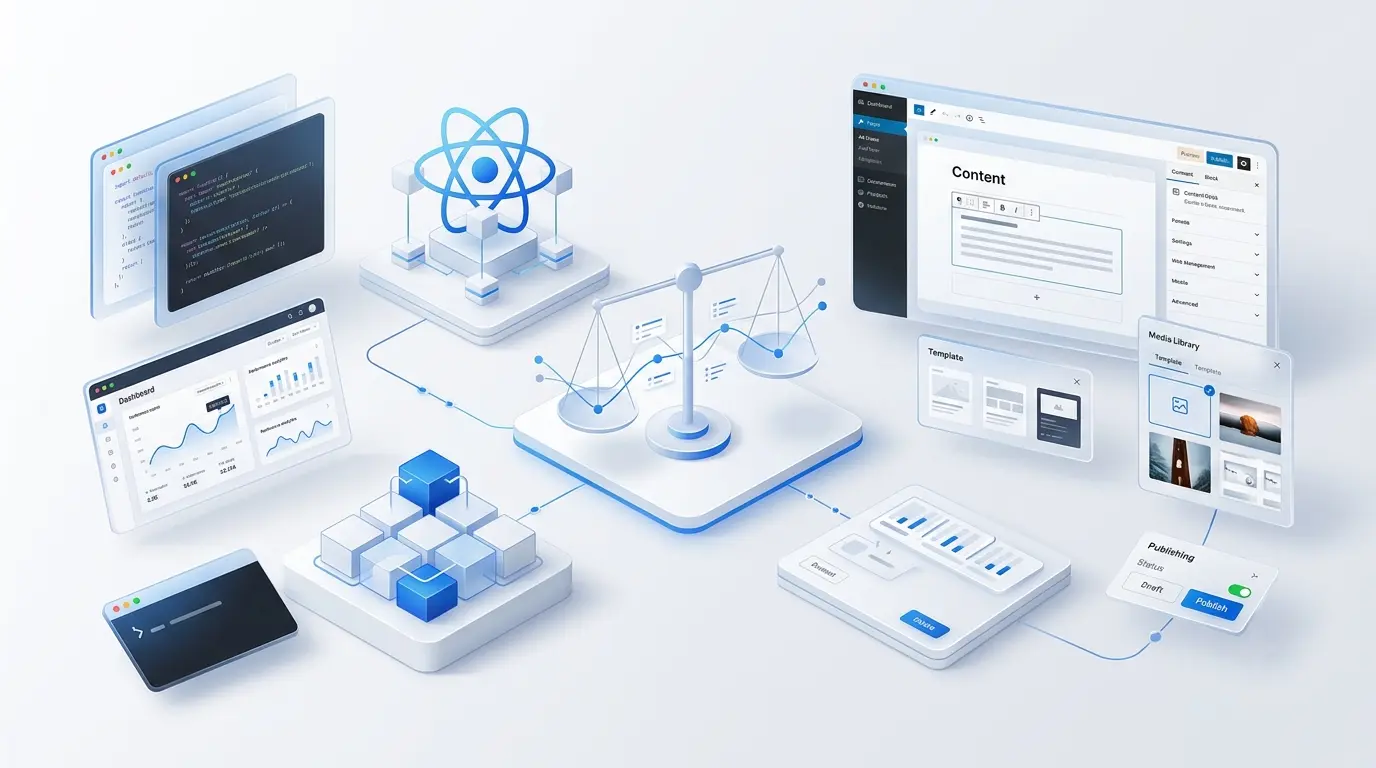
Web Development
8 min read
Custom Code vs WordPress: Which Wins? (2026)
Custom code vs WordPress in 2026: ownership, flexibility, performance, security, and total cost compared — plus when each approach is the right choice.
By NxFold
Updated 4 Sept 2026
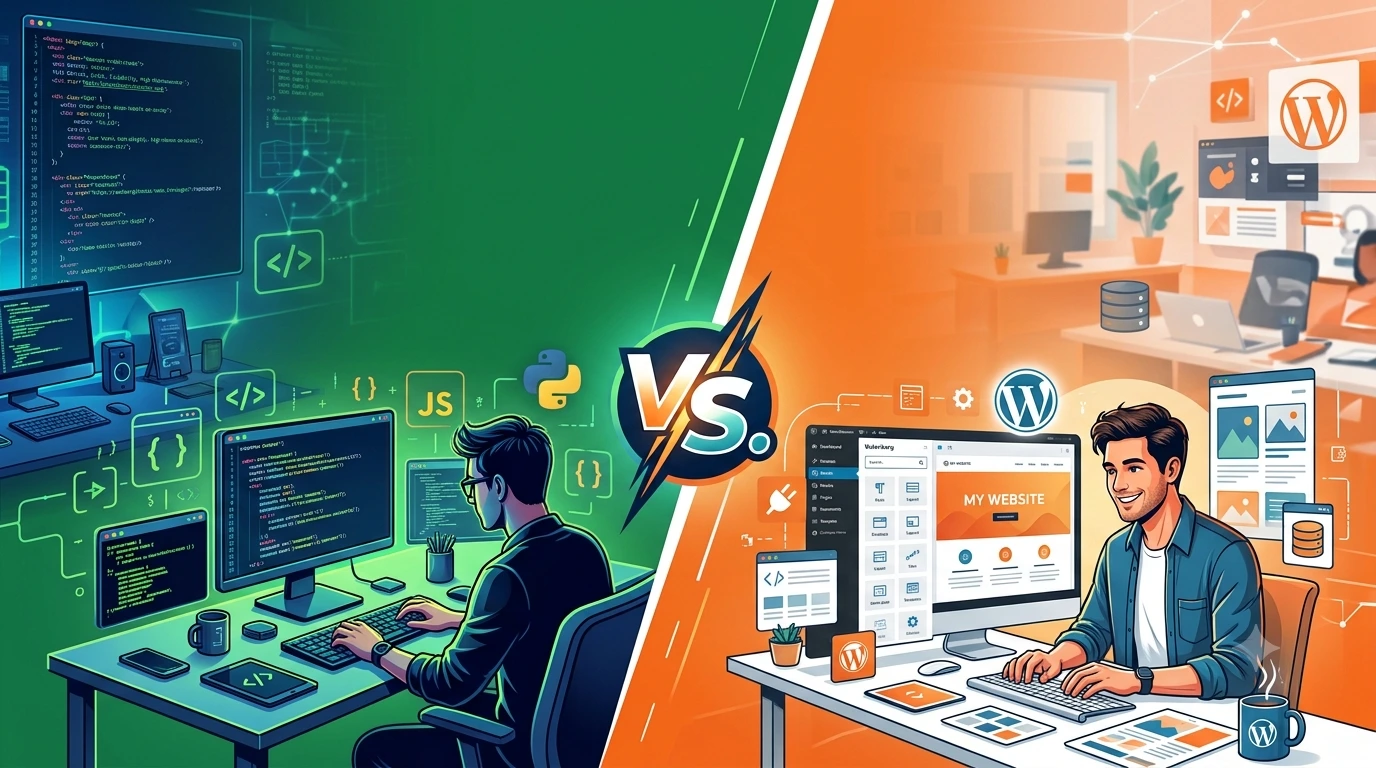
Every business website is built one of two ways: as a custom-coded site written from scratch for your specific needs, or on WordPress, the off-the-shelf content management system (CMS) that powers a large share of the web. This is a decision about approach, not just tools — and it shapes your site's speed, security, cost, and how much of it you genuinely own.
The short answer: Choose WordPress when you need a content-driven site live quickly and affordably, managed by non-technical staff, and a theme-and-plugin setup covers your needs. Choose custom code when performance, security, a bespoke experience, and full ownership matter more than out-of-the-box convenience — typically for products, platforms, and brands where the website is business-critical. This guide compares both honestly, including when WordPress is the smarter call.
If you have already decided to build custom, the next question is which technology to build on — we cover the leading option in Next.js vs WordPress. This article stays one level up: the approach itself, custom code versus a CMS.
What "custom code" actually means
A custom-coded website is built from the ground up by developers, usually on a modern framework, tailored to exactly what your business needs. There is no pre-made theme to bend to your design and no stack of third-party plugins holding the site together. Every feature exists because you asked for it, and the codebase is yours.
This is the same discipline behind custom software generally: instead of configuring a product someone else built, you commission something built to purpose. It costs more effort up front and rewards you with control, performance, and a clean foundation to grow on.
What WordPress actually means
WordPress is the world's most widely used CMS. Its strength is accessibility: pick a theme, add plugins for the features you want — e-commerce, forms, SEO, memberships — and manage everything from an admin dashboard without writing code. A massive ecosystem and talent pool surround it, which is exactly why it is so popular.
The trade-off is that a typical WordPress site is assembled from a theme and many plugins written by different authors. It works, but the result is heavier, harder to secure, and dependent on parts you do not control. What you gain in convenience you give up in ownership and performance headroom.
Ownership and control
Direct answer: with custom code you own 100% of the source code and intellectual property; with WordPress you own your content but depend on the platform, your theme, and every plugin author. Ownership is the difference most buyers underestimate.
With a custom build, insist that the code and IP are assigned to you in writing on final payment — the ownership clauses we cover in how to choose a web development company. With WordPress, your content is portable, but the site's behaviour is tied to third-party components that can change, break, or be discontinued outside your control.
Flexibility and fit
Custom code gives you exactly what you design — any layout, any workflow, any integration — with nothing dictated by a theme's assumptions. WordPress is flexible within the boundaries of its themes and plugins; the moment you need something they do not offer, you are commissioning custom plugin development anyway, bolted onto a platform that was not built for it.
For a standard brochure or blog, that boundary rarely bites. For anything with genuine product logic, bespoke user journeys, or unusual integrations, custom code fits where WordPress strains.
Performance
A custom-coded site, especially on a modern framework, is faster by default because it ships only the code it needs. A WordPress site carries the weight of its theme and plugins and assembles pages on each request, so speed becomes an optimisation project rather than a property of the build. For Core Web Vitals — Google's speed and stability metrics — the custom approach starts ahead.
WordPress can be made fast with caching, a good host, and disciplined plugin use. If you want the framework-level detail on how a modern custom stack compares head-to-head, see Next.js vs WordPress.
Security
A custom site has a far smaller attack surface: no plugin marketplace to introduce vulnerabilities and no shared, bot-targeted admin pattern. WordPress's popularity makes it the most-targeted CMS on the web, and the majority of successful attacks trace back to outdated plugins or themes. WordPress can be secured well with managed hosting, hardening, and rigorous updates — but security is a continuous responsibility rather than something designed in from the start.
Maintenance and who can edit
This is where daily life differs. WordPress lets non-technical staff edit content freely, but demands continuous upkeep — core, theme, and plugin updates, compatibility checks, backups, and monitoring. Miss them and you invite breakage or a breach.
A custom site has far less to patch, but content changes typically go through a developer unless it is paired with a headless CMS that gives editors a friendly interface. Our website maintenance guide breaks down what upkeep actually involves for each model, so you can budget honestly.
Total cost of ownership
Direct answer: WordPress usually costs less to launch; custom code often costs less to own over time. A WordPress site has a lower initial build cost but ongoing spend on premium plugins, maintenance, security, and performance work. A custom site costs more to build and less to maintain, with fewer moving parts to break.
Judge the decision on total cost of ownership over three to five years against your goals, not on the launch quote alone. Our Dubai website cost guide breaks down realistic ranges by project type.
Scalability and future-proofing
Custom code scales and extends cleanly — new features and traffic growth rarely force a rebuild. WordPress scales too, usually by adding server resources, caching, and optimisation, but a fast-growing product with complex logic can outgrow the CMS model and end up rebuilt from scratch. If you expect the site to grow into a platform, building custom from the start avoids paying twice.
When WordPress is the right choice
WordPress is genuinely the better pick when your site is content-first (a blog, magazine, or brochure); non-technical staff must manage it daily without a developer; budget and speed-to-launch are the top constraints; and a standard theme-and-plugin stack already covers your needs. For a large share of small businesses, that is exactly the situation — and choosing WordPress is the smart, honest answer.
When custom code is the right choice
Custom code is the stronger choice when performance and Core Web Vitals affect your revenue or rankings; you need a genuinely bespoke design and functionality; the site is a product or web app with real logic, not just pages; security and full ownership matter; you are building a bilingual English/Arabic experience where correct RTL and speed both count; and you expect to grow and iterate for years. In those cases the up-front investment usually pays back — talk to our web development and web design teams to scope it.
Custom code, Next.js, or a website builder — clearing up the overlap
These comparisons sit at different levels, so it helps to line them up:
- Custom code vs WordPress (this guide) — the approach: a bespoke build versus an off-the-shelf CMS.
- Next.js vs WordPress — the framework: once you have chosen custom, the specific technology many agencies build on.
- Website builder vs custom development — the DIY end: drag-and-drop builders like Wix or Squarespace versus a professionally built site.
Read them together and the full decision — from DIY builder, to WordPress, to a custom framework — becomes clear.
Frequently asked questions
Is custom code better than WordPress? Neither is universally better. Custom code is better for performance, security, bespoke functionality, and full ownership. WordPress is better for content-heavy sites managed by non-technical staff on a tighter budget. The right answer depends on your goals, team, and how long you expect to run and grow the site.
Do I own my website if it is built on WordPress? You own your content and your domain, but the site's functionality depends on your theme and plugins, which are made by third parties. With a custom build, you can own 100% of the source code and intellectual property outright — provided it is assigned to you in writing on final payment.
Is custom code more expensive than WordPress? Usually more to build and less to maintain. WordPress has a lower launch cost but ongoing spend on plugins, security, and performance; custom code costs more up front with fewer moving parts to maintain. Compare total cost of ownership over several years, not just the initial quote.
Can WordPress handle a large or complex website? It can, up to a point, with strong hosting, caching, and careful plugin management. But products with heavy custom logic or very high traffic can outgrow the CMS model, at which point a custom build is more cost-effective than fighting the platform.
Is a custom-coded site more secure than WordPress? Generally yes — a custom site has a smaller attack surface with no plugin marketplace and no shared admin pattern that bots target. WordPress can be secured well but is the most-targeted CMS, and most breaches trace to outdated plugins or themes, so it needs continuous maintenance.
Deciding between an off-the-shelf CMS and a site built for your business? Our web development team will help you scope the right approach — with full source-code ownership either way. If you are comparing agencies first, start with how to choose a web development company in Dubai.
Have a project in mind?
Ideas to put into practice.
Turn what you have learned into a clearer plan for your website or product. Tell us what you want to build.
Start your project