Web Apps
13 min read
ERP Development in Dubai: Build vs Buy (2026)
Custom ERP or off-the-shelf? An honest build-vs-buy guide for UAE companies: real cost ranges, the e-invoicing mandate, and when custom actually pays.
By NxFold
Updated 4 Sept 2026

Enterprise resource planning (ERP) software is a single shared database and workflow layer that runs a company's finance, inventory, procurement, people and project delivery in one place instead of across eleven spreadsheets and three disconnected apps. In Dubai, the question business owners actually face is rarely whether they need one. It is whether to license an off-the-shelf platform — Odoo, SAP Business One, Microsoft Dynamics 365 Business Central, Zoho, ERPNext — or commission something custom.
This guide answers that question the way we answer it for clients: from the position of an agency that both integrates off-the-shelf systems and builds custom ones, including the ERP that runs NxFold itself.
Should you build a custom ERP or buy one?
Buy the ledger, build the edge. License an off-the-shelf ERP for accounting, VAT and inventory — those problems are solved, regulated, and cheap to rent. Build custom only for the operational workflow that actually earns your margin and that no vendor models properly. Most UAE companies under 200 staff should not build a full ERP from scratch.
That single sentence disqualifies about seventy per cent of the custom-ERP enquiries we receive, and saying so early has saved clients more money than anything else we do.
What an ERP actually is (and what it is not)
An ERP is defined by three properties, not by a feature list:
- One source of truth. A customer, a product, an invoice and an employee exist once, not once per department.
- Enforced workflow. A sale cannot be invoiced before it is approved; stock cannot ship before it is reserved. The system encodes the rules, not the staff.
- Derived reporting. Financial statements, VAT returns and management reports are computed from transactions rather than re-keyed.
A CRM is not an ERP. An accounting package is not an ERP. A collection of Google Sheets with a shared drive is emphatically not an ERP, however well it is maintained. If you are weighing a customer-facing system instead, our guide to custom CRM development in Dubai covers that decision separately.
What ERP costs in Dubai in 2026
Published UAE vendor guides converge on roughly the following ranges. These are market figures from ERP resellers and implementers, not NxFold pricing — treat them as an order-of-magnitude sanity check before you take any proposal seriously.
| Segment | Typical first-year spend | What it usually buys |
|---|---|---|
| Micro business, 1–10 users | AED 15,000 – 80,000 | Cloud subscription, standard modules, light configuration |
| SME, 10–50 users | AED 80,000 – 400,000 | Subscription plus real implementation, data migration, training |
| Mid-market, 50–200 users | AED 400,000 – 1.2 million | Multi-entity, custom reports, integrations, change management |
| Enterprise | AED 1 million and up | Multi-country, heavy customisation, dedicated internal team |
Two figures matter more than the headline price.
The licence is the small number. Across the UAE market, implementation, data migration, integration and training typically cost between one and three times the software licence in year one. A quote that shows only per-user pricing is not a quote; it is an invitation.
Year five is the real number. A cloud ERP at AED 900 per user per month for 40 users is AED 432,000 a year, or over AED 2.1 million across five years, before any customisation. A custom build with a large capital cost and a modest hosting and maintenance line can cross under that curve — but only if the scope holds, which is the entire risk.
The build-vs-buy scorecard
Score each row 0 to 3. Anything under 10 means buy. 10 to 15 means buy the core and build around it. Above 15 is the narrow band where a custom build is genuinely defensible.
| Question | Score high when |
|---|---|
| Is your core process unusual for your industry? | No vendor demo ever matches how you actually work |
| Does that process create your margin? | It is the reason clients choose you, not overhead |
| Have you already outgrown two off-the-shelf tools? | You are paying for software you route around |
| Do you have more than 30 daily operational users? | Per-user licensing is compounding against you |
| Is a competitor's software their product? | Your operations tool could become a revenue line |
| Can you fund 12 months without the payoff? | Cash flow survives a build, not just a purchase |
| Do you have an internal owner with authority? | One person can decide and say no to scope creep |
The pattern behind a high score is consistency: businesses that should build custom are usually ones whose operations are the product. Fleet operators, holiday-home managers, brokerages and marketplaces all reach a point where the booking, dispatch or listing engine is too specific for any vendor and too central to outsource. Several of the platforms we have built — including fleet and short-term-rental operations products in our project catalog — began exactly there.
Everybody else is better served by a licensed ERP plus targeted business process automation around its edges.
The e-invoicing mandate changes the timeline, not the answer
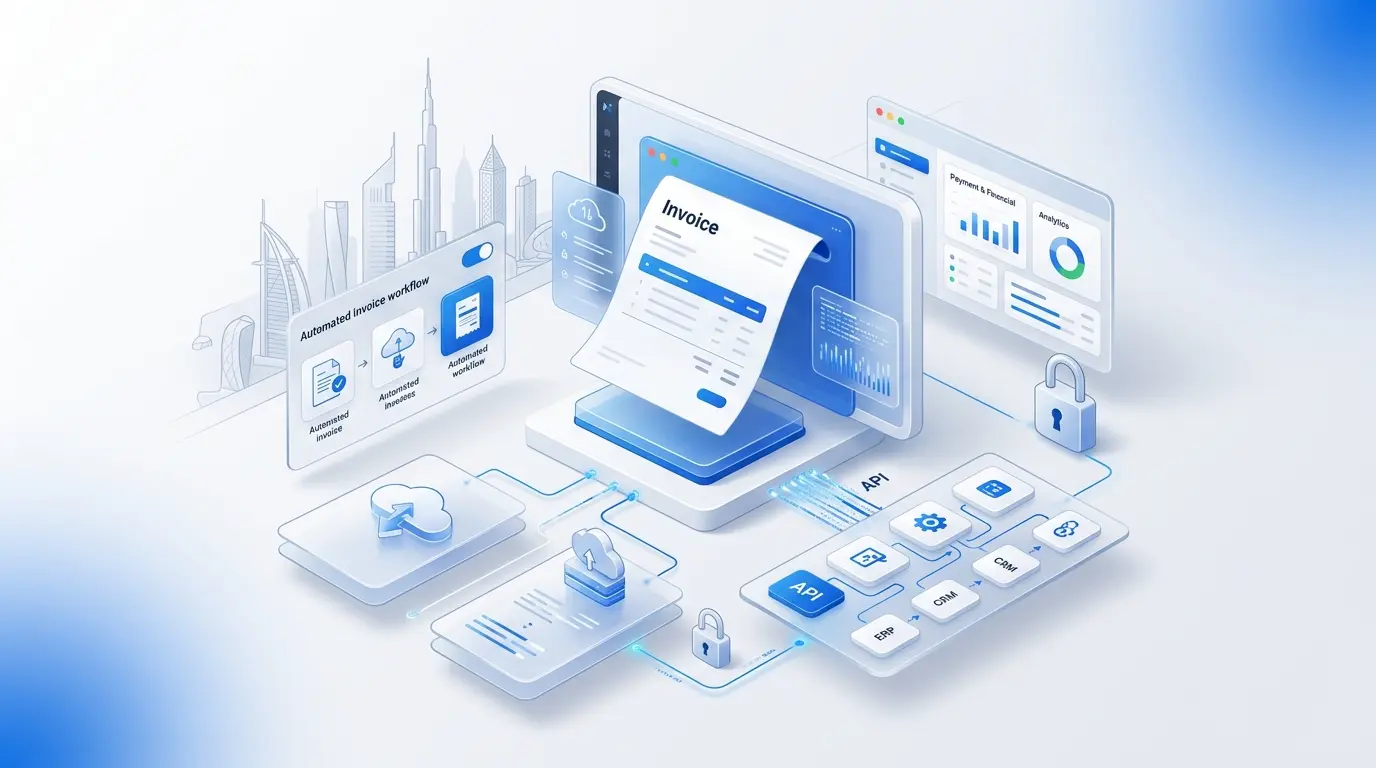
The UAE is rolling out mandatory structured e-invoicing under Ministerial Decisions No. 243 and 244 of 2025, using a Peppol-based five-corner model. Invoices must be exchanged as structured XML in PINT AE or UBL format through an Accredited Service Provider (ASP). A PDF emailed to a client will not satisfy the requirement.
| Milestone | Date | Who it applies to |
|---|---|---|
| Pilot phase | July – December 2026 | Selected volunteer taxpayers |
| ASP appointment deadline | 30 October 2026 | Businesses with revenue of AED 50 million or more |
| Phase 1 go-live | 1 January 2027 | Businesses with revenue of AED 50 million or more |
| ASP appointment deadline | 31 March 2027 | All remaining businesses and government entities |
| Phase 2 go-live | 1 July 2027 | SMEs and other in-scope entities, VAT-registered or not |
Penalties under Cabinet Decision 106 of 2025 include AED 5,000 per month for failing to appoint an ASP and AED 100 per missing or late e-invoice, capped at AED 5,000 per month.
The practical consequence for the build-vs-buy decision is narrow but real. Your ERP does not need to be an ASP — it needs to emit clean, complete, correctly-mapped invoice data that an ASP can transform and transmit. That is an integration requirement, not an architecture requirement. It does mean two things, though: any system you commission from here on must expose a well-structured invoice model, and any legacy system that stores invoices as free text or PDFs has an expiry date. We cover the plumbing in detail in our guide to UAE e-invoicing integration in Dubai.
The deadline should compress your timeline for deciding. It is not a reason to build.
What we learned building our own ERP
NxFold runs its internal operations on a system we built. It is a useful case precisely because we had no client to please and no budget to defend, so the design choices were made on merit.
Three decisions have held up:
An accepted quotation deterministically generates a project. Not a notification asking someone to create one — the rules engine produces the project record and a drafted contract as a consequence of acceptance. Every workflow gap we have ever seen in a client's business lives in exactly this kind of handoff, where a human is expected to re-enter what the system already knows.
Invoices are a projection, not a table you type into. They are derived from the project's stored state rather than authored independently. This is more work up front and it eliminates an entire class of reconciliation bug — the one where the invoice and the project disagree and nobody can say which is right.
Tenancy is a column on every table, not a deployment. Multi-tenant from the first migration, with role separation between admin, finance and content. Retrofitting tenancy into a single-tenant schema is one of the most expensive rewrites in this category of software. If that is on your roadmap at all, our write-up on multi-tenant SaaS architecture explains the trade-offs.
One decision we would revisit: we built the quotation-to-project engine before we had enough real quotations to know the edge cases. Building operational software ahead of operational volume produces confident code around guessed requirements.
The module map: what to buy, what to build
| Module | Default recommendation | Why |
|---|---|---|
| General ledger, VAT, corporate tax | Buy | Regulated, standardised, and someone else maintains compliance |
| Payroll and WPS | Buy | UAE-specific rules change; a specialist keeps up |
| Purchasing and basic inventory | Buy | Commodity workflow, well modelled by every vendor |
| Customer and deal pipeline | Buy or light-build | Depends on how unusual your sales motion is |
| Your core operational engine | Build | Booking, dispatch, allocation, production — this is the margin |
| Customer-facing portal | Build | Nobody's stock portal matches your brand or your UX |
| Reporting and dashboards | Build on top | Read from the ledger, present it your way |
The hybrid this table implies — licensed finance core, custom operational layer, integrated by API — is the shape of most successful UAE mid-market builds we have seen. It is less satisfying than a single unified system and considerably more likely to be in production two years later.
Architecture decisions that set your five-year cost
Four choices made in month one dominate everything spent afterwards.
Data model before screens. If the entity model is wrong, every screen built on it inherits the error. Spend the first weeks on entities, relationships and state transitions, not UI.
Explicit state machines. "Status" as a free-text field is where ERPs go to die. Enumerate states and legal transitions; make illegal states unrepresentable.
An integration boundary from day one. You will connect an accounting system, a payment gateway, a WhatsApp channel and eventually an ASP. Build against interfaces rather than wiring vendor SDKs through your domain logic. Our notes on payment gateway integration in Dubai show how much vendor-specific behaviour hides behind a clean interface.
Auditability as a feature. Who changed what, when, and from what previous value. Retrofitting an audit trail after a dispute is unpleasant; building it in costs almost nothing.
A realistic implementation timeline
| Phase | Buying an ERP | Building custom |
|---|---|---|
| Discovery and process mapping | 2–4 weeks | 4–8 weeks |
| Configuration or core build | 4–12 weeks | 12–24 weeks |
| Data migration | 2–6 weeks | 2–6 weeks |
| Integrations | 2–8 weeks | 4–12 weeks |
| Parallel run and training | 4–8 weeks | 4–8 weeks |
| Realistic total | 4–8 months | 8–15 months |
The parallel run is the phase clients try to cut, and it is the one that determines whether the system survives. Running the old process alongside the new one for a full monthly cycle is the only honest test of whether the numbers reconcile.
Seven mistakes that sink ERP projects in the UAE
- Buying by demo. Vendors demo the happy path. Insist on running three of your own real, ugly transactions during evaluation.
- Automating a broken process. A bad workflow encoded in software is a bad workflow that now cannot be changed informally. Fix the process first.
- Migrating everything. Ten years of dirty history poisons the new system. Migrate open balances, active records and a clean archive.
- No internal owner. A project sponsored by everyone is owned by nobody. One person must have authority to decide and to refuse scope.
- Treating Arabic as a translation task. If your team works in Arabic, right-to-left layout, Arabic numerals and Arabic search are functional requirements, not localisation polish. The same discipline applies to Arabic website design.
- Ignoring the tax and invoicing model until the end. VAT treatment, corporate tax grouping and structured invoice fields shape your data model. They are not a reporting layer bolted on later.
- Underfunding change management. The system does not fail; adoption does. Budget training and a support period as line items, not goodwill.
How to evaluate an ERP partner in Dubai
Ask for a reference client in your industry and actually call them. Ask who owns the source code and the data if the relationship ends — the answer should be you, in writing. Ask what happens in month thirteen: who fixes bugs, at what rate, under what response time. Ask them to explain a decision they talked a client out of; a partner who has never refused work is selling, not advising.
Then ask how they will handle your e-invoicing obligation, and listen for whether they name the ASP model and the XML formats or wave at "compliance". The general principles in our guide to choosing a web development company in Dubai apply here with higher stakes attached.
Frequently asked questions
How much does a custom ERP cost in Dubai?
Custom operational systems in the UAE typically start in the low hundreds of thousands of dirhams for a focused single-domain build and rise steeply with scope. The meaningful comparison is not against the licence fee of an off-the-shelf ERP but against five years of subscription, customisation and the cost of the workarounds you are running today.
Is Odoo good enough for a Dubai SME?
For a large majority of SMEs, yes — particularly for finance, inventory and purchasing. Where it strains is a genuinely unusual operational core, where heavy customisation starts to cost more than a purpose-built module that talks to it over an API.
Will an off-the-shelf ERP make us e-invoicing compliant automatically?
Not by itself. Compliance requires an Accredited Service Provider that transmits structured XML to the FTA e-Billing system. Your ERP's job is to hold complete, correctly-mapped invoice data and hand it over cleanly.
How long does a custom ERP take to build?
Eight to fifteen months for a real one, including discovery, migration, integration and a parallel run. Anyone promising a full custom ERP in three months is describing a prototype.
Can we start small and expand?
This is usually the right answer. Build or buy the single module that hurts most, run it in production for a quarter, and let real usage tell you what the second module should be.
Who owns the code we pay for?
You should, unambiguously, and it should be written into the agreement along with data export rights and repository access. If a vendor is evasive here, that is the whole answer.
Do we need a mobile app for our ERP?
Only for roles that work away from a desk — drivers, field technicians, warehouse staff, inspectors. Office roles are almost always better served by a responsive web application.
What is the single biggest predictor of success?
One empowered internal owner who understands the process and can say no. It outweighs budget, vendor choice and technology stack combined.
Where to go from here
If you are inside the AED 50 million threshold, your ASP decision has a date on it and your invoice data model should be reviewed now regardless of which direction you go. If you are below it, you have until 2027 — which is exactly enough time to fix the process before you encode it.
If you want a straight answer on whether your business is in the narrow band where a custom build pays, the fastest route is a scoped discovery: we map your current process, price both paths honestly, and tell you if the answer is to buy. Start with our web app development and web development services, or see how we approach product work for SaaS and startup teams.
We would rather talk one client out of a build than deliver a system that should never have existed.
Have a project in mind?
Ideas to put into practice.
Turn what you have learned into a clearer plan for your website or product. Tell us what you want to build.
Start your project