Car Rental Websites
15 min read
Car Rental Website Development in Dubai (2026)
Build a car rental website in Dubai with real-time booking, deposits, Salik & fines handling, and Arabic support. Costs, features & fleet management.
By NxFold
Updated 4 Sept 2026
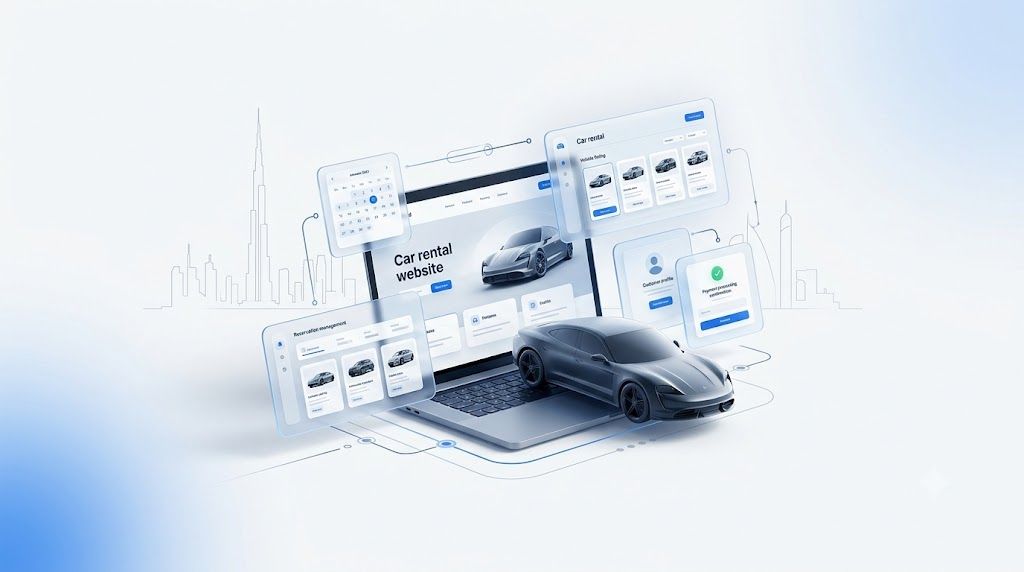
A car rental website in Dubai is a bilingual, booking-enabled platform that shows real-time fleet availability, takes online reservations and deposits, collects the documents the RTA requires, and handles the Salik tolls and traffic fines that come with every rental. For rent-a-car companies, chauffeur services, and fleet operators in the UAE, it is the storefront and the operations desk at once — where roughly 80% of bookings now begin online, most of them on a phone.
This guide covers what a car rental website in Dubai actually needs in 2026: the real cost, the features that convert, the Dubai-specific operational realities (Salik, deposits, fines, insurance) that separate a real rental platform from a brochure, and how to choose between a custom build and an off-the-shelf booking product.
What counts as a "car rental website" in Dubai
The term covers four different products, and the price depends entirely on which one you need:
| Type | Who it's for | Core job |
|---|---|---|
| Rent-a-car brochure site | Small agencies, new entrants | Show the fleet, capture enquiries, build trust |
| Self-drive booking platform | Growing rental companies | Real-time availability, online booking, payment, deposits |
| Chauffeur / limousine site | Chauffeur and airport-transfer firms | Quote, book, and dispatch with driver assignment |
| Fleet management platform | Multi-branch operators, leasing firms | Bookings, fleet, contracts, Salik/fines, and reporting in one system |
Most Dubai rental companies past their first year need the second or fourth: a booking platform that shows what is actually available today, takes payment and a refundable deposit, and pushes the reservation into an operations view — not a static gallery of cars with a WhatsApp number. The gap between those two is the difference between a website that generates bookings and one that just generates phone calls.
How much does a car rental website cost in Dubai?
A brochure-style rent-a-car website in Dubai typically costs between AED 10,000 and AED 30,000. A self-drive booking platform with real-time availability, online payment, and deposit handling ranges from AED 35,000 to AED 110,000. A custom fleet-management platform with Salik and fines reconciliation, contract generation, and multi-branch reporting usually starts around AED 130,000 and scales with fleet size and integrations.
The number is driven by four things: fleet size and how many branches you run, whether availability is live or manual, how much of the operational back office (deposits, Salik, fines, contracts) the platform automates, and whether it is bilingual with proper Arabic support. A single-branch site and a multi-branch fleet platform are different orders of magnitude. For how these ranges compare with other build types, see our guide on how much a website costs in Dubai.
| Build tier | Typical range (AED) | Best for |
|---|---|---|
| Brochure rent-a-car site | 10,000 – 30,000 | New agencies, small fleets |
| Self-drive booking platform | 35,000 – 110,000 | Growing rental companies |
| Custom fleet-management platform | 130,000+ | Multi-branch operators, leasing |
These are market ranges, not fixed quotes. Be cautious with any agency that prices a rental platform before understanding your fleet size, your branches, and which back-office processes you want automated.
The features a Dubai car rental website actually needs
A rental website earns its cost through the features that turn a search into a paid, contracted booking. In order of impact:
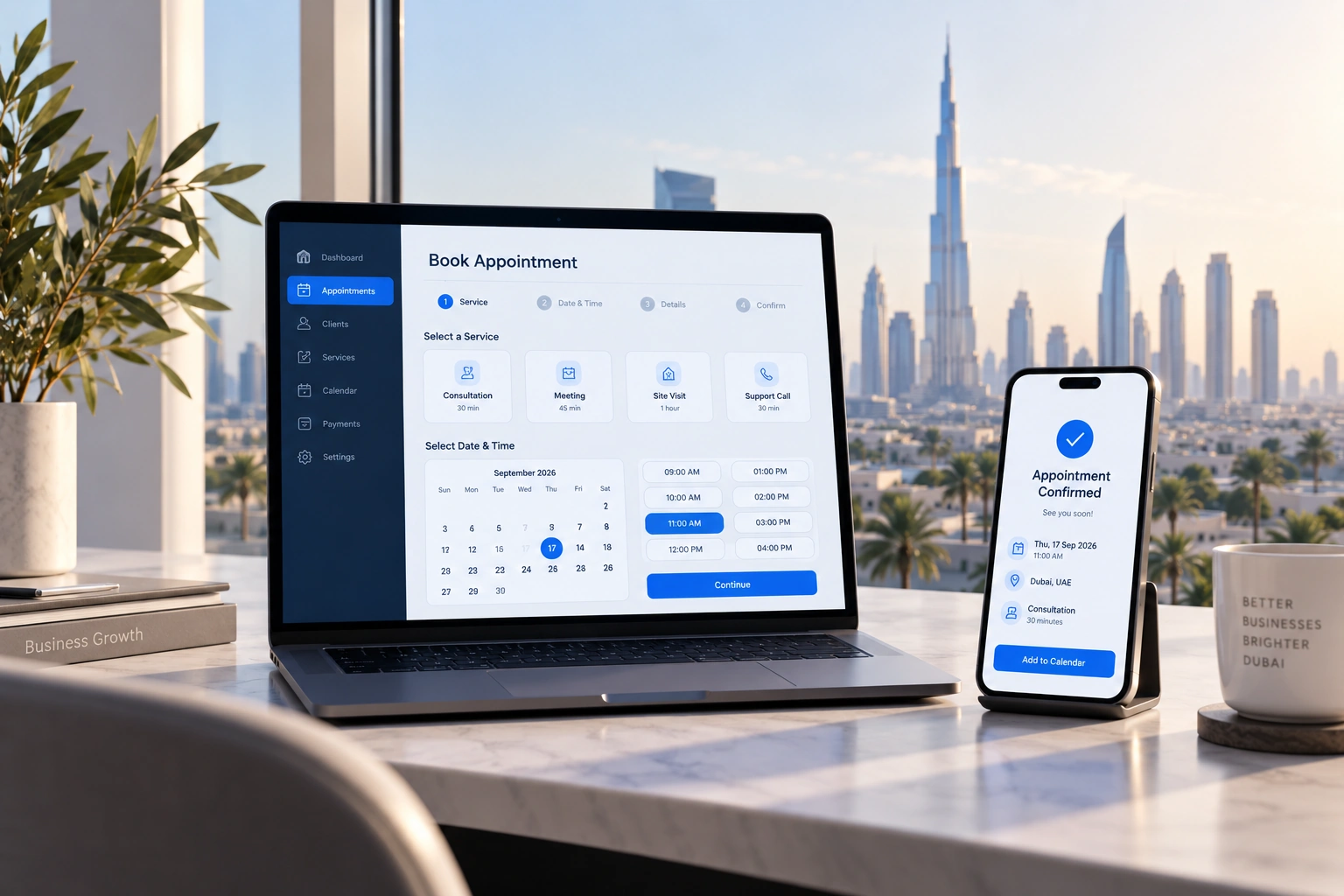
Real-time availability and instant booking. The single biggest lever. A customer should see which cars are free for their exact dates, book, and pay without a phone call. Availability that reflects the live fleet — not a fixed list — is what makes the platform trustworthy and reduces double-bookings to zero.
Online payment and a refundable deposit hold. Dubai rentals run on a refundable security deposit, usually pre-authorised on the customer's card and released after return. The platform has to take the rental payment and place the deposit hold cleanly, then release or capture it. Getting this right is a payment gateway problem, and it is where amateur builds fail.
Document capture at booking. UAE rentals require the renter's Emirates ID or passport, a valid driving licence (or International Driving Permit for tourists), and often a visa page. Collecting and verifying these at booking — securely — removes friction at the counter and cuts no-shows.
Salik, fines, and toll reconciliation. Every Dubai rental accrues Salik toll charges and, sometimes, traffic fines the operator must recover from the renter, typically with an admin fee. A serious platform tracks these against each booking so nothing is lost. This is the operational reality most brochure sites ignore entirely.
Insurance and CDW options. Renters choose between basic cover and Collision Damage Waiver upsells. Presenting these clearly at checkout lifts average order value and sets expectations before the counter.
Delivery, pickup, and airport handover. A large share of Dubai rentals are delivered to a hotel, home, or Dubai/Al Maktoum airport. Booking flows need address and time capture for delivery, with pricing rules by zone.
WhatsApp booking and support. WhatsApp is the default channel in the UAE. Wiring it into the booking — pre-filled with the reference and car — lifts conversion and speeds support. See our guide on WhatsApp Business API integration.
Bilingual English/Arabic with true RTL. Residents, GCC visitors, and tourists all use rental sites. A correctly built right-to-left Arabic interface — not a template with Arabic pasted over it — widens reach and signals credibility. Our Arabic website design guide covers what proper RTL requires.
Fast, Core Web Vitals-clean pages. Fleet pages are image-heavy and mostly viewed on mobile. Without disciplined image handling they load slowly and lose the booking. Our Core Web Vitals guide for UAE businesses explains the thresholds that matter.
Luxury and exotic fleets: what changes
A luxury or exotic fleet is not a standard rental site with more expensive cars on it. Three things change, and getting them wrong costs more at this end of the market than at any other.
Photography becomes the product. At AED 300 a day the customer is buying transport; at AED 3,000 a day they are buying an experience they can picture. That means fewer images at much higher quality, presented at a scale the category expects, with the page engineered to stay fast despite the weight. A gallery of mediocre photos actively devalues the fleet.
Instant self-serve checkout is often the wrong call. For a standard fleet, removing every wait is the goal — see instant booking UX for how far that goes. For an exotic fleet, the deposit is large, the licence and age requirements are stricter, and a short qualifying conversation protects both sides. Publishing daily and weekly pricing on the card still matters enormously; what changes is that the final step is an enquiry rather than a card charge.
A native app earns its place sooner. Luxury rental has a far higher repeat rate than the standard market, and a repeat customer with your fleet already on their phone books faster than one who has to search again. Superior runs both a web catalogue and an App Store listing sharing the same fleet and pricing, which is the pattern that fits a fleet with genuine repeat volume.
The contrast is worth seeing directly: Let's Go is the standard-fleet version of the same market, rebuilt around instant pricing and a checkout that completes in under three minutes. Same city, opposite emphasis.
Dubai operational realities most websites ignore
This is where a knowledgeable agency earns its fee, and where template car rental sites quietly cost their owners money. Running a rental business in Dubai comes with obligations a real platform has to model:
Salik tolls. Every gate crossing adds a toll to the rental. Whether you pre-charge, reconcile after return, or bundle it, the platform must attribute Salik to the right booking and vehicle. Leaving this manual leaks revenue on every trip.
Security deposits. The refundable deposit is central to UAE rentals. The platform must pre-authorise it, hold it for the rental period, and release or partially capture it on return — with a clear record the customer can see. Ambiguity here drives disputes and chargebacks.
Traffic fines. Fines issued during a rental are the operator's liability to recover, usually with an administrative fee. Tying fines to the booking, the vehicle, and the renter's held documents is how operators actually collect them instead of absorbing them.
Licensing and compliance context. Car rental companies in Dubai operate under a DED trade licence with RTA approval, typically obtained over two to four weeks, and must maintain current commercial insurance and inspection certificates per vehicle. Your website does not issue these, but it should present terms, insurance, and driver requirements consistently with them — and never contradict your rental contract.
A platform built for Dubai models these from the start. One built from a generic template hands you a pretty booking form and leaves every one of these as a spreadsheet your staff maintains by hand. If the back office is the part you actually need solved, our guide to car rental management software in the UAE covers that system in its own right.
The booking engine and payment mechanics
The booking engine is the heart of the platform, and it is more than a calendar. It has to enforce availability by vehicle and branch, apply pricing rules (daily, weekly, and monthly rates, seasonal pricing, long-term discounts), add extras (child seats, additional driver, CDW, delivery), calculate the total including VAT, take payment, and place the deposit hold — all in one flow the customer trusts.
On the money side, a UAE rental platform needs a gateway that supports both an immediate charge for the rental and a separate pre-authorisation for the deposit, with the ability to release or capture later. This is exactly the kind of two-step payment logic covered in our payment gateway integration guide, and it is a web application problem rather than a template setting.
Fleet management and back-office integration
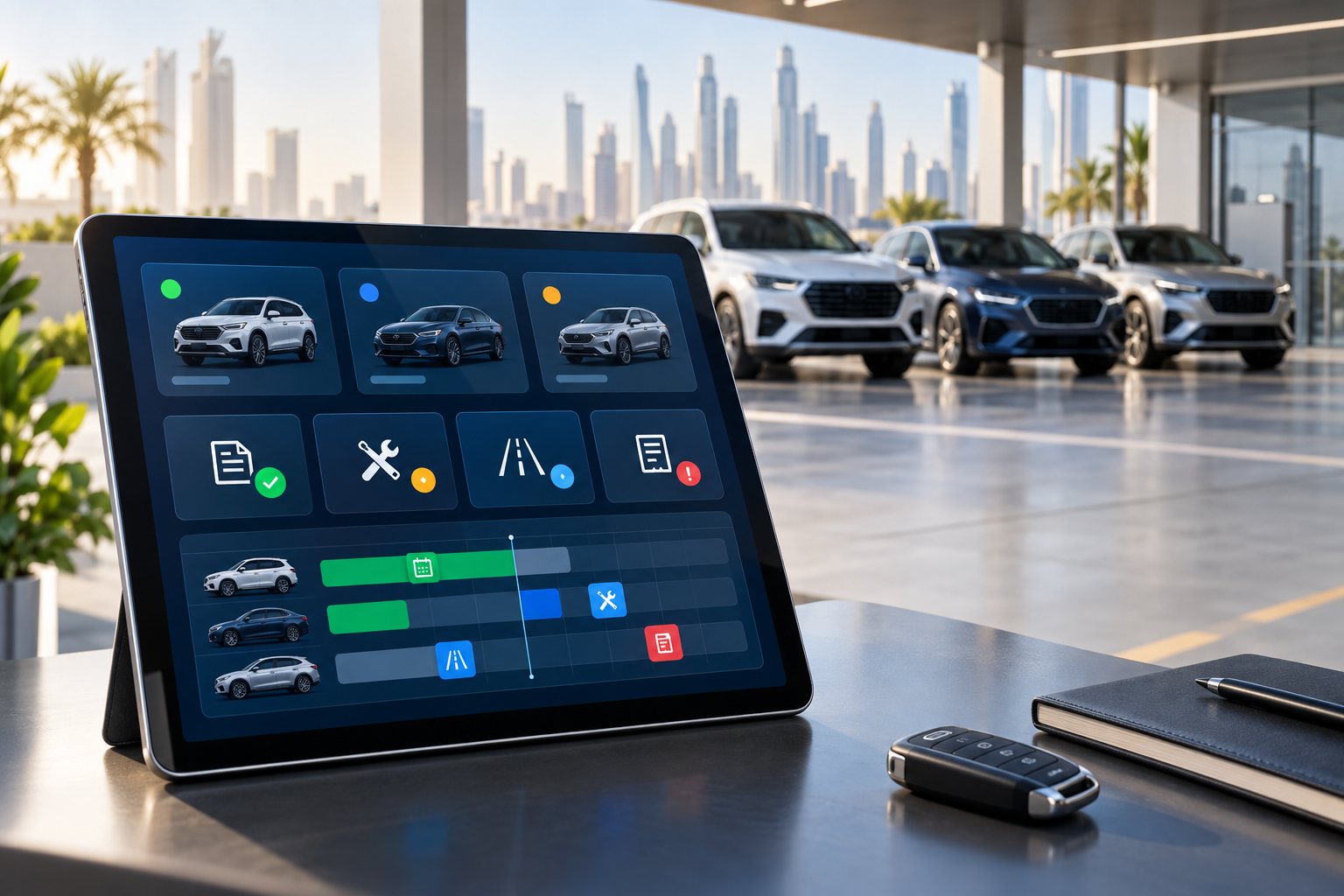
For operators past a single branch, the website is only the front of a larger system. A fleet-management platform ties the public booking site to the operational back office: which vehicle is on which contract, when it is due back, its service and inspection schedule, its Salik and fines ledger, and its utilisation. Bookings from the website, walk-ins, and partner channels (aggregators, hotels, travel platforms) all flow into one availability calendar so a car is never promised twice.
Building that integrated system well is a custom software development engagement — Vara Fleet is our own platform built to that shape — and where a mobile app for drivers or delivery staff adds value, it extends naturally into mobile app development.
Custom build vs off-the-shelf booking product
Not every rental company needs a custom platform. The honest comparison:
| Option | Strengths | Limits |
|---|---|---|
| Off-the-shelf rental SaaS | Fast to launch, low monthly cost | Generic workflows, limited branding, your data and customers live in their system |
| WordPress + booking plugin | Cheap, familiar | Fragile availability logic, weak deposit/Salik handling, poor Arabic RTL |
| Aggregator listing only | Instant demand | Commission per booking, no owned customer relationship or brand |
| Custom platform | Fits your fleet and back office, owns the data, scales | Higher upfront cost, needs a capable partner |
A new agency with a handful of cars is well served by an off-the-shelf tool or even an aggregator to start. An operator running a real fleet across branches, reconciling Salik and fines, and wanting its own brand, its own margins, and ownership of its customer data will hit the ceiling of packaged tools quickly. That is where a custom car rental platform pays for itself — the commissions, leaked tolls, and manual reconciliation it removes exceed the cost of building the right system once.
Technology, performance, and SEO
The stack matters because rental sites are fleet-heavy, mobile-first, and highly seasonal. A modern build uses server-side rendering so vehicle pages are fast and indexable, disciplined image handling to keep Core Web Vitals green, and structured data so individual cars and offers can surface as rich results.
SEO for a Dubai rental site is won on specific, high-intent queries: car models ("Range Rover rental Dubai"), categories ("luxury car rental Dubai", "monthly car rental Dubai"), and locations ("rent a car Dubai Marina", "car rental Dubai airport"). These convert far better than generic terms and are exactly where a specialist page can out-depth the aggregators. Pairing that with strong SEO fundamentals and genuine bilingual content is how an independent rental company competes against portals with bigger budgets. Chauffeur and limousine operators — a related but distinct market — win on airport-transfer and event queries, and often benefit from their own ecommerce-grade booking flow; Summit is the chauffeur version of this build, and limousine and chauffeur website design covers why that category needs a different approach. This mirrors the industry-page strategy we described for real estate websites.
How long does it take to build?
A brochure rent-a-car site takes three to five weeks. A self-drive booking platform with real-time availability, payment, and deposits typically runs eight to fourteen weeks. A full fleet-management platform with Salik and fines reconciliation, contracts, and multi-branch reporting is a three-to-six-month engagement. The booking-and-payment logic and the operational integrations — not the visual design — are usually the critical path.
How NxFold approaches car rental builds
NxFold is a Dubai-based custom software and web development agency that has delivered car rental and chauffeur work in the UAE market, including Superior and Let's Go in car rental, Summit in chauffeur and limousine, and Vara Fleet, a fleet-management product. That range shapes how we build: booking and deposit logic treated as a payments problem rather than a form, Salik and fines modelled into the data layer, and bilingual Arabic support built natively rather than bolted on.
The pattern we follow is live availability as the single source of truth, clean two-step payment and deposit handling, operational reconciliation (Salik, fines, contracts) built in, and Core Web Vitals discipline from the first commit. The goal is a platform that takes bookings while the office sleeps and a back office that never chases a toll by hand.
Five mistakes that sink Dubai car rental websites
The failures are predictable, and every one is avoidable at build time:
A gallery, not a booking engine. A site that shows cars but routes every booking through WhatsApp is a brochure. Without real-time availability and online payment, you carry the cost of a website and keep the workload of a phone.
Ignoring the deposit. Taking the rental fee but handling the security deposit off-platform invites disputes and chargebacks. The deposit hold belongs in the same clean payment flow as the booking.
Leaving Salik and fines manual. Every toll and fine not tied to a booking is revenue chased by hand or lost. This is core rental economics, not a nice-to-have.
Desktop-first, image-heavy pages. Most Dubai rental searches happen on mobile. A heavy, desktop-first site loses the booking before the fleet loads.
Arabic as an afterthought. Retrofitting right-to-left support onto an English-only build is expensive and usually looks wrong. Arabic and RTL belong in the design system from the first screen.
Avoiding these is less about budget than about choosing a partner who has built rental platforms for this market and designs the constraints in from day one.
Frequently asked questions
How much does a car rental website cost in Dubai? A brochure rent-a-car site runs AED 10,000–30,000, a self-drive booking platform with payment and deposits AED 35,000–110,000, and a custom fleet-management platform AED 130,000 and up. The main cost drivers are fleet size, number of branches, and how much of the back office you automate.
Can customers book and pay online for a rental in Dubai? Yes. A proper platform shows real-time availability, takes the rental payment, and pre-authorises a refundable security deposit in one flow, then releases or captures the deposit on return. Two-step payment logic is what makes this work.
How does a rental website handle Salik tolls and fines? A serious platform ties Salik toll charges and any traffic fines to the specific booking, vehicle, and renter, so the operator can reconcile and recover them, usually with an admin fee. Leaving this manual leaks revenue on every rental.
Is a luxury car rental website different from a standard one? Yes, in three ways: photography carries far more weight and needs to be fewer images at higher quality, the final step is usually a qualifying enquiry rather than a self-serve card charge because deposits and driver requirements are stricter, and a native app earns its place sooner because repeat rates are higher.
Should I build a custom platform or use an off-the-shelf tool? A new agency with a few cars is well served by off-the-shelf rental software or an aggregator. Operators running a real fleet across branches, reconciling Salik and fines, and wanting to own their brand, margins, and customer data reach the limits of packaged tools and benefit from a custom platform.
Does my car rental site need to be in Arabic? For the UAE and GCC market, yes. A properly built right-to-left Arabic interface — not a translated English template — widens your reach across residents and Gulf visitors and signals credibility.
What documents does a Dubai rental site need to collect? Typically the renter's Emirates ID or passport, a valid UAE driving licence or International Driving Permit, and often a visa page. Collecting and verifying these securely at booking cuts counter friction and reduces no-shows.
Turn your fleet into an online booking engine
A car rental website in Dubai is worth building only if it does three jobs: shows what is truly available and lets customers book and pay without a call, handles deposits, Salik, and fines instead of leaving them to your staff, and ranks for the model, category, and location searches your customers actually make. If your current site does none of these, it is costing you bookings and leaking revenue every week.
If you are planning a rental platform — a rent-a-car booking site, a chauffeur service, or a custom fleet-management system — request a quote for a car rental website build and we will map the right scope to your fleet, your branches, and the back office you want automated.
Have a project in mind?
Ideas to put into practice.
Turn what you have learned into a clearer plan for your website or product. Tell us what you want to build.
Start your project