Web Design
15 min read
Choosing a Web Development Company in Sharjah
A practical guide to vetting web development companies in Sharjah: real costs, red flags, must-ask questions, and how to compare proposals.
By NxFold
Updated 6 Sept 2026
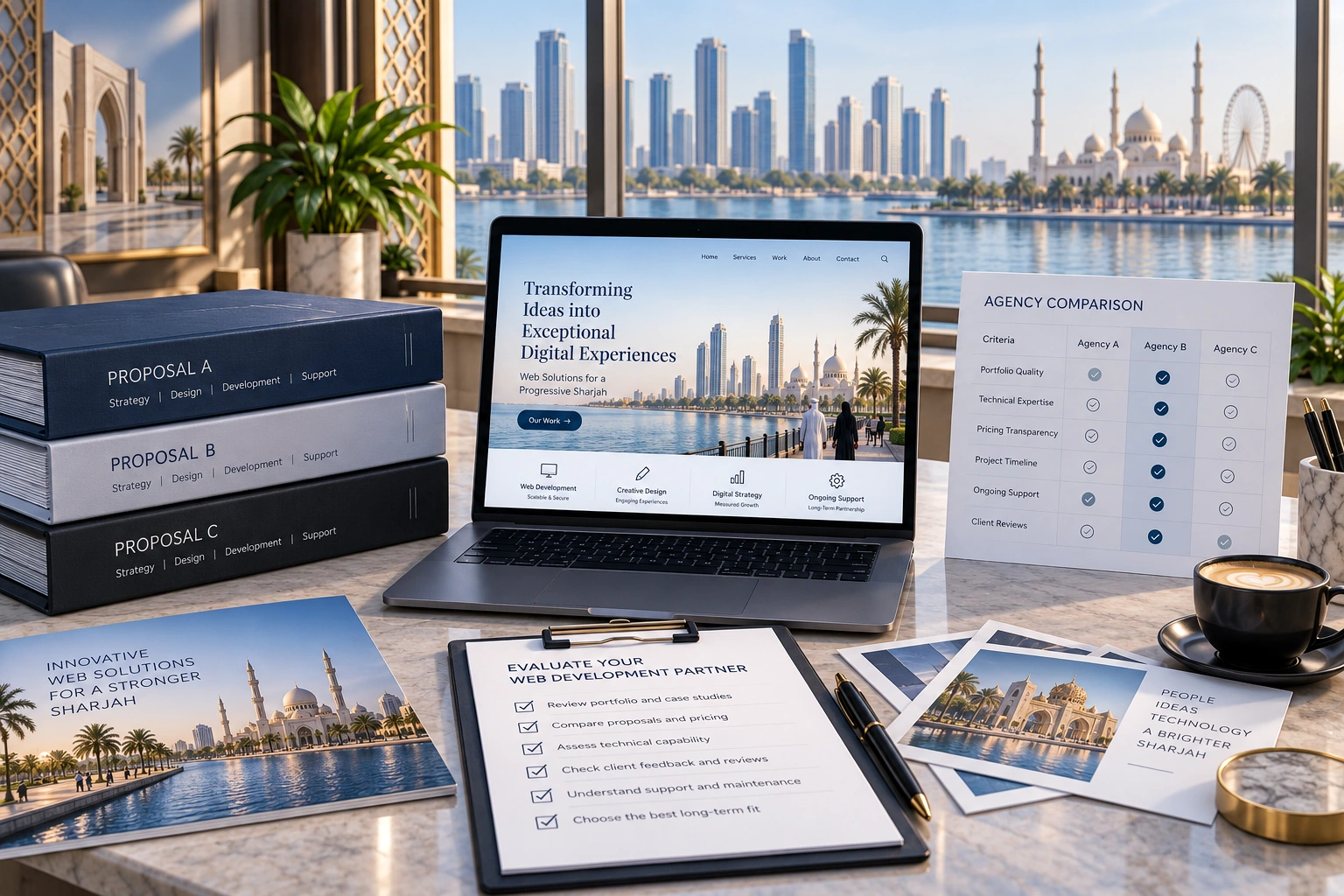
Sharjah is the UAE's cultural and creative capital and its third-largest economy — home to a dense base of family-owned SMEs, manufacturing and trading businesses, and a growing creative and tech sector anchored by free zones like Shams (Sharjah Media City) and SRTIP (Sharjah Research Technology and Innovation Park). Choosing the wrong web development company here doesn't just cost money; it costs the months you spend waiting for a site that never quite launches, or launches and never brings in a single qualified lead.
Quick answer: the right web development company for a Sharjah business is judged on five things — verifiable portfolio work in your sector, technical transparency (real code vs. a page-builder template), built-in SEO and Core Web Vitals discipline, genuine bilingual EN/AR delivery, and a written scope with no hidden costs. Everything below expands on how to check each one before you sign anything.
If you'd rather skip straight to a conversation with a UAE-based team that builds this way, you can get a scoped, written proposal from NxFold before reading further — there's no obligation, and it gives you a real proposal to measure every other pitch against.
Why Sharjah Is a Different Buying Decision Than Dubai or Abu Dhabi
Sharjah shares a border with Dubai and sits close enough to Abu Dhabi that businesses often compare quotes across all three emirates, but treating it as a smaller Dubai misses what actually drives the buying decision here. Sharjah's economy leans harder on manufacturing, trading, logistics and family-run SMEs than Dubai's consumer- and tourism-heavy market, and its free zones serve a different mix of businesses: Shams (Sharjah Media City) hosts media, creative and consulting companies, SRTIP hosts research- and technology-driven firms, and industrial/trading free zones like Hamriyah and SAIF Zone serve manufacturing and logistics operators. Businesses operating out of Sharjah frequently need:
- A website that reads credibly to a cost-conscious SME or family-business buyer, where a clear, itemized quote often matters more than a flashy pitch deck.
- Content built for search behavior that skews more transactional and local than Dubai's more international, tourism-adjacent search demand.
- Arabic content that is genuinely native — not machine-translated — because a substantial share of Sharjah's business audience, including its large Emirati and long-established Gulf trading community, reads and searches in Arabic first.
- Data handling that respects the UAE PDPL (Personal Data Protection Law), which applies regardless of which emirate a business is registered in.
None of this means Sharjah companies need a different technology stack from a Dubai or Abu Dhabi business. It means the vetting bar for "does this company actually understand my market and my budget" is a bit different, because Sharjah buyers are, on average, more price-sensitive and more likely to walk away from a vague, padded quote than a Dubai enterprise buyer might be.
The Five-Point Vetting Framework
1. Portfolio Fit, Not Portfolio Size
A long client list means less than three or four projects that resemble what you're building. If you run a trading or logistics business, ask to see a live B2B or catalog-style site the agency built, not a mockup. If you're a creator or media company operating out of Shams, ask for a live content or creator-platform project. A company that shows you five polished screenshots but no live URLs you can click through is showing you a design exercise, not a shipped product.
2. Technical Transparency: Custom Code vs. Page Builders
Ask directly: is this built on a proprietary CMS, WordPress with a page builder, or a modern framework like Next.js/React with a real codebase you'll own? Each has a legitimate place — a five-page brochure site doesn't need a custom framework — but the answer should be a direct one, not a dodge. Agencies that avoid the question are usually reselling a templated build at a custom-build price. For a fuller breakdown of when custom code is worth it and when it isn't, see our Custom Code vs WordPress comparison.
3. SEO and Core Web Vitals Are Built In, Not Bolted On
A website that looks good in a design review and then loads in six seconds on mobile is a website that will lose both search ranking and buyers. Ask how the company approaches Core Web Vitals (loading, interactivity, visual stability), whether metadata and structured data are handled at build time, and whether the site will be crawlable in both English and Arabic from launch. If SEO is something they plan to "add later," that's a red flag — retrofitting technical SEO onto a finished site is far more expensive than building it in from the start.
4. Genuine Bilingual Delivery, Not a Translated Afterthought
A surprising number of "bilingual" UAE websites are an English site with an Arabic layer bolted on — same layout, same imagery, text run through translation software, and no real right-to-left (RTL) design pass. That fails Arabic-speaking users on sight, and it fails technical SEO too: search engines increasingly penalize sites where the Arabic version reads as a mechanical translation rather than native content. Ask to see a live Arabic page the agency has shipped, not a screenshot. Our guide to Arabic Website Design in Dubai: the RTL Guide covers what proper RTL implementation actually involves, and it applies the same way to a Sharjah-facing site.
5. Transparent Scope and Pricing — In Writing
The single biggest source of project disputes in web development isn't price, it's scope creep from a proposal that was never specific enough to begin with. This matters even more in a price-sensitive market like Sharjah, where a vague quote is more likely to be renegotiated mid-project. A trustworthy proposal spells out: what pages/features are included, how many revision rounds, what happens if you want to add a feature mid-project, who owns the code and hosting once the project ends, and what post-launch support costs. If a proposal is a single paragraph and a total number, ask for the breakdown before you sign. For current Sharjah market pricing by project type, see our Website Cost in Sharjah (2026 Guide) — this article focuses on how to vet who you hire, not what to pay them, since pricing depends heavily on scope.
6. Post-Launch Support Isn't Optional
A website is not a one-time deliverable — browsers update, plugins go stale, security patches lapse, and content needs updating long after launch. Ask specifically what happens in month two: is there a maintenance retainer, an hourly rate for changes, or nothing at all until you renegotiate? Companies that go quiet after the final invoice are common enough that this deserves its own line item in your evaluation, not an assumption. See our Website Maintenance Packages guide for what a reasonable ongoing support scope looks like.
7. Mobile-First, Accessibility-Aware Design
The majority of traffic to a UAE business website now arrives on mobile, and Google's indexing is mobile-first by default — meaning the mobile version of your site, not the desktop one, is what determines your ranking. Ask how the agency tests on real devices (not just a browser's responsive-mode simulator), and whether accessibility basics — readable contrast, working alt text, keyboard navigation — are part of the build checklist or an afterthought only raised if a client asks.
A Note for Free-Zone, Trading, and Industrial Businesses
Sharjah's free zones serve a genuinely different mix of businesses than Dubai's or Abu Dhabi's, and it's worth vetting an agency with that in mind. A company licensed through Shams (Sharjah Media City) — media, marketing, consulting, and creative businesses — typically needs a fast, content-heavy, SEO-forward site more than heavy e-commerce logic. A company operating through SRTIP, Sharjah's research and technology park, often needs a site that reads credibly to an enterprise or research-partner audience, closer to a B2B SaaS positioning than a consumer storefront. Manufacturing, trading, and logistics businesses licensed through zones like Hamriyah Free Zone or SAIF Zone typically need a catalog- or capability-driven site — product ranges, certifications, and B2B inquiry flows — over a flashy consumer design. None of this changes the underlying vetting framework above, but it's worth asking a prospective agency whether they've actually built for your specific business model, rather than assuming a template built for a Dubai retail brand will translate cleanly to a Sharjah trading company.
Why "Top 10 Agency" Lists Rarely Help You Choose
A search for web development companies in Sharjah turns up mostly listicle-style "Top 10" articles, and it's worth understanding their limits before treating one as due diligence. One widely-shared Sharjah agency ranking is transparent that its own publisher sits at the top of its own list — a disclosed conflict of interest that's still rarely adjusted for in the actual ranking, and the publisher's own case studies carry named client results while the other nine entries get two or three generic sentences each with no outcomes attached. A second common Sharjah listicle format covers technology platforms and a "cost factors" section but includes no actual pricing figures, no case studies with measurable results, and no performance, SEO, or security comparisons between the agencies it ranks — leaving the reader with a list of names and little else to compare them on.
None of that makes these lists useless as a starting point for names to research — it means the list itself isn't the due diligence. The vetting framework above is what turns a list of names into an actual decision.
What a Proper Discovery Process Looks Like
A rushed sales call that jumps straight to a quote is a signal in itself. A discovery process worth trusting usually includes:
- A scoping conversation that covers your business goals, not just "what pages do you want" — a company that asks what you're trying to achieve commercially will design toward that outcome, not just toward a page count.
- A written proposal, not a verbal estimate, covering deliverables, timeline, revision rounds, and what's explicitly out of scope.
- A technical plan, even briefly — what the site will be built on, how content will be managed after launch, and who owns what.
- A realistic timeline that accounts for your side of the work too: content, approvals, and asset delivery routinely take longer than clients expect, and a proposal that ignores this is setting up a missed deadline that gets blamed on the agency later.
Why AI Search Visibility Belongs in This Conversation Now
Buyer research increasingly starts in AI-powered search — Google AI Overviews, ChatGPT, and similar tools that synthesize an answer instead of returning ten blue links. A website built without this in mind can rank reasonably in classic search and still be invisible to an AI Overview, because these systems favor pages with clear, extractable answers, well-structured FAQs, and explicit entities rather than dense marketing prose. Ask whether the agency you're evaluating actually understands this shift, or is still optimizing purely for 2015-era keyword SEO. Our Generative Engine Optimization (GEO) guide covers what AI-search-ready content actually requires.
Freelancer vs. Small Agency vs. Full-Service Agency vs. In-House
| Option | Best for | Strength | Watch out for |
|---|---|---|---|
| Freelancer | A single simple site, tight budget | Lowest cost, direct communication | Single point of failure — if they're unavailable, your project stalls |
| Small agency (2–10 people) | SMEs needing design + build + basic SEO | Personal attention, faster decisions | Limited bench for large or urgent projects |
| Full-service agency | Businesses needing design, development, SEO, and ongoing growth in one relationship | Broader skill coverage, accountability, continuity after launch | Higher cost than a solo freelancer; verify the team behind the pitch actually does the work |
| In-house hire | Companies with continuous, large-scale development needs | Full control, embedded institutional knowledge | Highest fixed cost; slow to scale up or down with project volume |
There's no universally "right" answer here — a five-page site for a new trading company and a multi-market e-commerce platform for an established retailer call for genuinely different structures. The mistake is picking based on price alone without matching the option to the complexity of what you're building.
Red Flags to Watch For
- No live portfolio links — only screenshots or PDFs, never a URL you can open and click through yourself.
- Vague ownership terms — if the contract doesn't clearly state you own the final code, domain, and hosting access after final payment, that's a serious risk.
- "We'll figure out SEO after launch" — technical SEO is a build-time discipline, not a post-launch add-on.
- English-only proof of Arabic capability — if they can't show you a live Arabic page they built, don't take their word for bilingual expertise.
- Pressure to sign before a written scope exists — a company confident in its process will happily put the scope in writing before asking for a deposit.
- No maintenance or support conversation — ask what happens the week after launch if something breaks, and get the answer in writing.
- A quote far below every other bid with no explanation — in a price-sensitive market like Sharjah, the lowest bid is sometimes genuinely lean pricing, but it's also the most common way agencies win a deal and then push for change-order fees once the scope was never fully covered to begin with.
Questions to Ask Before You Sign
- Can you show me a live project in my industry, not just a screenshot?
- Who exactly will work on my project — is it the person pitching me, or a different delivery team?
- What's built into the base price, and what's billed separately?
- How many rounds of revisions are included, and what happens beyond that?
- Will I own the source code, domain, and hosting after the project closes?
- How do you handle Core Web Vitals and mobile performance?
- Is the Arabic version natively written, or translated after the English is finished?
- What's your process for staying compliant with UAE data protection requirements? See our UAE PDPL Compliance Guide for what this should cover.
- What does post-launch support cost, and what's included in it?
- What's the realistic timeline, including your side and mine (content, approvals, assets)?
How NxFold Approaches This
NxFold is a bilingual EN/AR agency — NxFold Technologies LLC — building on Next.js and React rather than templated page builders, with SEO and Core Web Vitals treated as part of the build, not an afterthought. Our work spans real estate platforms like Zain, fintech-adjacent sites like Alpha Global, and SaaS products like Leadora and Orseda — the full portfolio is on our projects page. We serve Sharjah, Dubai, and Abu Dhabi from the same UAE-based team, with web development, web design, and SEO delivered as one coordinated engagement rather than three separate vendors.
If you're comparing options for a Sharjah project, our Sharjah services hub outlines what we build locally, and our web development in Sharjah page covers our approach for this market specifically.
Frequently Asked Questions
How much does web development cost in Sharjah? Costs vary by scope: simple brochure sites typically start lower than Dubai's equivalent tier, while custom platforms with integrations run significantly higher. See our Sharjah pricing guide for a full breakdown by project type.
Do I need a web development company physically based in Sharjah? Not necessarily. What matters more is whether the team understands UAE business requirements, delivers genuine bilingual EN/Arabic work, and can support you responsively in your timezone — a UAE agency serving Sharjah from Dubai or Abu Dhabi works the same way as a locally based one.
How long does a business website take to build in Sharjah? A marketing website typically takes four to eight weeks from kickoff to launch; a custom web application or e-commerce platform with integrations can take three to six months depending on scope and approval cycles.
Should I choose a custom-built website or a website builder for my Sharjah business? A website builder can be faster for a very simple site, but custom development gives you better performance, SEO control, and room to grow — this matters more once search visibility or bespoke functionality becomes a priority. See our comparison of custom code vs. WordPress for the trade-offs.
Is Sharjah web development cheaper than Dubai? Published agency rate cards in Sharjah often start lower than Dubai's, reflecting a more price-sensitive SME and family-business buyer base, but complex custom platforms cost roughly the same regardless of emirate because the engineering work involved doesn't change with location.
The Bottom Line
The fastest way to de-risk a Sharjah web development project is to insist on specifics before you sign: live portfolio links in your sector, a written scope with clear ownership terms, a real answer on how SEO and Core Web Vitals are handled, and proof — not a promise — of genuine bilingual delivery. A company that answers all five without hesitation is worth a serious conversation. One that dodges two or more of them is worth walking away from, however good the pitch sounds — and however low the number on the quote.
Ready to compare a proposal against this checklist? Talk to NxFold about your Sharjah project — we'll walk through scope, timeline, and cost before you commit to anything.
Print or save the ten questions above and bring them to every sales call you take this quarter — the companies worth hiring will answer them without hesitation, and the ones that dodge will have told you everything you need to know before you've spent a single dirham.
Have a project in mind?
Ideas to put into practice.
Turn what you have learned into a clearer plan for your website or product. Tell us what you want to build.
Start your project