Web Design
14 min read
Website Builder vs Custom Development in Dubai
Wix or custom website development? Compare cost, SEO ceiling, scalability, and ROI of website builders vs custom-coded development for Dubai businesses.
By NxFold
Updated 6 Sept 2026
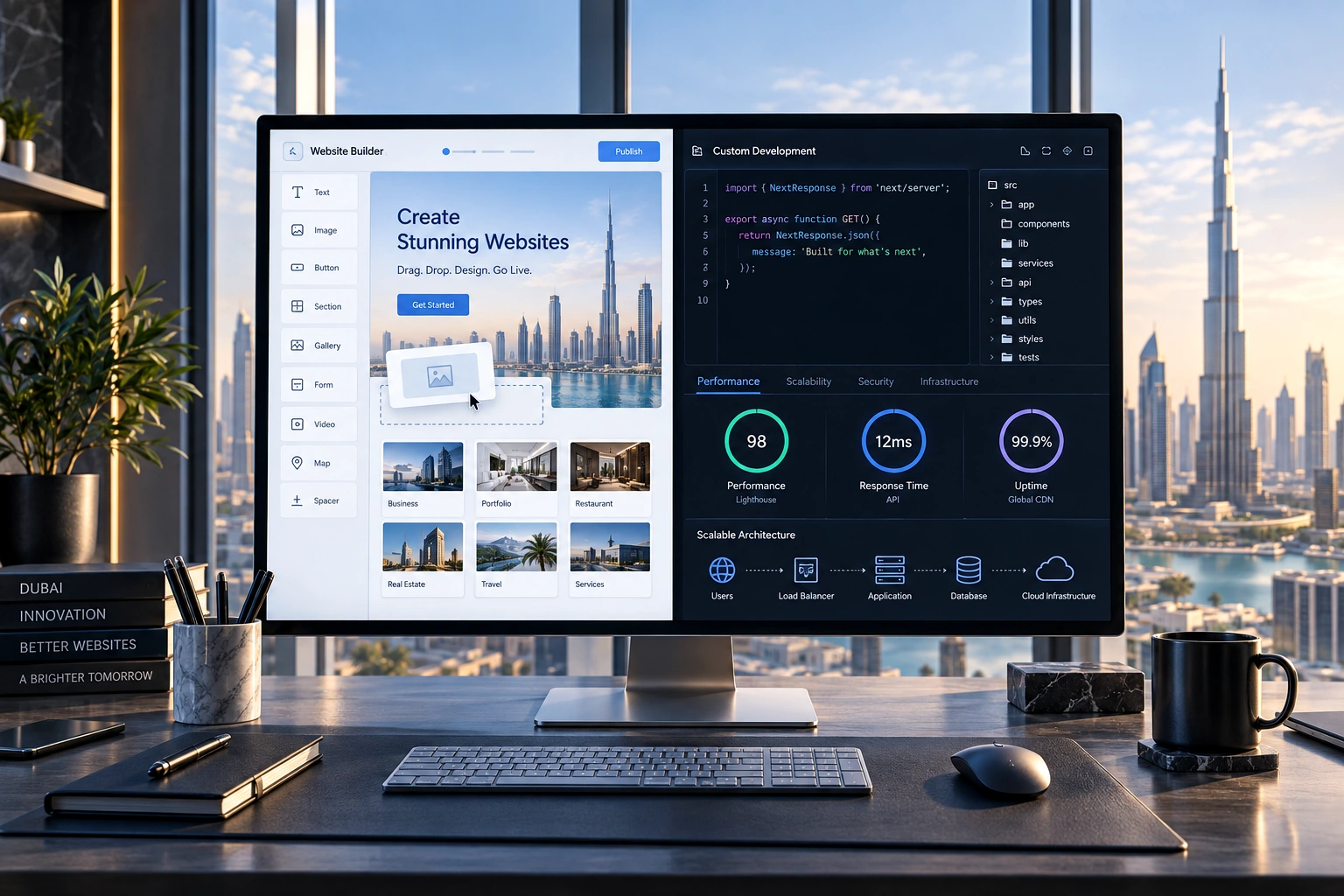
Website Builder vs Custom Web Development in Dubai: Which One Actually Grows Your Business?
If you've searched anything like "website builder Dubai," "website creator Dubai," or "how to create a website in Dubai," you've probably landed on a page trying to sell you a drag-and-drop template. This isn't that page.
This is a straight, no-fluff comparison — written by a Dubai-based custom software and web development agency, so read the positioning for what it is — between two genuinely different ways of getting a business online in the UAE: a website builder (Wix, Squarespace, Shopify's site builder, GoDaddy Website Builder, and similar tools) versus custom web development (a site built from scratch in code, like Next.js/React, with no template underneath it).
Neither option is "wrong." A builder is the right call for plenty of businesses. But it stops being the right call at a fairly predictable point, and most Dubai business owners only discover that point after they've already spent a year and several thousand dirhams finding out the hard way. This guide is meant to help you see it coming.
What "Website Builder" Actually Means in 2026
A website builder is a hosted, drag-and-drop platform. You pick a template, swap in your logo and copy, and the platform hosts and runs everything for you — the servers, the code, the updates, the security patches. Wix, Squarespace, Shopify's built-in site builder, and GoDaddy's Website Builder are the ones we see most often among Dubai SMEs, alongside WordPress paired with a page-builder plugin (Elementor, Divi), which behaves like a builder even though WordPress itself is technically open-source software.
The appeal is obvious: you can have something live in an afternoon, for a few hundred dirhams a month, with zero code. For a personal portfolio, a pop-up event page, or a very early-stage test of a business idea, that's a genuinely good trade.
What "Custom Web Development" Actually Means
Custom development means the site is built specifically for your business, in code, without a pre-built template underneath it. At NxFold, that means Next.js and React — no WordPress, no page builder, no third-party theme. Every component, every interaction, and every line of markup is written for your business's actual requirements: your booking flow, your product catalogue, your CRM integration, your Arabic-language RTL layout.
The trade-off is upfront cost and lead time. You're paying for engineering time instead of a subscription, and the build takes weeks instead of hours. What you get in exchange is a site with no structural ceiling — nothing you'll eventually "grow out of," because there's no shared codebase limiting what you can add.
Website Builder vs Custom Development: The Side-by-Side
| Website Builder (Wix / Squarespace / Shopify builder) | Custom Web Development (Next.js / React) | |
|---|---|---|
| Time to launch | Hours to days | 3–8 weeks, depending on scope |
| Upfront cost | Low (subscription-based) | Higher (one-time build cost) |
| Ongoing cost | AED 500–3,000+/year in platform + app fees, forever | Hosting + optional maintenance retainer — no platform tax |
| Page speed / Core Web Vitals | Constrained by shared, template-heavy codebase | Built for performance from the first commit |
| SEO ceiling | Real — limited control over technical SEO, duplicate templated markup across thousands of other sites on the same platform | No ceiling — full control over metadata, schema, canonical tags, hreflang |
| Design flexibility | Bounded by the template and app ecosystem | Unlimited — anything you can specify can be built |
| Custom integrations (CRM, ERP, payment gateways, booking systems) | Limited to available apps/plugins, often at extra monthly cost | Native, direct integration |
| Ownership | You're a tenant on someone else's platform | You own the codebase outright |
| Bilingual EN/AR + RTL | Usually bolted on via a translation app, imperfect RTL | Built natively into the layout and routing |
| Scalability | Hits a wall as traffic, catalogue size, or feature needs grow | Scales with your business, not the platform's limits |
| Migration risk if you outgrow it | High — moving off the platform later means rebuilding | None — it's already the final form |
The Hidden Cost of Website Builders in Dubai
The sticker price is where most comparisons stop, and it's also where they mislead. A Wix or Squarespace plan advertised at AED 40–150/month looks like an obvious win against a custom build quoted at AED 8,000–15,000+. But that comparison only holds if you ignore what happens in year two and year three.
Website builder costs compound in ways that aren't visible on the pricing page:
- App and plugin fees. Want a real booking system, a CRM connection, multi-currency checkout, or an Arabic RTL toggle that actually works? Each of those is usually a separate app subscription on top of the base plan, and they add up fast — AED 100–500/month is common once a business has three or four of them running.
- The SEO ceiling. Builder platforms serve thousands of businesses off the same underlying templates and shared JavaScript frameworks. That means slower page loads, bloated code you can't touch, and — critically for Dubai's crowded services market — content structures that look near-identical to competitors on the same platform. Google's ranking systems increasingly reward page speed (Core Web Vitals) and technical cleanliness, both of which are structurally harder to achieve on a builder. We cover the mechanics of this in more depth in our Core Web Vitals guide for UAE businesses.
- Lock-in. Your content, your design, and often your URLs live inside the platform's proprietary system. If you decide to leave, you're not "exporting a website" — you're rebuilding one, usually from scratch, on a new host.
- Diminishing differentiation. In a market as saturated with agencies and service businesses as Dubai's, a templated site makes it structurally harder to look different from the ten other businesses using the same Wix theme in your industry.
None of this makes builders a bad choice categorically — it makes them a bad choice for a business that expects to still be operating, and growing, in three years.
When a Website Builder Is Actually the Right Call
To be fair to the other side of this comparison: a website builder is the right tool when you need to validate an idea fast, when budget genuinely doesn't allow for a custom build yet, or when the site's job is simple — a single landing page, an event microsite, a personal brand page with no e-commerce or booking logic. If that's your situation, don't let anyone talk you into a AED 15,000 custom build you don't need yet. Build it in Wix, launch this week, and revisit the decision once the business itself has proven out.
Signs You've Outgrown a Website Builder
Most Dubai businesses that switch from a builder to custom development do it for one or more of these reasons, in order of how often we see them:
- Google rankings have stalled or gone backward. You're paying for Google Ads because organic traffic won't move, and a technical SEO audit keeps surfacing the same builder-imposed limitations.
- Page speed is costing conversions. Mobile visitors — the majority of UAE web traffic — are bouncing before the page finishes loading.
- You need integrations the app store doesn't offer, or the ones it does offer are unreliable, expensive, or both. Common triggers: a proper CRM connection, UAE-specific payment gateways, a booking engine with real availability logic, or an ERP-linked quotation system.
- Your Arabic site is an afterthought. A machine-translated Arabic version bolted onto an English template rarely reads naturally and almost never gets real RTL layout treatment — which matters, because a meaningful share of high-intent commercial searches in the UAE happen in Arabic.
- You're spending more on apps and workarounds than a custom build would have cost. If your monthly app-and-plugin bill has crept past AED 300–400, you're already paying a "custom development tax" — you're just not getting a custom site for it.
- The design looks like a template — because it is one. Prospective clients in Dubai's B2B and professional-services markets increasingly notice when a site looks like a stock theme, and it undercuts trust at exactly the moment you're trying to build it.
If two or more of these sound familiar, the honest math has usually already tipped in favour of a custom build — you're just financing the delay with app fees and lost organic traffic instead of financing the fix.
Why Website Builder Templates Struggle to Rank in Dubai and the Wider UAE
This deserves its own section because it's the reason most builder-to-custom migrations happen. Three structural issues recur constantly in UAE website audits:
Duplicate and thin templated content. Thousands of businesses run the same builder themes with lightly reworded copy. Search engines are built to detect and discount this kind of pattern-matched content, which is a disadvantage no amount of on-page keyword stuffing can fix.
Core Web Vitals and mobile performance. Builder platforms load shared frameworks, third-party app scripts, and generic CSS regardless of whether your specific page needs them. That drags down Largest Contentful Paint and Interaction to Next Paint scores — both now meaningful, if not decisive, ranking factors — especially on the mobile connections most UAE users are browsing from.
Limited technical SEO control. Canonical tags, structured data (schema.org markup), and proper hreflang implementation for bilingual EN/AR sites are either unavailable, buggy, or locked behind premium app tiers on most builders. A custom-coded site controls all of this natively — canonical URLs, JSON-LD schema for services and FAQs, and en-AE/ar-AE/x-default hreflang tags that tell Google exactly which page to serve to which audience.
None of this is theoretical. It's the same reason a locally-built custom web development or web design project consistently outperforms a templated equivalent over a 12-month horizon, even when the builder site launched first.
Real Results: What Custom Development Delivers When It's Done Right
We don't publish case studies with invented numbers, so here are three from NxFold's own project history that illustrate the gap in practice: a custom rebuild for Superior (car rental) delivered a 38% increase in qualified leads after moving off a templated platform; Ayla (holiday homes) saw a 43% lift in organic bookings following a custom, SEO-structured rebuild; and Alpha Global Group Marketing saw a 52% improvement in on-site conversion after replacing a generic template with a purpose-built site and conversion flow. Browse the full breakdown of these and other UAE projects on our projects page.
These aren't universal guarantees — every business, catalogue, and market is different — but they're representative of the ceiling a templated builder site structurally can't reach, because the constraint isn't the design, it's the platform underneath it.
Migrating From a Website Builder to Custom Development Without Losing Your Rankings
If you already have organic traffic on your builder site, the single biggest risk in switching isn't the new site itself — it's losing the SEO equity you've already built. A properly planned migration protects and typically improves on it:
- Full technical and content audit first. Every ranking page, every backlink, every piece of indexed content gets catalogued before anything is rebuilt.
- A 301 redirect map for every existing URL. Every old builder URL needs to point to its new custom-built equivalent — no exceptions, no "we'll get to it later." Missed redirects are the single most common cause of a ranking drop during a rebuild.
- Metadata and content parity, not just visual parity. Titles, meta descriptions, headings, and on-page copy need to be recreated (and improved) in the new build — not just the visual design.
- Structured data from day one. Schema.org markup for your services, FAQs, and breadcrumbs should ship with the new site at launch, not get added later.
- Updated sitemap submission to Google Search Console, plus a monitored watch period immediately after launch to catch and fix any indexing issues fast.
Done this way, a migration is a controlled upgrade, not a gamble — most sites see rankings hold steady through the transition and then improve over the following two to three months as the new technical foundation starts compounding.
Website Builder vs Custom Development: What It Actually Costs in Dubai
Exact numbers depend heavily on scope, but as a starting reference for Dubai, Abu Dhabi, and Sharjah businesses: website builders typically run AED 500–3,000+ per year once app and plugin costs are included, indefinitely, with no ownership at the end of it. Custom web development typically starts around AED 8,000–15,000 for a small business site and scales with functionality (bookings, e-commerce, CRM integration, multi-language), but it's a one-time investment in an asset you own outright. For a full breakdown by business size and feature set, see our detailed website cost guide for Dubai (with matching guides for Abu Dhabi and Sharjah).
If WordPress is part of your comparison set too — it sits in an odd middle ground, technically custom-capable but almost always deployed with the same page-builder plugins and third-party themes that create the same SEO and performance ceiling as a hosted builder. We break that specific comparison down separately in Custom Code vs WordPress: Which Is Right for You?
How to Decide, Practically
Ask yourself three questions. If organic Google traffic matters to your business's growth, if you expect to still be running this business in three years, and if you've already hit — or can see yourself hitting within a year — any of the six "outgrown a builder" signals above, custom development is very likely the better long-term decision, even though it costs more today. If none of those apply yet, a website builder remains a perfectly reasonable way to get online this week.
Either way, the worst outcome is indecision — a business that keeps delaying a decision on either path usually ends up with the downside of both: a builder site slow enough to lose search visibility, and no custom site yet to replace it.
Talk to NxFold About Your Website
NxFold builds 100% custom-coded websites — no templates, no WordPress, no page builders — for businesses across Dubai, Abu Dhabi, and Sharjah, in both English and Arabic with proper RTL support. If you're weighing a first website, or planning a migration off a builder without losing the SEO ground you've already gained, start a project brief with our team and we'll give you a straight, no-obligation read on which route actually makes sense for your business — not the one that's easiest to sell.
Frequently Asked Questions
Is a website builder like Wix or Squarespace good enough for a Dubai business? For a personal project, hobby page, or very early-stage test, yes. For a UAE business that depends on Google rankings, page speed, or integrations like payment gateways and CRMs, a builder's templated codebase becomes a ceiling within 12–18 months — most NxFold clients who switch from a builder to custom development do so because of SEO or performance limits, not design preferences.
How much does custom web development cost vs a website builder in Dubai? Website builders run roughly AED 500–3,000/year in subscription and app fees. Custom development in Dubai typically starts around AED 8,000–15,000 for a small business site and scales with functionality — but it's a one-time build you own outright, with no monthly platform tax and no rebuild required when you outgrow it.
Can I switch from a website builder to a custom-coded website later without losing my SEO rankings? Yes, if it's planned properly. The main risks are broken URLs and lost redirects. A migration plan that 301-redirects every old builder URL to its new custom equivalent, preserves metadata, and resubmits an updated sitemap to Google Search Console typically preserves — and often improves — existing rankings.
Why is my website builder site not ranking on Google in the UAE? The most common causes are shared/bloated page code that hurts Core Web Vitals, duplicate templated content across thousands of other builder sites, and limited control over technical SEO elements like structured data, canonical tags, and hreflang for Arabic/English versions — all of which custom-coded sites can control directly.
Does NxFold build custom websites or use website builders and WordPress? NxFold builds exclusively custom-coded websites in Next.js and React — no templates, no WordPress, no third-party page builders — for every project, including all Dubai, Abu Dhabi, and Sharjah engagements.
Does NxFold offer both Arabic and English websites? Yes. Bilingual EN/AR delivery with proper RTL support is a core part of every NxFold web design and development project, not an add-on — which matters for UAE audiences searching in Arabic.
Have a project in mind?
Ideas to put into practice.
Turn what you have learned into a clearer plan for your website or product. Tell us what you want to build.
Start your project