Holiday Home Websites
13 min read
Holiday Homes Management Software in Dubai (2026)
Build vs buy a Dubai holiday-homes platform: channel manager, DET permits & Tourism Dirham, direct booking, and multi-owner payouts — a 2026 guide.
By NxFold
Updated 4 Sept 2026
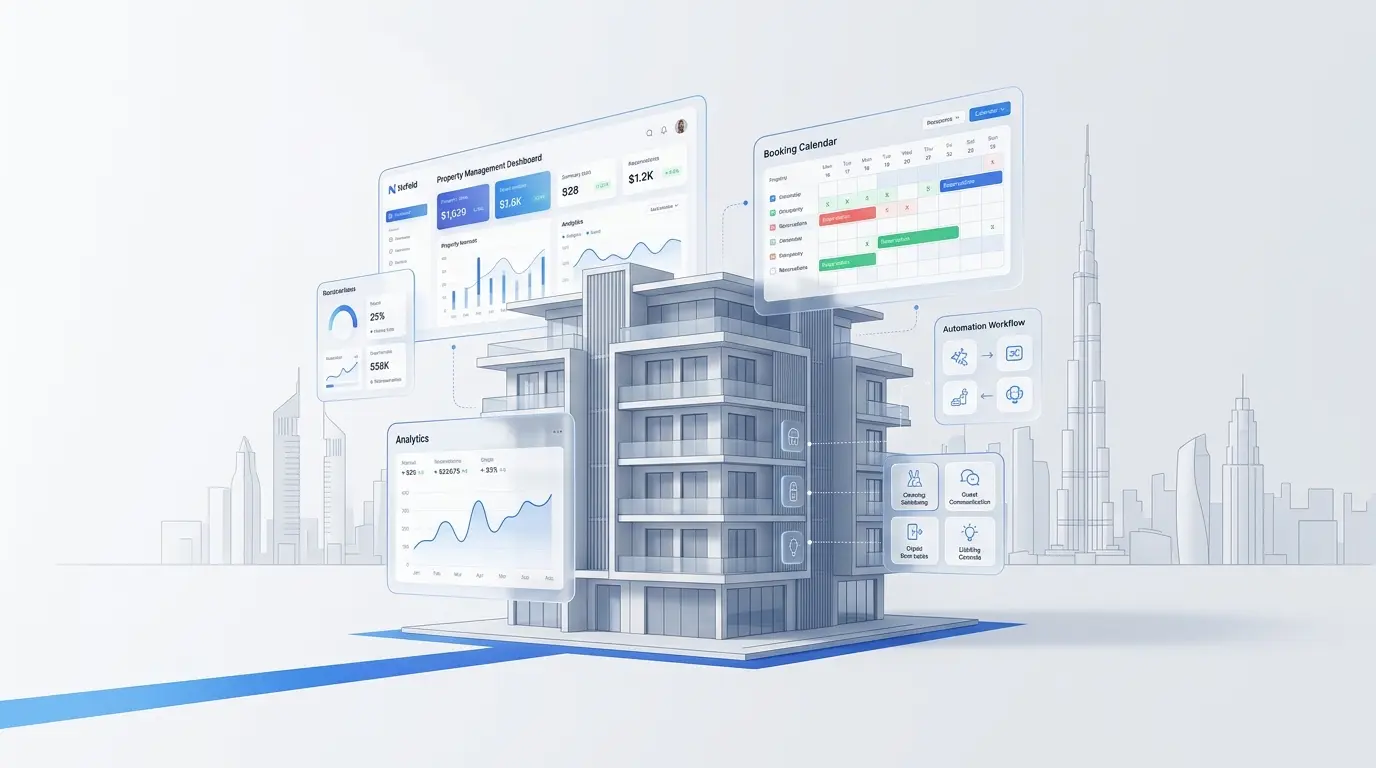
Running one holiday home in Dubai is a spreadsheet problem. Running ten is a software problem — and running fifty across Airbnb, Booking.com, and your own website, while staying compliant with the Department of Economy and Tourism, is a problem that quietly breaks most operators before they realize software was the fix.
The short-term rental market here is unusual: heavily regulated, highly seasonal, and split across booking channels that don't talk to each other by default. This guide is written from the build side — for operators and founders deciding whether to buy an off-the-shelf property management system (PMS) or build a custom holiday-homes platform, and for the developers who'll own it. It covers what such a platform actually needs, how Dubai's DET rules shape the data model, the channel-sync problems that cause double-bookings, and where custom software earns its keep versus a subscription tool.
The Short Answer
A holiday-homes management platform is, at its core, four systems working as one: a channel manager that keeps availability and rates in sync across every booking channel, a unit and permit registry that ties each property to its DET permit, a guest and operations layer (check-in data, housekeeping, messaging), and a financial layer (Tourism Dirham, owner payouts, statements). Off-the-shelf tools like Guesty, Hostaway, and Lodgify cover the generic version of this well; custom software becomes worth it when your model has something they don't handle cleanly — multi-owner payout splits, a specific DET-compliance workflow, a branded direct-booking experience that cuts OTA commissions, or deep integration with the rest of your business.
The single most important thing to get right is channel synchronization. Every serious problem in this business — double-bookings, angry guests, lost revenue, bad reviews — traces back to availability being wrong on one channel because it updated late on another. Whatever you build or buy, that sync has to be near-real-time and reliable, or nothing else matters.
How Dubai Regulates Holiday Homes (and Why It Shapes the Software)
Short-term rentals in Dubai are regulated by the Department of Economy and Tourism (DET) — the authority formerly known as DTCM — under Decree No. 41 of 2013. Understanding the structure matters because it directly determines what your system has to store and track.
There are two distinct authorizations. A licence permits you to conduct holiday-home activity at all, and a permit is required for each individual unit you operate. This one-permit-per-unit structure is the backbone of the data model: every property in your system needs to carry its own DET permit number, classification, and renewal date — not as a note in a spreadsheet, but as a first-class field the platform enforces.
Two classifications exist for holiday homes: Standard and Luxury (note that "Deluxe" is a hotel-apartment term, not a holiday-home one). The classification matters financially because of the Tourism Dirham — a per-night fee the operator collects and remits to DET. As currently published, it runs at AED 10 per occupied room per night for standard units and AED 15 for luxury, with remittance due by the 16th of the following month. That is not a detail to handle manually across fifty units; it's a calculation your software should perform automatically on every booking and roll up into a monthly remittance report.
A few compliance realities worth designing around from day one: operating a unit generally requires a No Objection Certificate from the developer or owners' association (many Dubai buildings prohibit short-term leasing outright), the title deed and proof of the right to let, and adherence to DET's technical specifications. Booking platforms such as Airbnb also expect the DET permit number to be displayed on each listing. And one honest caveat: Dubai periodically adjusts this regime — a 2026 relief package, for example, temporarily waived certain permit fees, and specific rules evolve — so treat the figures above as the current published baseline and build the system so permit numbers, fees, and classifications are configurable data, not hard-coded constants. The compliance layer is exactly the kind of jurisdiction-specific detail worth confirming with a specialist, much like the regulatory nuance in our UAE e-invoicing integration guide.
What a Holiday-Homes Platform Actually Needs
Strip away the marketing and a holiday-homes system is a handful of tightly coupled modules. Here's what each one is really for.
The channel manager. This is the heart. It connects to Airbnb, Booking.com, Expedia, and others, and keeps a single source of truth for availability, rates, and restrictions — pushing updates out and pulling bookings in. The hard part isn't the initial connection; it's staying consistent when three channels try to book the same night within seconds of each other. A booking on Airbnb must block that date everywhere else immediately, or you've oversold a villa and you're refunding a guest at 11pm.
The unit & permit registry. Every property, its DET permit number and classification, its NOC and document expiry dates, its owner, and its channel listings — all linked. A good registry surfaces expiring permits before they lapse and refuses to publish a listing that's missing a permit number, turning compliance into a guardrail rather than a fire drill.
Tourism Dirham & financial automation. Per-booking fee calculation by classification, a monthly remittance roll-up aligned to the 16th deadline, and — critically for management companies — per-owner payout statements. If you manage properties for multiple owners, you need to split each booking's revenue (minus your commission, cleaning, and fees) to the right owner and produce a clean statement. That split-payout requirement is the same money-movement design discussed in our payment gateway integration guide — and it carries the same caution: once you're routing funds to third parties, the compliance picture changes, so use a licensed processor's connected-accounts tooling rather than moving money yourself.
Guest & operations. Guest data capture at booking and check-in, automated messaging (confirmation, check-in instructions, upsells, review requests), and a housekeeping and maintenance scheduler that turns every checkout into a cleaning task assigned to the right team. Operations is where owner satisfaction is actually won or lost.
The direct-booking website. OTAs take 15–20% in commission. A branded direct-booking site — with the same real-time availability the channel manager maintains — lets an operator win repeat guests at zero commission. For established operators this single feature often pays for a custom build. This is the same booking-engine discipline covered in our car rental website development guide: live availability, a clean checkout, and no double-bookings.
Dynamic pricing. Rates that move with demand, season, events (a single Dubai expo or concert can triple a nightly rate), and occupancy — either rule-based or fed by a pricing service. Static pricing leaves real money on the table in a market this seasonal.
Build vs. Buy: An Honest Framework
Most operators should start with an off-the-shelf PMS, and many should stay there. Guesty, Hostaway, and Lodgify are mature, handle channel management competently, and are far cheaper than a custom build for a standard operation. If your business is "list units, sync channels, message guests, get paid," buying is usually the right call.
Custom software earns its place when you hit something the subscription tools handle badly or not at all. The common triggers: multi-owner payout logic more complex than the tools support; a DET-compliance workflow you want enforced in-product rather than tracked on the side; a direct-booking brand experience that off-the-shelf sites can't match; integration with other systems you run (a real-estate arm, accounting, a CRM); or simply scale where per-unit subscription fees across hundreds of units exceed what owning the software would cost. This is the same build-vs-buy calculus laid out in our custom software development guide — the honest answer is usually "buy until a specific, expensive gap justifies building."
We've built on the custom side of that line for UAE holiday-home operators — including Ayla in Abu Dhabi and Superhomes — where a branded direct-booking experience and operations tailored to how the business actually runs mattered more than a generic dashboard. The deciding factor in both cases wasn't features on a comparison chart; it was owning the guest relationship and the data end to end.
The Architecture That Keeps It From Breaking
The failure modes in this business are specific, and the engineering that prevents them is well understood:
Webhooks and idempotency on every channel event. Channels notify you of bookings, cancellations, and modifications via webhooks. Those can arrive late, out of order, or twice — so each must be processed idempotently (a retried "new booking" event must never create a second reservation) and the webhook, not a periodic poll, should drive availability updates so blocks propagate in seconds.
A single availability source of truth. Never let two channels each believe they own a calendar. One internal calendar holds truth; every channel is a projection of it. This is the architectural decision that prevents double-bookings.
Graceful degradation. When a channel's API is down (and they go down), the system should queue updates and reconcile on recovery rather than silently drifting out of sync. A reconciliation job that detects and flags divergence is not optional at scale.
Clean per-owner and per-unit data boundaries. If you manage for multiple owners, each owner should only ever see their own units and statements — the same tenant-isolation thinking from our multi-tenant SaaS architecture guide applies directly.
Reviews, Ranking, and the Guest Journey
On the OTAs, your listing's visibility is a function of its performance — response time, review scores, cancellation rate, and how completely you fill your calendar. That turns "operations" into a growth lever, not just a cost centre, and it's where software quietly compounds. Automated, well-timed guest messaging (a prompt reply, clear check-in instructions the morning of arrival, a review request at the right moment after checkout) measurably lifts scores, and higher scores lift ranking, which lifts bookings. A platform that centralizes messaging across every channel into one inbox — so a guest question from Booking.com and one from Airbnb land in the same place with the same response-time clock — is doing revenue work, not just support work.
The same logic runs through housekeeping. A missed or late clean is the fastest route to a one-star review, so a scheduler that turns every checkout into an assigned, tracked cleaning task with a completion check protects the exact metric the OTAs rank you on. In a market where a listing's position determines its occupancy, the operational modules are not back-office plumbing — they are the marketing.
Common Mistakes We See
Treating channel sync as a nice-to-have. It's the product. Under-investing here guarantees double-bookings, which guarantee bad reviews, which sink a listing's ranking.
Hard-coding compliance values. DET fees, Tourism Dirham rates, and classifications change. Store them as configuration; a regulatory update should be a settings change, not a code deploy.
Ignoring the direct-booking channel. Operators who rely 100% on OTAs hand over 15–20% of every booking forever and never own their guest list. A direct channel is the highest-ROI feature for an established operator.
Manual Tourism Dirham and owner payouts. These are error-prone, monthly, and auditable. Automating them removes a recurring failure point and makes owner relationships transparent.
Building before validating with a PMS. Unless you already know exactly why off-the-shelf fails you, run on one first. Let the specific, costly gap reveal itself — then build against it.
What It Costs and Takes to Build
A custom holiday-homes platform is a real software project, not a template install, so the honest range depends heavily on scope. A branded direct-booking website with real-time availability on top of an existing PMS is a contained project; a full custom platform — channel manager, permit registry, Tourism Dirham automation, owner statements, operations, and dynamic pricing — is a substantial multi-module build, closer in scope to the custom software work described in our custom software development guide. The cost that surprises operators is rarely the initial build; it's the ongoing channel-integration maintenance, because OTA APIs change and each channel is its own moving target. Scope that maintenance in from the start rather than treating the launch as the finish line.
Frequently Asked Questions
Do I need a licence to run a holiday home in Dubai? Yes. Dubai's Department of Economy and Tourism (DET) requires a licence to conduct holiday-home activity and a separate permit for each unit you operate. Your software should track a DET permit number and renewal date for every property.
Should I build custom software or use Guesty/Hostaway/Lodgify? For a standard operation, start with an off-the-shelf PMS — they're mature and cost-effective. Build custom when you hit a specific expensive gap: complex multi-owner payouts, an enforced DET-compliance workflow, a branded direct-booking experience, or integration with your other systems.
What is the Tourism Dirham and does the software handle it? It's a per-night fee the operator collects and remits to DET — as currently published, around AED 10 per occupied room per night for standard homes and AED 15 for luxury, due by the 16th of the following month. A good platform calculates it per booking and produces the monthly remittance report automatically. Confirm current rates with DET, as the regime is periodically adjusted.
What causes double-bookings and how are they prevented? They happen when availability updates late on one channel after a booking elsewhere. Prevention is architectural: one internal calendar as the single source of truth, webhook-driven near-real-time updates, and idempotent event processing so retries never create duplicate reservations.
Can I take direct bookings to avoid OTA commissions? Yes — a branded direct-booking website sharing the same real-time availability as your channel manager lets you win repeat guests at zero commission. For established operators this is often the single feature that justifies a custom build.
How does the software handle multiple property owners? Through per-owner data isolation and automated payout statements: each booking's revenue is split (minus commission, cleaning, and fees) to the correct owner, with a clean monthly statement. Fund routing to owners should go through a licensed processor's connected-accounts tooling.
Does it integrate with Airbnb and Booking.com? Yes — that's the channel manager's core job. The connections themselves are standard; the engineering that matters is keeping them consistent and recovering gracefully when a channel's API has an outage.
How long does a custom build take? A direct-booking site over an existing PMS is a contained project; a full multi-module platform is a substantial build. The longer commitment is ongoing channel-integration maintenance, since OTA APIs change over time — scope that in from the start.
The Bottom Line
Holiday-homes software in Dubai lives or dies on two things: rock-solid channel synchronization and a compliance-aware data model that treats DET permits and the Tourism Dirham as first-class, configurable parts of the system rather than afterthoughts. Most operators are right to start on an off-the-shelf PMS; custom software earns its place when a specific, costly gap — multi-owner payouts, a branded direct channel, enforced compliance, or scale — makes owning the platform cheaper and better than renting it.
If you're an operator weighing that decision, or you've outgrown your PMS and want a branded platform built around how your business actually runs, get in touch — we've built holiday-homes platforms for Dubai operators and can help you scope the right channel manager, compliance model, and direct-booking experience before committing to a build.
Have a project in mind?
Ideas to put into practice.
Turn what you have learned into a clearer plan for your website or product. Tell us what you want to build.
Start your project